הרב יהושע העשיל ב״ר חנוך זונדל סינגער ז״ל
Chazzan and Maggid in Buffalo for Nearly Thirty Years
Yahrzeit: 8 Teves | יארצייט: ח׳ טבת
Kever Location: Ahavas Sholom (Jefferson Shul) Cemetery, 645 Pine Ridge Heritage Blvd, Cheektowaga, NY 14225.
Service in Buffalo: 1892 – about 1920 (Beth Jacob, then Bris Shalom)
Table of Contents
Overview
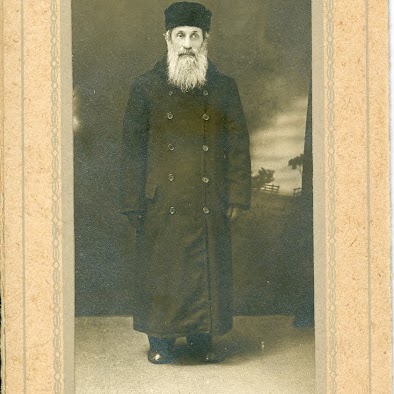
Rabbi Yehoshua Heschel Singer (1848–1925), known in English as Rev. Harry Singer or “Hazzan Singer,” was the chazzan and maggid of two of Buffalo’s leading Orthodox shuls: first Congregation Beth Jacob, the Clinton Street Shul, and then Congregation Bris Shalom, the Pine Street Shul. Born in Ponevezh, Lithuania, he served for some twenty years as chazzan in Kreutzburg before coming to Buffalo in 1892.
He was also a Torah scholar and the author of two Hebrew seforim: Zikaron BaSefer (Vilna, 1900) and Mishneh Zikaron, which began printing in Jerusalem in 1913 and, after the First World War halted the work, was completed in St. Louis. The Aderes, Rabbi Eliyahu Dovid Rabinowitz-Teomim, wrote a warm haskamah for his work. He passed away on 8 Teves 5685 (January 4, 1925) and is buried in Cheektowaga.1
Birth in Ponevezh and a Family of Chazzanim
Rabbi Yehoshua Heschel Singer was born in Ponevezh, in the Kovno province of Lithuania. His matzeivah gives his birth date as 24 Adar 5608 (1848). His father was Reb Chanoch Zundel, whose name appears on the title pages of both his seforim: “יהושע העשיל בלא״א מו״ר חנוך זונדיל זללה״ה.”2
Ponevezh would remain part of his story. Decades later, when he was already in Buffalo, the Aderes, who had been rav of Ponevezh, wrote that he knew Rabbi Singer and the members of his family from that city as “יר״א ישרים ותמימים,” upright, wholesome and G-d-fearing people. (See below.)
According to family tradition, Rabbi Singer was the seventh or eighth generation of chazzanim in his family, and the family’s original surname was Chazan. A brother, Berel, lived with him in Buffalo for a short time before returning to Riga.3
Twenty Years as Chazzan in Kreutzburg
Before coming to America, Rabbi Singer served as chazzan in Kreutzburg (today Krustpils, Latvia), then in the Vitebsk province of the Russian Empire, for about twenty years. He recorded this in his own words at the end of the introduction to Zikaron BaSefer, where he signed himself:
“יהושע העשיל ש״ץ מחברת ברית שלום בעיר באפאלא באמעריקא, ומלפנים בעיר קריסבארג פלך וויטעבסק בארץ רוסיא.”
“Yehoshua Heschel, chazzan of the Bris Shalom congregation in the city of Buffalo in America, and formerly in the city of Kreutzburg, in the province of Vitebsk, in the land of Russia.”
His son Jacob was born in Kreutzburg on May 5, 1883.4
1892: First Chazzan of Beth Jacob
Rabbi Singer emigrated with his family in 1892, already in his mid-forties. That year’s Buffalo city directory lists “Rev. Harry Singer” at Congregation Beth Jacob, at the corner of Clinton and Walnut Streets. The Jewish Buffalo History Center remembers him as the congregation’s first chazzan: “Harry Singer, known as ‘Hazzan Singer’ was the first Hazzan … at Beth Jacob.”
Through the 1890s the directories list him as Beth Jacob’s “Rev.” and later “Pastor,” living at 35 Randall Street. From about 1894, the shul’s rav was Rabbi Yisroel Feinberg, a Volozhin-trained talmid chacham, so for several years the two served Beth Jacob together.5
Chazzan and Maggid of Bris Shalom, the Pine Street Shul
In 1899, the directory lists Rabbi Singer under both Beth Jacob and Congregation Bris Shalom (Brith Sholem), and from then on he served Bris Shalom, whose shul at 171 Pine Street gave it the name “Pine Street Shul.” There he served under Rabbi Simcha Paltrovich, the congregation’s longtime rav, and he remained at Bris Shalom “for the balance of his active career.”
His position combined two roles. In the 1903 American Jewish Year Book he described himself as “Cantor and Preacher in Congregation Brith Sholem,” and on the title page of Mishneh Zikaron he signed himself “ש״ץ ומ״מ”: shliach tzibbur and maggid meisharim, the preacher who gave the congregation its derashos.6
His Chazzanus and Choir
Hazzan Singer was remembered as a gifted musician. According to Buffalo’s Jewish historians, he “knew not only the classical East-European chants, but had studied the western cantors, Sulzer, Lewandowski and others, and he thus was able to combine the old with the new.” He was also “an excellent choirmaster, and his choir contained many East Side boys later destined to make their mark in the Jewish community.”
His matzeivah sums up his life’s work in the same words: “שליח צבור בעדה, ככהן גדול בעבודה”: a shliach tzibbur in the congregation, like a Kohen Gadol in the avodah.7
Zikaron BaSefer (Vilna, 1900)
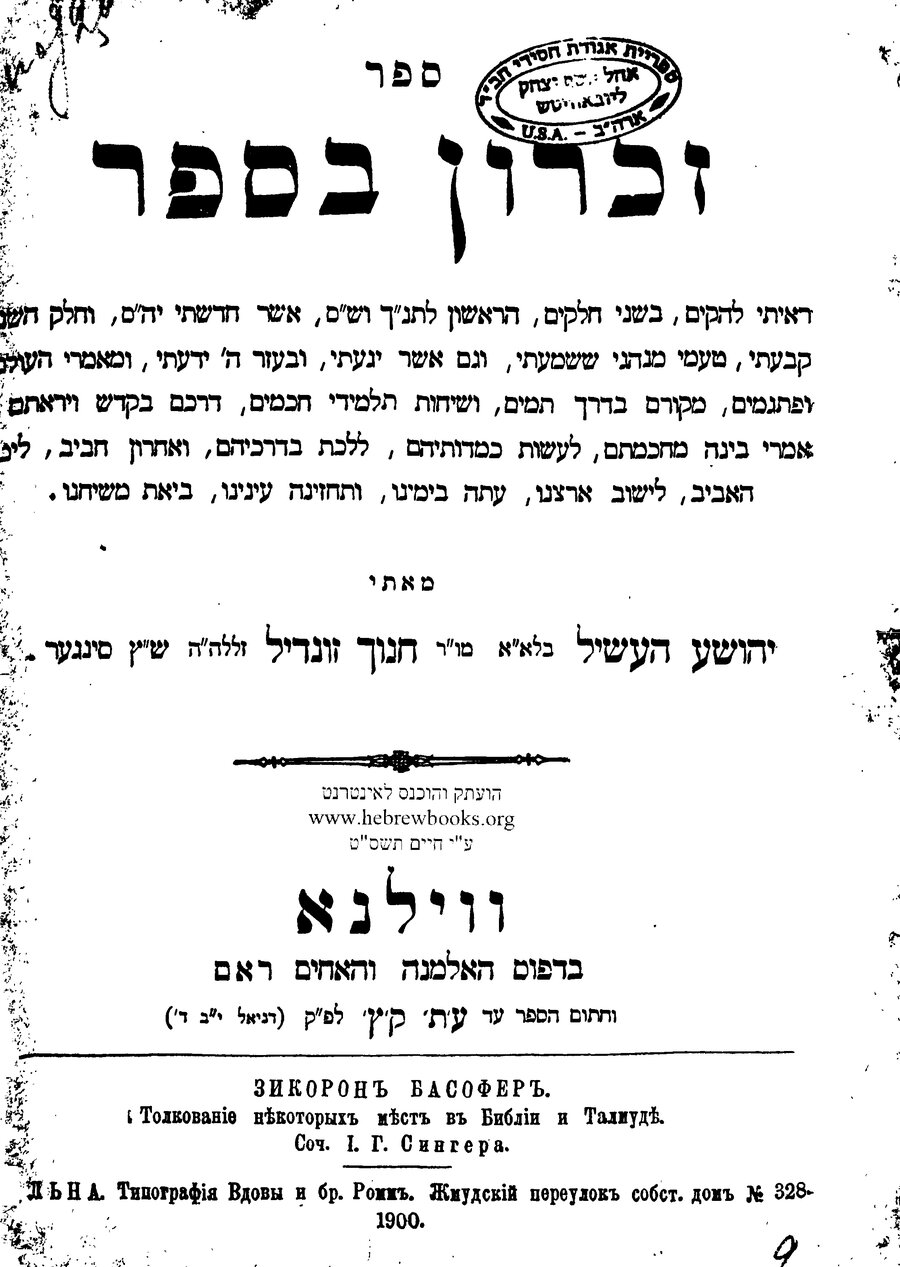
Rabbi Singer’s first sefer, Sefer Zikaron BaSefer, was printed in Vilna by the famous Romm press (“the widow and brothers Romm”) in 5660 (1900); the Russian censor approved it on December 15, 1899. The title page describes a work in two parts: the first on Tanach and Shas, and the second explaining the reasons for minhagim, sayings and stories of tzaddikim and talmidei chachamim, and, “ואחרון חביב,” last but most beloved, “לישוב ארצנו”: the settlement of Eretz Yisroel, ending with a prayer that “our eyes may behold the coming of our Moshiach.”8
A Haskamah That Became a Torah Exchange
The haskamos printed at the front of Zikaron BaSefer are not ordinary approbations. They record a correspondence in learning between Rabbi Singer and Rabbi Shlomo Nosson Kotler, who signed himself as formerly a rav in the Kovno province and “now a rav in New York, in the house of the Gaon Rabbi Yaakov Yosef, the Chief Rabbi.”
Rabbi Singer had offered a new explanation for the minhag of eating dairy foods on Shavuos, one that turned on the status of milk before Matan Torah: whether milk, as a product of a living animal, would have been forbidden to a ben Noach under eiver min hachai. Rabbi Kotler responded with a detailed critique, drawing on the Noda BiYehudah, the Pri Yitzchak, Tosafos in Chullin and others. He nonetheless concluded that “it is a book worthy of being published,” and blessed the author with every good. Rabbi Singer, signing himself “זעירא דמן חבריא,” the least of the group, wrote back defending his view from the Shitah Mekubetzes and the commentary of Rabbi Yom Tov Algazi on the Ramban’s Hilchos Bechoros.
Rabbi Kotler replied once more, on Wednesday of Parshas Chayei Sarah 5660 (November 1899), from New York. He was leaving that day for Chicago and had no time to answer at length. Still, he asked that the entire exchange be printed in full, “כי דברי במקומם עומדים,” for his words stood in their place, and he blessed Rabbi Singer that his book would soon see the light of day.9
Mishneh Zikaron and the Haskamah of the Aderes
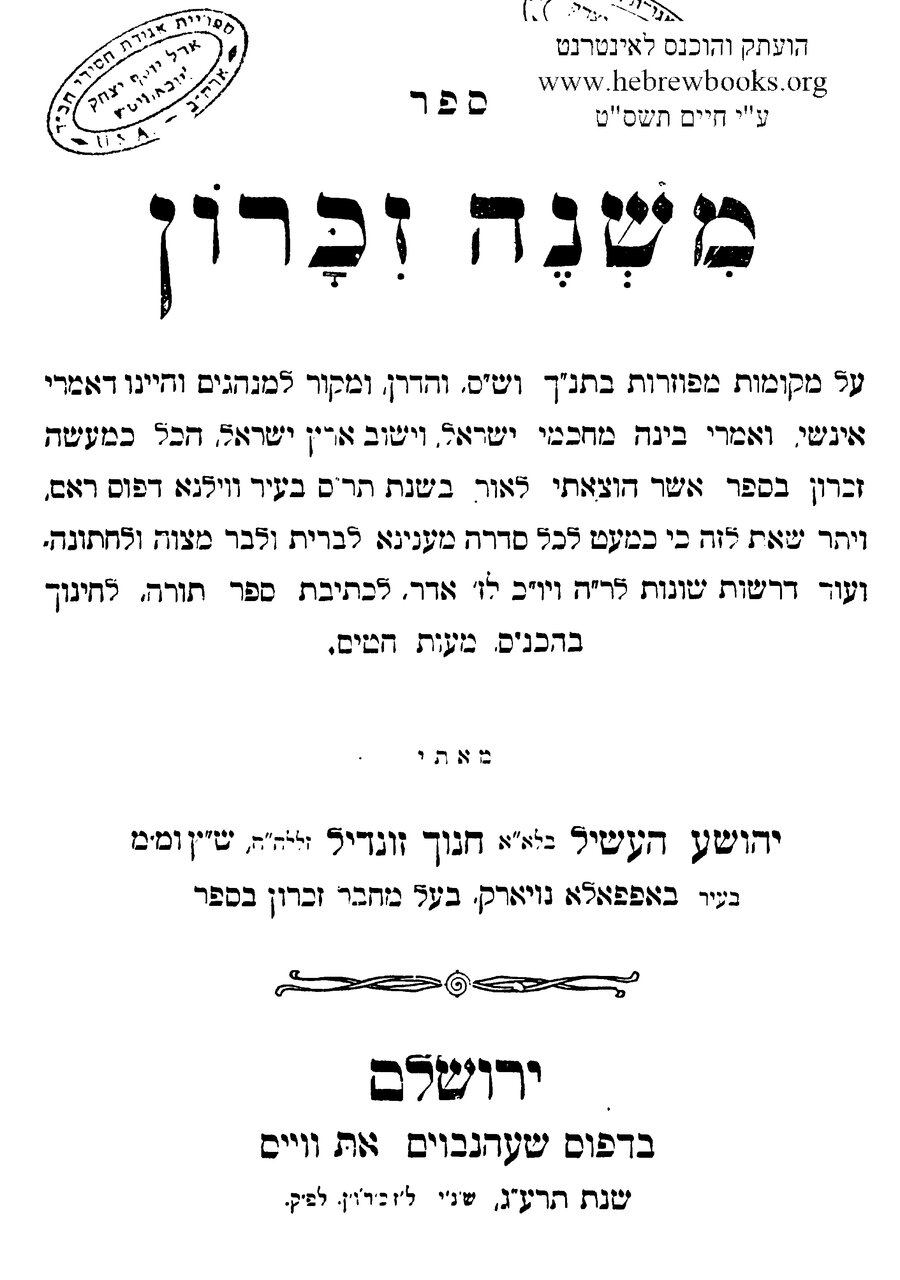
His second work, Sefer Mishneh Zikaron, was, as its name suggests, a “second” Zikaron, following the pattern of Zikaron BaSefer. According to its title page, it contains insights on scattered passages of Tanach and Shas, hadranim, sources for minhagim and popular sayings, and Yishuv Eretz Yisroel. It adds material for almost every parshah suited to a bris, bar mitzvah or wedding, along with derashos for Rosh Hashanah and Yom Kippur, for 7 Adar, for the writing of a Sefer Torah, for the chinuch of children, and for maos chittim. On the title page the author signed himself “ש״ץ ומ״מ בעיר באפפאלא נויארק, בעל מחבר זכרון בספר,” and the next page gives his address: “Rev. H. Singer, 169 William str., Buffalo, New York, America.”
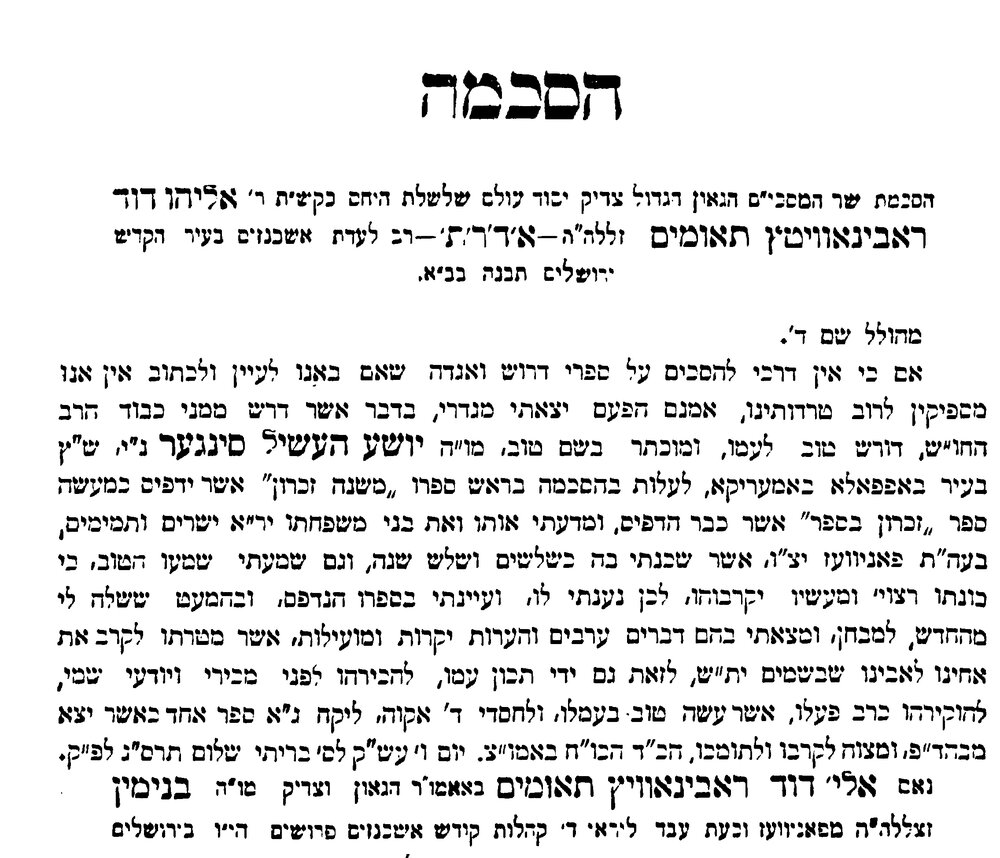
The sefer opens with a haskamah from Rabbi Eliyahu Dovid Rabinowitz-Teomim, the Aderes, former rav of Ponevezh and then rav of the Ashkenazi community in Yerushalayim. He began by explaining that he did not normally give haskamos to works of derush and aggadah: “אם כי אין דרכי להסכים על ספרי דרוש ואגדה… אמנם הפעם יצאתי מגדרי,” “although it is not my way to give approbations to works of derush and aggadah… this time I have gone beyond my usual practice.”
The reason was personal. The Aderes wrote that he knew “him and the members of his family” from Ponevezh as upright, wholesome and G-d-fearing, and had heard good reports of him. Having read the printed Zikaron BaSefer and the new material sent to him, he found in it “pleasant words and precious, useful comments, whose aim is to bring our brethren closer to our Father in Heaven.” He urged “those who know and recognize my name” to support the author by buying a copy. The haskamah is dated Friday, Erev Shabbos Parshas Pinchas, 5663 (July 1903), ten years before the book went to press.10
Printed in Jerusalem, Finished in St. Louis
Mishneh Zikaron has an unusual printing history. Printing began in Jerusalem in 5673 (1913) at the press of Schoenbaum and Weiss, but the outbreak of the First World War cut off the work partway through. The book was finished across the ocean, at the Moinester Printing Company, 1318 Carr Street, St. Louis, Missouri. The final page explains:
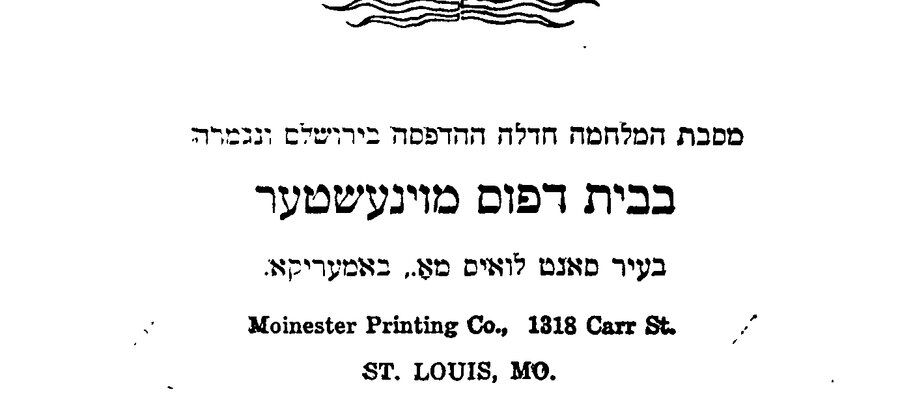
“מסבת המלחמה חדלה ההדפסה בירושלים ונגמרה בבית דפוס מוינעשטער בעיר סאנט לואיס מא., באמעריקא.”
The St. Louis section begins on page 137, and the complete book has 214 numbered pages. Bibliographers have noted that the two copies at the National Library of Israel end at page 136; they were apparently distributed before the American portion was printed. Most surviving copies are likewise missing the St. Louis section.11
Rabbi Singer was not the only Buffalo talmid chacham to print a sefer in Jerusalem that year. In the same year, 5673 (1913), Rabbi Simcha Paltrovich, the former rav of Bris Shalom, published Kol Simcha there. Historian Nathan Kaganoff listed both men among the American rabbis whose works were printed in Eretz Yisroel before 1926.12
His Torah Still Studied Today
A century after his passing, Rabbi Singer’s Torah is still being quoted. In February 2025, the weekly Hamaayan on Torah.org cited Mishneh Zikaron on Parshas Yisro. Rabbi Singer asked why the Torah says that Yisro “took” an olah-offering (Shemos 18:12), rather than “gave.” He answered from the Gemara in Kiddushin (7b): when an important person accepts a gift, it is considered as though the giver has received something of value. So when Aharon and the elders accepted Yisro’s offerings, Yisro in fact “took.”13
The bibliographer Tovia Preschel included Mishneh Zikaron in his bibliography of hadranim and siyumim, noting the siyum discourses on pages 109–110, 129–130 and 171–172.14
The Bookstore on William Street
Alongside his work in the shul, Hazzan Singer kept a store selling seforim and religious articles in the heart of the William Street Jewish neighborhood. About 1920 he retired from the chazzanus and devoted himself to the store at 169 William Street, which, in the words of Buffalo’s Jewish historians, “soon became a Mecca for local scholars and Jewish savants who passed through the city.” The Hebrew-reading circles of the East Side gathered there. The store was later bought by Rev. Isaac Manch, who expanded it into a Judaica shop.15
His Family
Rabbi Singer’s wife was Chaya Pesha, daughter of Reb Yaakov, born in Iyar 5612 (1852). Her matzeivah opens with the verse from Eishes Chayil, “רבות בנות עשו חיל ואת עלית על כלנה,” “many women have done worthily, but you surpass them all,” and calls her “האשה החשובה,” the distinguished woman. She survived her husband by six years and passed away on Isru Chag Shavuos 5691 (1931).16
Their sons included Julius Singer, a violin and music teacher in Buffalo in whose studio the city’s Jewish Choral Society first met, and Jacob Singer (1883–1964), who was born in Kreutzburg, grew up in Buffalo, and later became a rabbi, an army chaplain in the First World War, and a sociologist. A great-granddaughter recalled in 2012 that the family preserved photographs and further details of his life.17
Passing and Burial
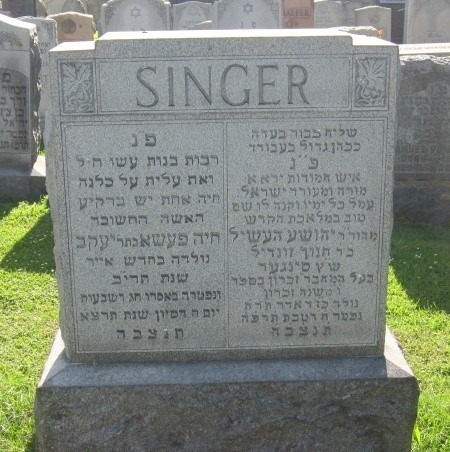
Rabbi Yehoshua Heschel Singer passed away on Sunday, 8 Teves 5685 (January 4, 1925), at the age of 76. He is buried in the Ahavas Sholom (Jefferson Shul) Cemetery on Pine Ridge Heritage Boulevard in Cheektowaga, beside his wife.
His matzeivah reads:
“שליח צבור בעדה / ככהן גדול בעבודה / פ״נ / איש אמונות ירא א[להים] / מורה ומעורר ישראל / עמל כל ימיו וקנה לו שם / טוב במלאכת הדרש / מוהר״ר יהושע העשיל / בר חנוך זונדיל / ש״ץ סינגער / בעל המחבר זכרון בספר / ומשנה זכרון / נולד כ״ד אדר תר״ח / נפטר ח׳ טבת תרפ״ה / תנצב״ה”
“A shliach tzibbur in the congregation, like a Kohen Gadol in the avodah. Here lies a man of faith, G-d-fearing, a teacher who awakened Israel, who toiled all his days and acquired a good name in the work of derush: our teacher Rabbi Yehoshua Heschel, son of Chanoch Zundel, the chazzan Singer, author of Zikaron BaSefer and Mishneh Zikaron. Born 24 Adar 5608, passed away 8 Teves 5685. May his soul be bound in the bond of eternal life.”
His two seforim, which are freely available on HebrewBooks.org, together with the haskamah of the Aderes and the memories of Buffalo’s old William Street, preserve the memory of a chazzan who was also a talmid chacham, devoted to Torah, to Eretz Yisroel, and to bringing his fellow Jews closer to their Father in Heaven.18
Sources, Footnotes & Links
- Adler and Connolly, From Ararat to Suburbia; American Jewish Year Book, 1903–1904; Rabbi Singer’s matzeivah.
Adler and Connolly: “‘Hazzan Singer’ was another famous functionary of the Pine Street Shul. Joshua H. Singer (1848-1925) was born in Ponivez, province of Kovno. Harry Singer, as he was often called, began as a cantor in Kreutzberg, Russia, where he served for twenty years before coming to the United States.” The book is a lending item on archive.org, and the quotations here are taken from its full-text search.
Selig Adler and Thomas E. Connolly, From Ararat to Suburbia: The History of the Jewish Community of Buffalo (Philadelphia: Jewish Publication Society, 1960), pp. 190–191
American Jewish Year Book, vol. 5 (5664/1903–1904), “Biographical Sketches of Rabbis and Cantors Officiating in the United States” (PDF)
Kevarim.com — “Rabbi Yehoshua Herschel Singer” (matzeivah photograph and burial details) ↩︎ - Rabbi Singer’s matzeivah; title pages of Zikaron BaSefer and Mishneh Zikaron; American Jewish Year Book, 1903–1904; Kaganoff.
The matzeivah reads “נולד כ״ד אדר תר״ח.” Because 5608 was a leap year, this was either February 28 or March 29, 1848, depending on whether Adar I or Adar II is meant. His own entry in the 1903–1904 American Jewish Year Book, whose sketches were supplied by the rabbis and cantors themselves, reads: “Born April, 1847, at Poneviezh, Russia. Son of Julius Singer.” Kaganoff also gives 1847. The father’s name “Julius” conflicts with the matzeivah and both title pages, which name him Chanoch Zundel; Julius was in fact the name of one of Rabbi Singer’s sons.
Kevarim.com — “Rabbi Yehoshua Herschel Singer” (matzeivah photograph and burial details)
HebrewBooks — Zikaron BaSefer (Vilna, 5660/1900), full scan
HebrewBooks — Mishneh Zikaron (Jerusalem, 5673/1913; completed in St. Louis), full scan
American Jewish Year Book, vol. 5 (5664/1903–1904), “Biographical Sketches of Rabbis and Cantors Officiating in the United States” (PDF)
Nathan M. Kaganoff, “Rabbinic Books Published in Palestine,” in A Bicentennial Festschrift for Jacob Rader Marcus (1976), p. 239 and note 29 ↩︎ - Kevarim.com, comments by family members.
A great-granddaughter wrote in 2012: “He was the 7th or 8th generation hazzan in the family. He came to the USA from Riga,” and gave his name as “Yehoshua Heschel Singer (ne Chazan).” A descendant of his brother wrote in 2019 that Berel “lived with him in Buffalo briefly before returning to Riga.” These are family recollections and have not been checked against documents.
Kevarim.com — “Rabbi Yehoshua Herschel Singer,” with comments by family members, 2010–2025 ↩︎ - Introduction to Zikaron BaSefer, p. [4]; American Jewish Year Book, 1903–1904; Adler and Connolly; Kaganoff; Hill and Callahan.
The Year Book: “Officiated as Cantor in Kreutzburg, Russia, and in Congregation Beth Jacob, Buffalo, N. Y.” Kaganoff: “Singer was a cantor in Kreutzberg, Russia, for almost twenty years.” A 2010 comment on Kevarim.com says that he was chazzan in Dvinsk, but a family researcher questioned this, and the documentary sources all name Kreutzburg, which lay in the same region of Vitebsk province as Dvinsk.
HebrewBooks — Zikaron BaSefer (Vilna, 5660/1900), full scan
American Jewish Year Book, vol. 5 (5664/1903–1904), “Biographical Sketches of Rabbis and Cantors Officiating in the United States” (PDF)
Selig Adler and Thomas E. Connolly, From Ararat to Suburbia: The History of the Jewish Community of Buffalo (Philadelphia: Jewish Publication Society, 1960), pp. 190–191
Nathan M. Kaganoff, “Rabbinic Books Published in Palestine,” in A Bicentennial Festschrift for Jacob Rader Marcus (1976), p. 239 and note 29
Michael R. Hill and Mary Ann Callahan, “Jacob Singer (1883–1964): Bio-Bibliography of a Jewish-Latvian-Nebraskan Sociologist,” Sociological Origins 6:1 (2010), pp. 17–25 (PDF)
Kevarim.com — “Rabbi Yehoshua Herschel Singer,” with comments by family members, 2010–2025 ↩︎ - Hill and Callahan; Buffalo City Directories, 1892–1899; Jewish Buffalo History Center, “Beth Jacob”; Rabbi Yisroel Feinberg.
Hill and Callahan, on his son Jacob: “Jacob emigrated with his parents to the United States in 1892.” The 1892 directory lists “Beth Jacob—Corner Clinton and Walnut … Rev. Harry Singer.” The 1891 directory lists a different minister at Beth Jacob. A 1981 music reference book gives 1888 as the start of his Buffalo career, but the directories and his son’s biography point to 1892.
Michael R. Hill and Mary Ann Callahan, “Jacob Singer (1883–1964): Bio-Bibliography of a Jewish-Latvian-Nebraskan Sociologist,” Sociological Origins 6:1 (2010), pp. 17–25 (PDF)
Buffalo City Directory, 1892 (archive.org text)
Buffalo City Directory, 1894
Buffalo City Directory, 1898
Jewish Buffalo History Center — “Beth Jacob”
Chabad Buffalo — Rabbi Yisroel Feinberg ↩︎ - Buffalo City Directory, 1899; American Jewish Year Book, 1903–1904; Adler and Connolly; Jewish Buffalo History Center, “Brith Sholem”; title page of Mishneh Zikaron; Rabbi Simcha Paltrovich.
The 1899 directory lists “Beth Jacob—Clinton cor. Walnut. Rev. Harry Singer, Pastor” and “Brith Sahlem—Pine near William. Rev. Harry Singer. Residence, 244 William.” The Jewish Encyclopedia (1902) also named “Rev. Harry Singer, author of ‘Sefer Zikkaron basefer,’ published in Wilna” among the Hebrew scholars of Buffalo’s Russian-Jewish community.
Buffalo City Directory, 1899
American Jewish Year Book, vol. 5 (5664/1903–1904), “Biographical Sketches of Rabbis and Cantors Officiating in the United States” (PDF)
Selig Adler and Thomas E. Connolly, From Ararat to Suburbia: The History of the Jewish Community of Buffalo (Philadelphia: Jewish Publication Society, 1960), pp. 190–191
Jewish Buffalo History Center — “Brith Sholem”
HebrewBooks — Mishneh Zikaron (Jerusalem, 5673/1913; completed in St. Louis), full scan
Jewish Encyclopedia (1902), “Buffalo”
Chabad Buffalo — Rabbi Simcha Paltrovich: Rav of Bris Shalom ↩︎ - Adler and Connolly; Marcus; Rabbi Singer’s matzeivah.
Marcus calls him “a beloved Buffalo cantor who had emigrated from Russia when he was no longer young,” and adds that he was “an excellent choirmaster and a scholar, too, who published two works in Hebrew.”
Selig Adler and Thomas E. Connolly, From Ararat to Suburbia: The History of the Jewish Community of Buffalo (Philadelphia: Jewish Publication Society, 1960), pp. 190–191
Jacob Rader Marcus, United States Jewry, 1776–1985, vol. IV (Detroit: Wayne State University Press, 1993), pp. 169–170
Kevarim.com — “Rabbi Yehoshua Herschel Singer” (matzeivah photograph and burial details) ↩︎ - Zikaron BaSefer, title page and censor’s approval; HebrewBooks catalogue.
The Russian censorship notice reads: “Дозволено цензурою. 15 Декабря 1899 г. Вильна.” A scholar of Jewish religious thought in America at Bar-Ilan University wrote in 2022 that he would teach “R Singer’s religious Zionism (at the end of Zikaron basefer)” in his course. Some auction listings misdate the book to 5620 (1860); the title page reads 5660 (1900).
HebrewBooks — Zikaron BaSefer (Vilna, 5660/1900), full scan
Kevarim.com — “Rabbi Yehoshua Herschel Singer,” with comments by family members, 2010–2025 ↩︎ - Zikaron BaSefer, haskamos, pp. [3]–[4].
Rabbi Kotler’s signature reads, in part, “…וכעת רב בנויארק בבית הגאון ר׳ יעקב יאסעף הרב הכולל.” His closing reply is headed “ע״ז השיב לי: יום ד׳ חיי שרה תר״ס פה נויארק.” The New York connection to Rabbi Yaakov Yosef recalls Rabbi Yisroel Feinberg, rav of Beth Jacob, who had also served in Rabbi Yaakov Yosef’s circle.
HebrewBooks — Zikaron BaSefer (Vilna, 5660/1900), full scan
Chabad Buffalo — Rabbi Yisroel Feinberg ↩︎ - Mishneh Zikaron, title page, p. [2] and haskamah, p. [3].
The haskamah addresses “מו״ה יהושע העשיל סינגער נ״י, ש״ץ בעיר באפפאלא באמעריקא,” and states: “ומדעתי אותו ואת בני משפחתו יר״א ישרים ותמימים, בעה״ת פאניוועז יצ״ו.” It is signed “אלי׳ דוד ראבינאוויץ תאומים… מפאניוועז וכעת עבד לי״אי ד׳ קהלות קודש אשכנזים פרושים הי״ו בירושלים,” and dated “יום ו׳ עש״ק לס׳ בריתי שלום תרס״ג.”
HebrewBooks — Mishneh Zikaron (Jerusalem, 5673/1913; completed in St. Louis), full scan ↩︎ - Mishneh Zikaron, colophon; HebrewBooks catalogue; Mizrahi, 2015; Winner’s Auctions; Kaganoff.
HebrewBooks: “מסבת המלחמה חדלה ההדפסה בירושלים ונגמרה בעיר סט. לואיס בבית דפוס מוינשטער (מדף סט׳ ואילך נדפס בסט. לואיס).” Winner’s Auctions: “Printing began in Jerusalem in 1913, but was halted because of the war. Page 137 onward was printed in St. Louis. However, most copies are missing the section printed in the USA.” Mizrahi: “JNUL has 2 copies of this book in their collection, both incomplete, containing only until page 136.” The year the St. Louis printing was completed is not stated in the book.
HebrewBooks — Mishneh Zikaron (Jerusalem, 5673/1913; completed in St. Louis), full scan
Israel Mizrahi, “Mishneh Zikaron published in Jerusalem and publishing completed in St Louis due to WWI,” Musings of a Jewish Bookseller, January 30, 2015
Winner’s Auctions — “Mishneh Zikaron – Sections Printed in Jerusalem and St. Louis,” Auction 92, Lot 511
Nathan M. Kaganoff, “Rabbinic Books Published in Palestine,” in A Bicentennial Festschrift for Jacob Rader Marcus (1976), p. 239 and note 29 ↩︎ - Kaganoff; Rabbi Simcha Paltrovich.
Kaganoff: “a commentary on the Bible and the Talmud by Joshua H. Singer, of Buffalo. The book bears a Jerusalem imprint, but the last page of the volume contains the following…”; and, in the same essay, “Simon Paltrovich, of Buffalo, published three works in Jerusalem.”
Nathan M. Kaganoff, “Rabbinic Books Published in Palestine,” in A Bicentennial Festschrift for Jacob Rader Marcus (1976), p. 239 and note 29
Chabad Buffalo — Rabbi Simcha Paltrovich: Rav of Bris Shalom ↩︎ - Torah.org, Hamaayan, Yisro 5785.
“R’ Yehoshua Heschel Singer z”l (1848-1925; rabbi in Buffalo, NY) asks: Should not the verse have said, ‘Yisro, the father-in-law of Moshe gave an Olah-offering . . .’? … (Mishneh Zikaron).”
Torah.org — Shlomo Katz, Hamaayan, Parashas Yisro 5785 (February 2025) ↩︎ - Preschel, “ספרות הדרנים,” no. 176.
“משנה זכרון: חידושים, ביאורים ודרשות מאת יהושע העשל סינגער ירושלים תרע״ג. סיומים והדרנים, עמ׳ 110-109, 130-129, 172-171.”
Tovia Preschel, “ספרות הדרנים” (bibliography of hadranim and siyumim), no. 176 ↩︎ - Adler and Connolly; Marcus; Kaganoff; Jewish Buffalo History Center, “Brith Sholem.”
Marcus: “The Hebrew-reading intelligentsia met in Harry Singer’s store where he sold religious articles.” Kaganoff: “Singer also operated a Jewish bookstore, which was a meeting place for Jewish intellectuals.” The 169 William Street address also appears in Mishneh Zikaron.
Selig Adler and Thomas E. Connolly, From Ararat to Suburbia: The History of the Jewish Community of Buffalo (Philadelphia: Jewish Publication Society, 1960), pp. 190–191
Jacob Rader Marcus, United States Jewry, 1776–1985, vol. IV (Detroit: Wayne State University Press, 1993), pp. 169–170
Nathan M. Kaganoff, “Rabbinic Books Published in Palestine,” in A Bicentennial Festschrift for Jacob Rader Marcus (1976), p. 239 and note 29
Jewish Buffalo History Center — “Brith Sholem” ↩︎ - The Singers’ matzeivah.
Kevarim.com — “Rabbi Yehoshua Herschel Singer” (matzeivah photograph and burial details) ↩︎ - Adler and Connolly; Buffalo City Directories; Hill and Callahan; Kevarim.com.
Adler and Connolly mention “the violin studio of Julius Singer, the son of the well-known Hazzan Singer.” City directories list Julius Singer at his father’s address, as a bookkeeper (1895), a teacher (1902) and a music teacher (1903).
Selig Adler and Thomas E. Connolly, From Ararat to Suburbia: The History of the Jewish Community of Buffalo (Philadelphia: Jewish Publication Society, 1960), pp. 190–191
Buffalo City Directory, 1902
Buffalo City Directory, 1903
Michael R. Hill and Mary Ann Callahan, “Jacob Singer (1883–1964): Bio-Bibliography of a Jewish-Latvian-Nebraskan Sociologist,” Sociological Origins 6:1 (2010), pp. 17–25 (PDF)
Kevarim.com — “Rabbi Yehoshua Herschel Singer,” with comments by family members, 2010–2025 ↩︎ - Kevarim.com; Rabbi Singer’s matzeivah; Jewish Buffalo History Center, “Ahavas Sholem”; HebrewBooks.
Kevarim.com gives his date of death as “Sun. January 4, 1925 – Teves 8 5685” and the cemetery as “Ahavas Shalom Jefferson Shul Cemetery,” 645 Pine Ridge Heritage Blvd, Cheektowaga. Ahavas Sholem, the Jefferson Street Shul, was founded on Buffalo’s East Side in 1890.
Kevarim.com — “Rabbi Yehoshua Herschel Singer,” with comments by family members, 2010–2025
Kevarim.com — “Rabbi Yehoshua Herschel Singer” (matzeivah photograph and burial details)
Jewish Buffalo History Center — “Ahavas Sholem”
HebrewBooks — Zikaron BaSefer (Vilna, 5660/1900), full scan
HebrewBooks — Mishneh Zikaron (Jerusalem, 5673/1913; completed in St. Louis), full scan ↩︎