Buffalo Jewish HistoryChabad Center for Jewish Life of Buffalo
Chabad History in Buffalo
Over 130 years of Chabad-Lubavitch, Jewish life and outreach in Buffalo, New York, from the Lubavitz Synagogue of the 1880s to today.
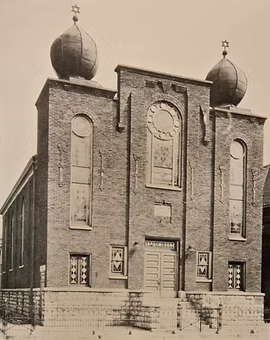
Chabad-Lubavitch history in Buffalo spans more than 130 years, beginning in the 1880s with Anshe Lubavitz, The Lubavitz Synagogue. From those early beginnings, Chabad-Lubavitch developed a lasting presence in Buffalo. Today, multiple Chabad institutions serve the Buffalo Jewish community, including the Chabad Center for Jewish Life of Buffalo, also known as Chabad Downtown Buffalo, co-directed by Rabbi Mendy and Chaya Mushka Labkowski. Across the generations, Chabad-Lubavitch has played an important role in Jewish education, youth programming, communal life and outreach, helping Jewish life in Buffalo continue to grow while remaining firmly rooted in Torah, tradition and halachah.
Help us preserve and expand the story of Chabad history in Buffalo. If you have additional information, historical documents, photographs, memories or corrections, please email history@chabadbuffalo.com, call, text or WhatsApp 716-545-6806, or message us on social media at @chabadbuffalo.
About this research This history was researched and written by Rabbi Mendy Labkowski. Most of it comes from original sources: incorporation papers, deeds and court records at the Erie County Clerk’s Office; the letters of the Previous Rebbe and the Rebbe; contemporary newspapers; gravestones; memoirs and interviews of the people involved; and family papers.
Part one
1880s–1951
The Lubavitz Synagogue
An East Side congregation of Lubavitcher Chassidim, its rabbis and leaders, and its first contacts with the Rebbeim.
The Founding of Anshe Lubavitz, The Lubavitz Synagogue
Founded 1880s · incorporated July 11, 1890
Founded in the 1880s and formally incorporated in 1890 as The Lubavitz Synagogue, it became the first organized Chabad-Lubavitch congregation in Buffalo, New York, and was among the earliest Nusach Ari synagogues established in the United States.1 Its founding placed Buffalo among the earliest centers of organized Chabad-Lubavitch life in America, reflecting the spread of Chabad-Lubavitch communities beyond Eastern Europe.
Its Certificate of Incorporation, recorded on July 11, 1890, named Laizer (Louis) Bernstein, Israel Slater, Pesach (Peter) Rakin, Zusin Dickman and Israel Barkan as its first five trustees. Its stated purposes were the furtherance of religious worship, charitable and benevolent work, and the maintenance of a Sabbath school.2
At this time, Buffalo already had several Orthodox synagogues. The creation of Anshe Lubavitz shows that there was already a meaningful Lubavitch presence in the City of Buffalo, large and committed enough to organize its own shul, daven according to the Chabad nusach, preserve Lubavitch Chassidic customs, and create a communal home centered on the traditions and identity of Chabad-Lubavitch.
The congregation initially met in private homes. As the community grew, Anshe Lubavitz erected a large permanent synagogue in 1911 at 115–117 Pratt Street on Buffalo’s East Side, near William Street.3 The building reportedly cost $30,000 and seated approximately 650 people. The congregation faced difficult financial years after its construction, operating on a budget of only $700 in 1917, but by 1923 it had grown to approximately 140 members and was spending about $5,000 annually.4
The synagogue became a landmark of Jewish life on the East Side, and Anshe Lubavitz became widely known as the “Pratt Street Shul” or simply the “Lubavitcher Shul.” It served as a permanent home for Lubavitch prayer, Chassidic traditions and community life for decades. The congregation’s own burial ground, the Lubavitz Congregation Cemetery on Pine Ridge Road in Cheektowaga, holds 792 recorded burials.5
Jacob Rosokoff: President for Twenty-Seven Years
1858–1940
One of the central figures in the early development of Anshe Lubavitz was Jacob Rosokoff (1858–1940). Rosokoff came to Buffalo in 1890 and served as president of Anshe Lubavitz for twenty-seven years. Remembered as a deeply religious man who attended services daily, his long presidency made him one of the defining lay leaders of the congregation during its formative decades.
Rosokoff was such a prominent figure within the congregation that, when an Anshe Lubavitz member named Jacob Schiller was asked during his citizenship examination, “Who is President?”, he replied, “Jacob Rosokoff!”
Rosokoff was also a jeweler and an early pioneer of Buffalo’s motion-picture business. In 1904 he and his sons opened a penny arcade at 1021 Broadway, which they later turned into a nickelodeon, and he went on to open one of the first movie houses in Lackawanna. During the Panic of 1907 he ran his own bread line in Lackawanna, handing out as many as 200 loaves of bread a day to unemployed laborers.
He and his wife, Devorah (Dora) Rosokoff, are buried together in the Lubavitz Congregation Cemetery. His gravestone describes him as an “עסקן בצרכי ציבור,” one who devoted himself to the needs and affairs of the community.6
1903: Reb Menachem Mendel Leib Gilden
Shochet, mohel and chazzan · 1869–1933
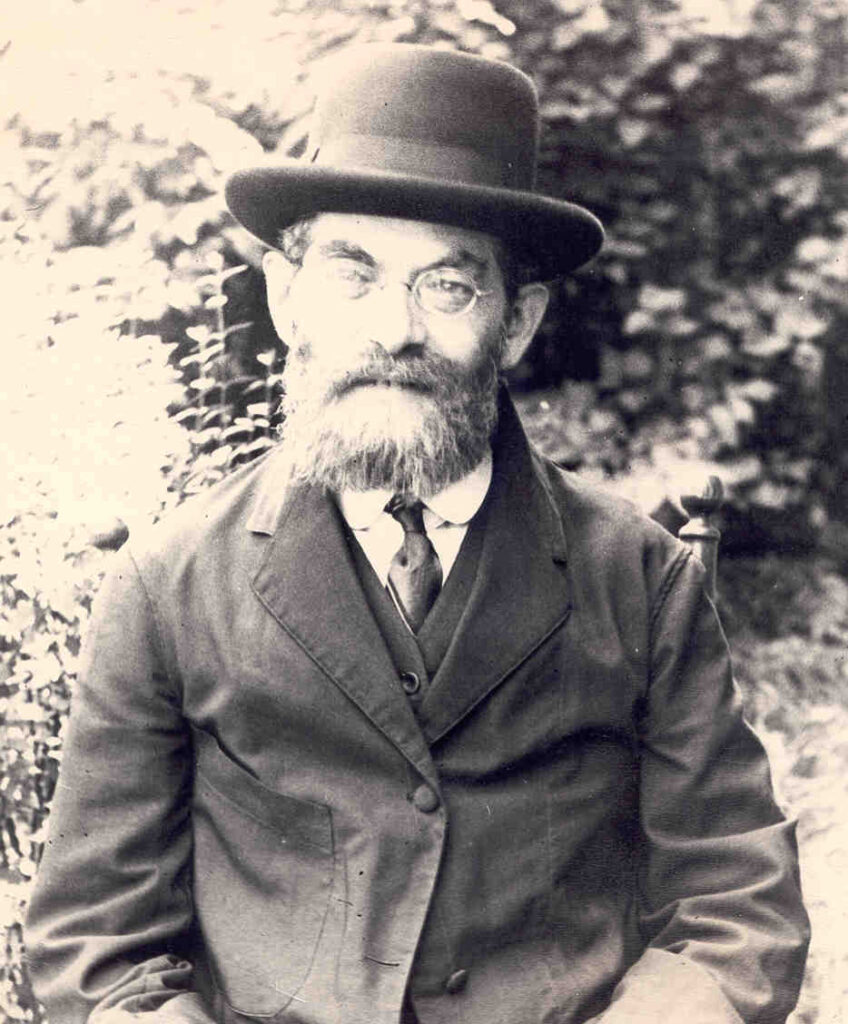
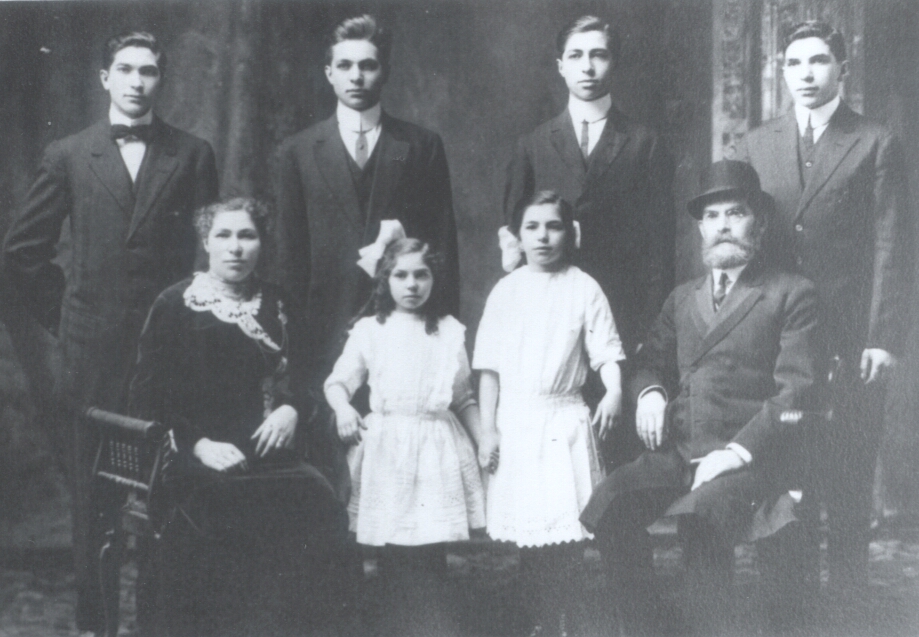
Among the most important early religious figures of Anshe Lubavitz was Reb Menachem Mendel Leib (Mendel Loeb) Gilden, a shochet u’bodek, mohel and chazzan, who brought with him a direct connection to the Chassidic world of the Vitebsk region. Born in 1869, Reb Mendel left Russia for the United States in August 1903 and settled in Buffalo, where he served Anshe Lubavitz on and off for many years.7
Reb Mendel came from Beshenkovichi, near Vitebsk in present-day Belarus, and was the son of Harav Avram Yisroel Gildensohn, one of the Chassidic rabbonim of Beshenkovichi. The family preserved Yiddish letters that Harav Avram Yisroel sent from Beshenkovichi to his son in Buffalo, together with passports and photographs. The records also preserve several forms of the family name: Gildensohn, Gildenson, Gildin and Gilden.8
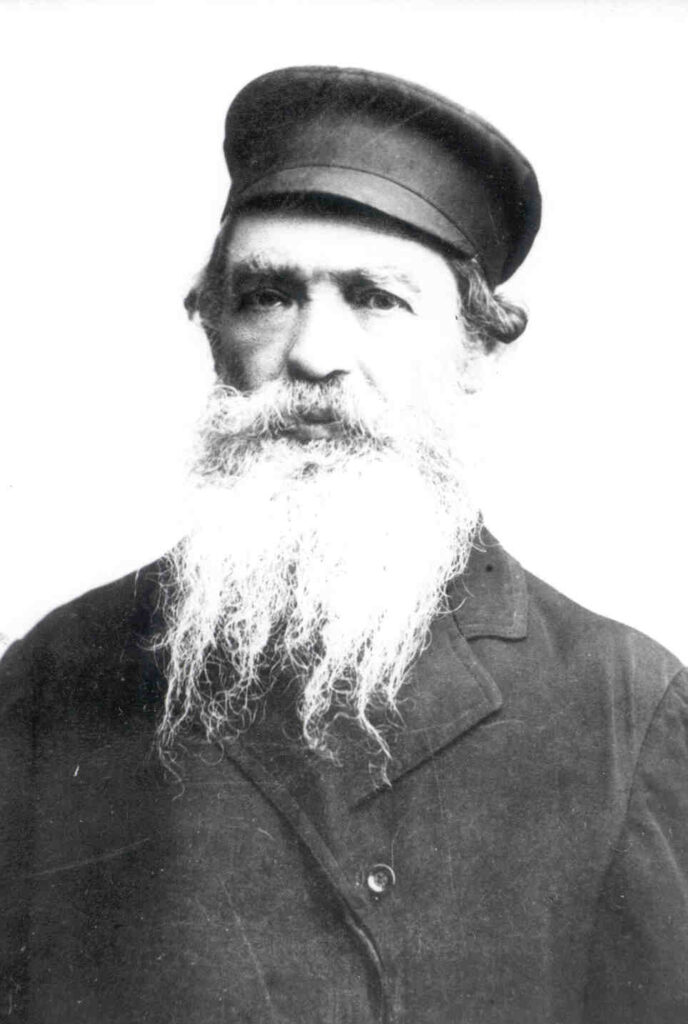
Beshenkovichi had particularly strong ties to Lubavitch. In 1896, while the Gilden family was still rooted there, the town had only five synagogues, two of which belonged specifically to Lubavitch Chassidim. The connection extended beyond the synagogues themselves. In a diary entry from 14 Sivan 5662 (June 19, 1902), the Previous Rebbe described meeting two Chassidic melamdim from Beshenkovichi, Reb Peretz and Reb Menachem Mendel, resting by the road on their way home from Lubavitch after Shavuos and reviewing a maamar of Chassidus. It was their thirty-third annual Shavuos journey to Lubavitch, made on foot every year since 1871.9
A surviving diary written by Reb Mendel during his emigration, titled “The Diary of My Trip to the United States,” provides a rare first-person glimpse of his journey from Russia to America. Beginning on 10 Av 5663 (August 3, 1903), he recorded his departure from his family and the difficult voyage westward through Danzig, Libau, Copenhagen, Hull and Liverpool. Even amid the hardships of the journey, he carefully maintained his religious observance. During severe seasickness on Friday night he nevertheless davened and made Kiddush, and on Shabbos morning, still ill, he davened and reviewed the weekly Torah portion. In England, housed among other emigrants, he questioned how the meat had been identified and salted and checked the separation of milk and meat himself before he would eat.10
Taken together, Reb Mendel’s background adds an important dimension to the early history of Chabad in Buffalo. He did not encounter Lubavitch for the first time after reaching America. He came from a Chassidic rabbinic family in a town with deep and longstanding ties to Lubavitch, and his service at Anshe Lubavitz was rooted in the Chassidic world from which he had come. His religious training suited the needs of an immigrant Orthodox congregation: as shochet, mohel and chazzan he filled several of the essential functions on which traditional Jewish communal life depended, and his years at the shul coincided with its move from modest quarters to its own permanent building on Pratt Street.11
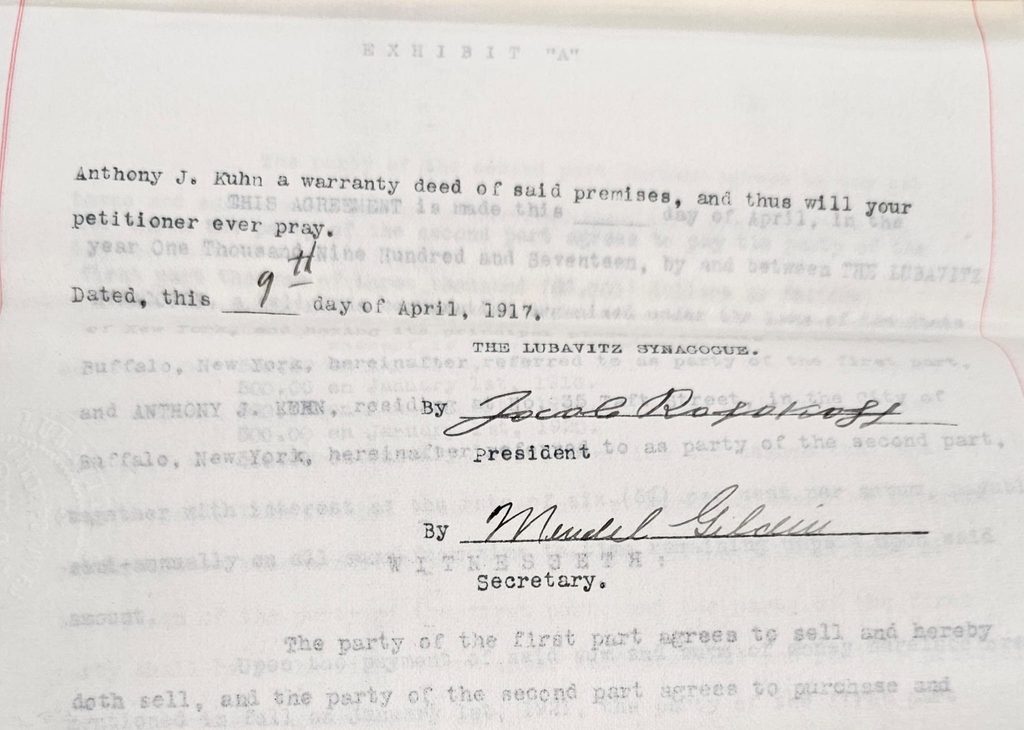
Signed by the president and the secretary
When the Lubavitz Synagogue sold part of its cemetery plot in 1917, the deed was signed by Jacob Rosokoff as president and by Reb Mendel Gilden as secretary.12
Reb Mendel was married to Baila (Beila Steinhart) Gilden, known in American records as Bertha. Their eldest son, Jacob H. (Zvi Hersch) Gilden, born in Beshenkovichi in 1891, married Anna Sernoffsky in Buffalo in 1919, studied dentistry at the University of Buffalo and practiced in the city as Dr. Jacob H. Gilden.13
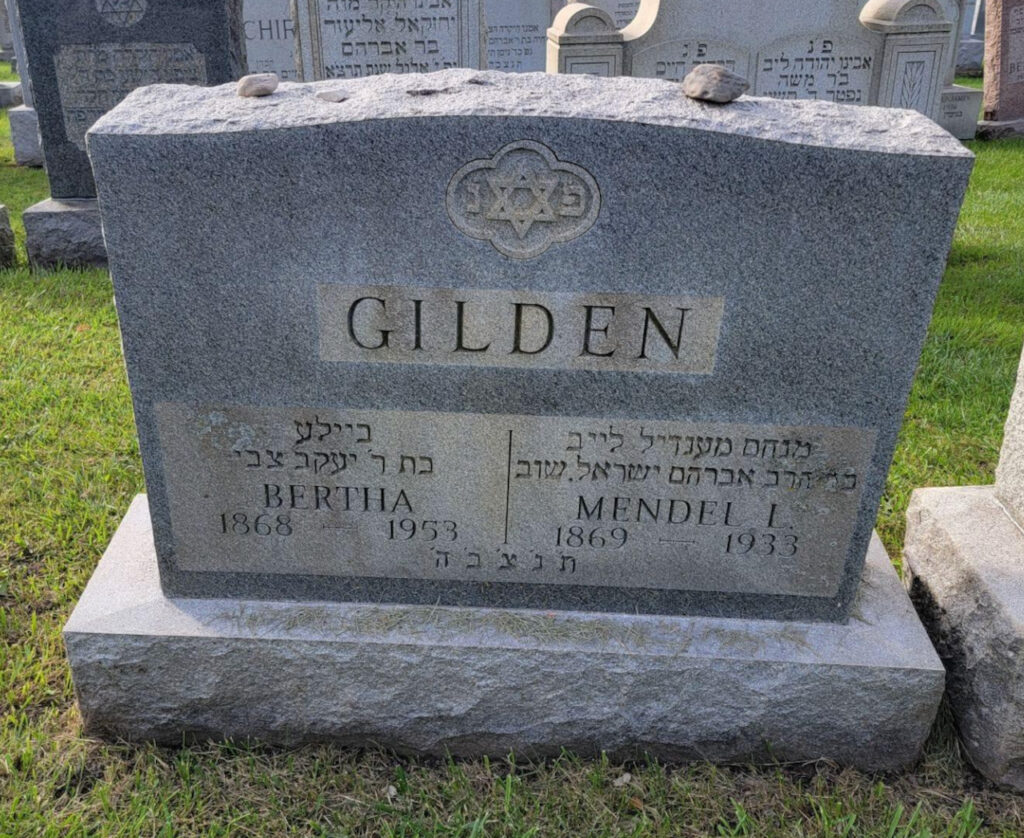
Reb Mendel Gilden passed away on November 10, 1933, at about sixty-four, and was buried in the Lubavitz Congregation Cemetery, the cemetery of the congregation he had served. Baila was later buried beside him. Their adjoining stones, “Mendel L. Gilden 1869–1933” and “Bertha Gilden 1868–1953,” remain a surviving physical link between Reb Mendel and Buffalo’s early Lubavitch community.14
That same year marked a transition in Buffalo’s Orthodox leadership. Rabbi Yehoshua Halevi Zambrowsky arrived from Syracuse in the spring of 1933 to serve as Chief Rabbi of Buffalo’s newly organized Orthodox Jewish Council and became the rav of the Lubavitch Shul on Pratt Street. His arrival preceded Reb Mendel’s passing by several months, placing both men in Buffalo during the final months of Reb Mendel’s life.15
Cantor Perez Freedman
Chazzan from 1923
Cantor Perez Freedman served as the chazzan of Anshe Lubavitz on Pratt Street beginning in 1923. A businessman as well as a cantor, Freedman had received voice and choir training in Europe and became a popular chazzan in downtown Buffalo, retaining a devoted following for many years. He continued officiating at Anshe Lubavitz through the congregation’s later years on Pratt Street.16
Rabbi Chaim Davidovich and the Previous Rebbe
Rabbi of Anshe Zedek, 1927–1945
Rabbi Chaim Davidovich was the prominent Orthodox rabbi of Anshe Zedek in Buffalo from his arrival in 1927 until his departure for Denver in 1945. He served as a rav in the city for eighteen years and was an active member of the Orthodox Rabbinical Council of Buffalo. During his years in Buffalo, he maintained an ongoing correspondence with Rabbi Yosef Yitzchak Schneersohn, the Previous Rebbe and sixth Rebbe of Chabad-Lubavitch.
In a letter dated 7 Marcheshvan 5689 (October 21, 1928), written from Riga, the Previous Rebbe answered Rabbi Davidovich’s letter about the religious situation in Buffalo. Religious education anywhere, he wrote, “נוגע הוא בנפשי”, “touches my very soul,” because he had seen in Soviet Russia how a small number of badly educated people had brought about all the persecution of religion. He advised Rabbi Davidovich to reach a compromise with the left-leaning faction in the community, on condition that his view would be binding in religious education: which teachers were hired, what was taught and how, and the schedule of Torah study. He should form a special committee of lay leaders, find God-fearing teachers first, and keep the Rebbe informed.
The correspondence continued. In a follow-up letter of 18 Teves 5689 (December 31, 1928), the Previous Rebbe thanked Rabbi Davidovich for the mazel tov he had sent upon the marriage of the future Rebbe, Rabbi Menachem M. Schneerson, and Rebbetzin Chaya Mushka Schneerson, which had taken place on 14 Kislev 5689. He described the cruelties of the Yevsektsia against Soviet Jews and the office he had set up for their relief under his son-in-law, Rabbi Shmaryahu Gurary, and asked Rabbi Davidovich to connect him with people of influence in America.17
This correspondence demonstrates that Buffalo maintained a direct connection with the leadership of Chabad-Lubavitch years before the Previous Rebbe arrived in the United States in 1940, underscoring the city’s place in the early history of Chabad-Lubavitch in America.
1933–1939: Rabbi Yehoshua Halevi Zambrowsky
Rav of Anshe Lubavitz · Chief Rabbi of Buffalo
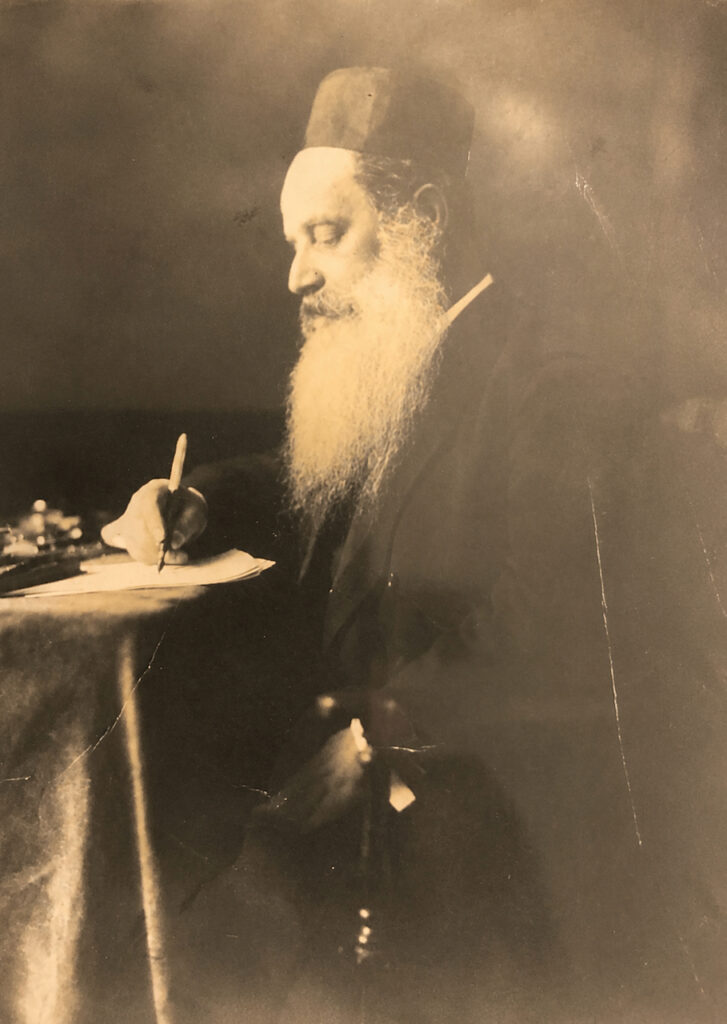
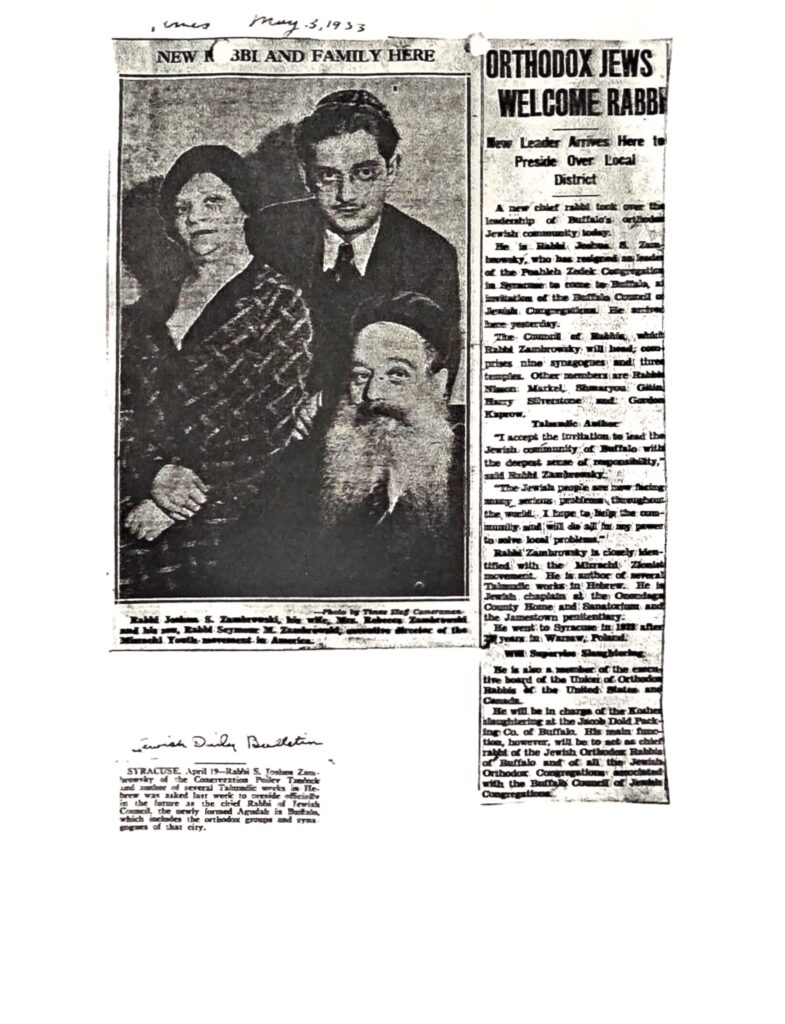
In 1933, Rabbi Yehoshua (Joshua) Halevi Zambrowsky came to Buffalo from Syracuse and became the rabbi of Anshe Lubavitz at 115–117 Pratt Street, the historic congregation known as the Lubavitch Shul or Pratt Street Shul. Rabbi Zambrowsky was a distinguished Torah scholar and communal rabbi whose arrival brought one of Buffalo’s leading Orthodox rabbinic figures to the pulpit of Anshe Lubavitz. Louis Silverstein, Buffalo’s last shochet, later recalled: “The Lubavitch Shule on Pratt Street had Rabbi Joshua Zambrowsky.”18
Rabbi Zambrowsky’s leadership extended far beyond Anshe Lubavitz. Upon his arrival on May 2, 1933, at the invitation of the Buffalo Council of Jewish Congregations, he assumed leadership of the city’s Orthodox community as Chief Rabbi of the Council, an organization encompassing nine synagogues and three temples.19 His arrival followed the passing in 1932 of Rabbi Avraham Meir Franklin, one of Buffalo’s leading Orthodox rabbinic authorities, who had been recognized as the city’s Chief Rabbi and Av Beis Din. Rabbi Zambrowsky became the next major Orthodox rabbinic figure in Buffalo to bear the title of Chief Rabbi.20
Rabbi Zambrowsky also played an important role in kashrus throughout Buffalo. He supervised kosher slaughter at the Jacob Dold Packing Company and was subsequently appointed to the New York State Department of Agriculture and Markets to assist in enforcing the state’s kosher food laws. He also served on the executive board of the Union of Orthodox Rabbis of the United States and was active in the national Mizrachi movement.21
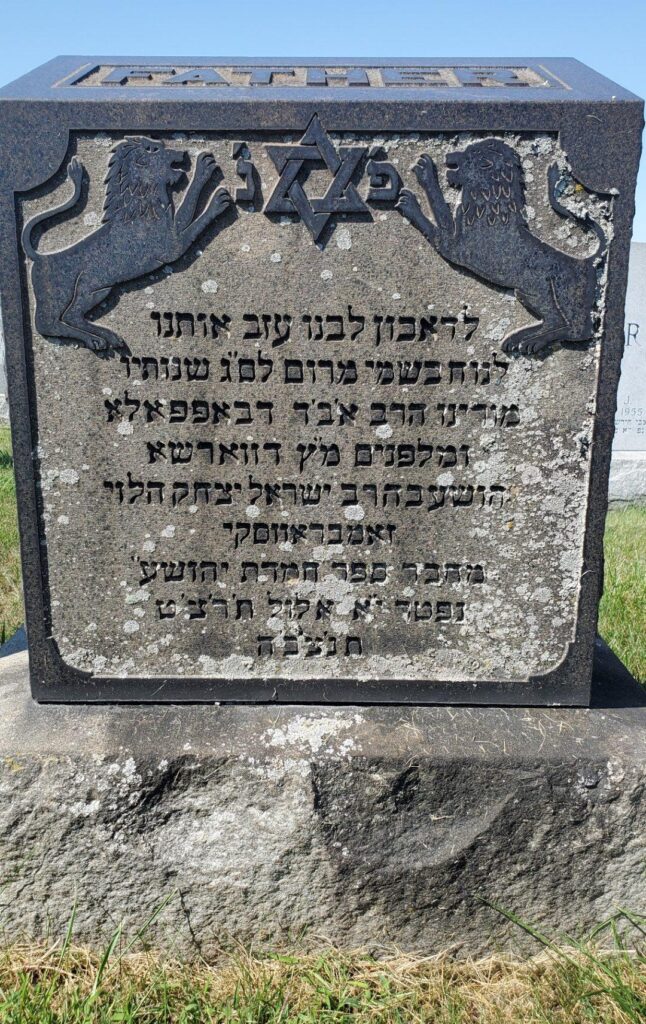
Rabbi Zambrowsky remained in Buffalo until his passing on 11 Elul 5699 (August 26, 1939). He was buried in the Lubavitz Congregation Cemetery in Cheektowaga. His gravestone identifies him as Av Beis Din of Buffalo, formerly of Warsaw, and as the author of Chemdat Yehoshua.22
On the map of American Chabad
In the mid-1930s Agudas Chassidei Chabad, the Chassidim’s organization in America, set out to register the Chabad shuls in the country. A surviving list from those years names 48 Nusach Ari congregations across the United States and Canada. Number 15 is “בופאלא — אנשי ליובאוויטש”, Buffalo, Anshei Lubavitch. Outside the New York area, only a few cities, among them Boston, Buffalo and Chicago, appear on it by name.23
1942: Rabbi Dov Ber (Berish) Zuckerman
Rav of Anshe Lubavitz from 1942 · in Buffalo until 1968
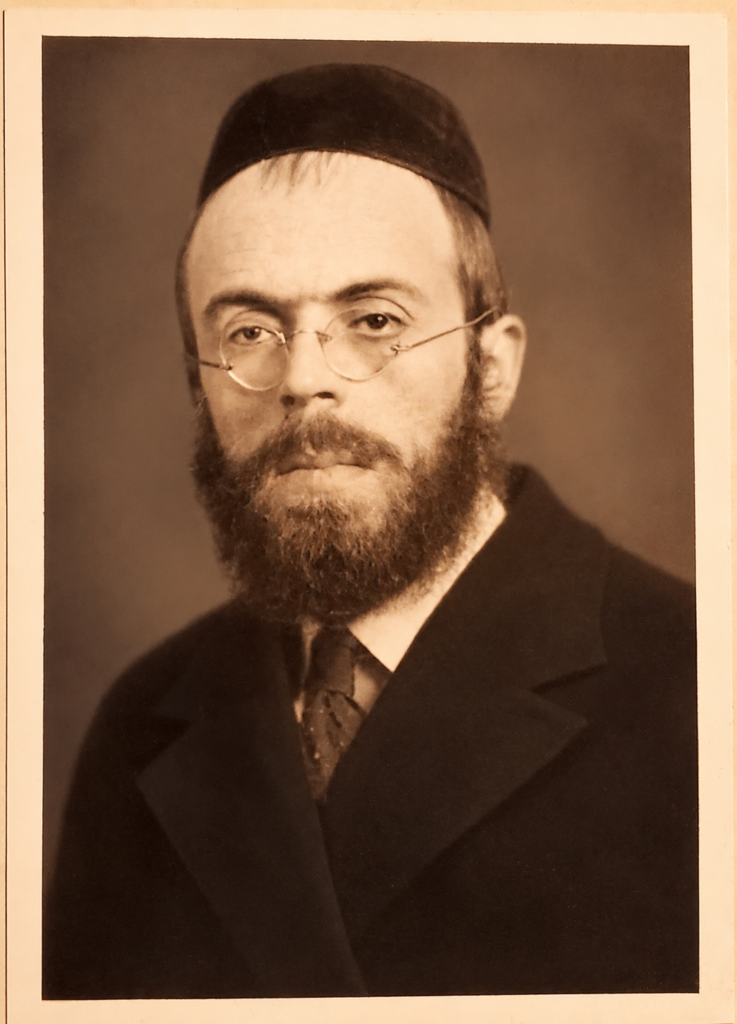
In 1942, Rabbi Dov Ber (Berish) Zuckerman was appointed the rabbi of Anshe Lubavitz in Buffalo and was recognized as Buffalo’s Chief Rabbi, a position he held for approximately twenty-five years.24
Born in 1901 in Galicia, Rabbi Zuckerman was a renowned Torah scholar and Belzer Chassid who came to the United States in 1939 after escaping Nazi-controlled Europe.
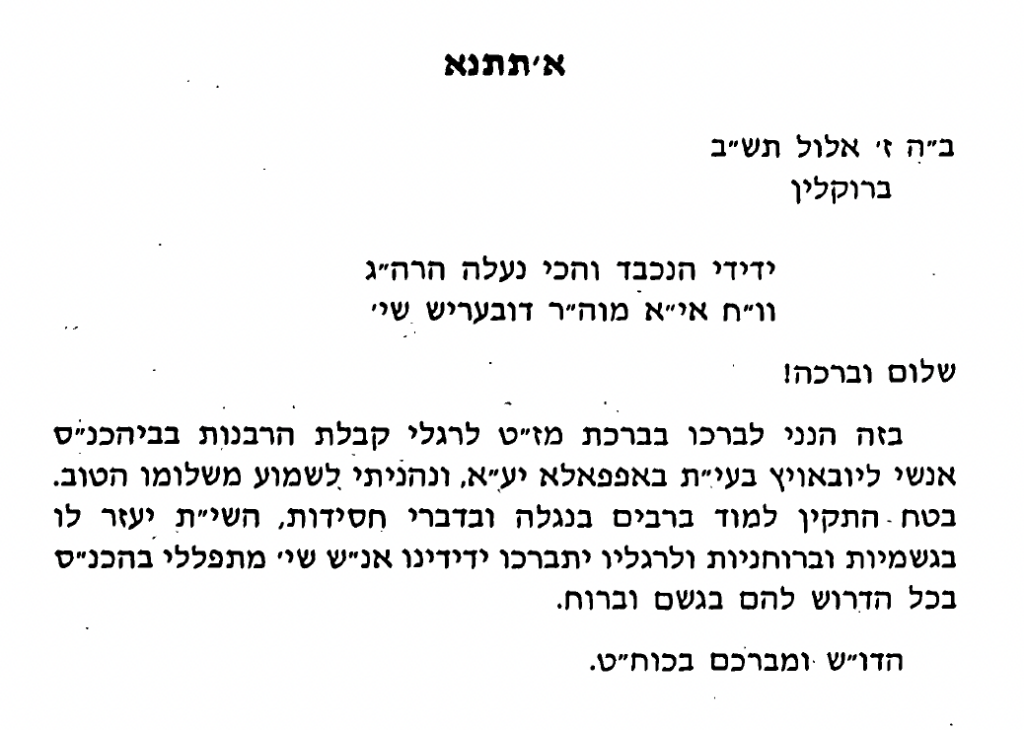
His appointment at Anshe Lubavitz is documented in a letter dated 7 Elul 5702 (August 20, 1942) from the Previous Rebbe, congratulating him on accepting the rabbinate of “ביהכנ״ס אנשי ליובאויץ” in Buffalo. The Previous Rebbe wrote that he was sure Rabbi Zuckerman had already established public Torah study in both Nigleh and Chassidus, “בטח התקין למוד ברבים בנגלה ובדברי חסידות,” and blessed him and the members of the congregation in all their material and spiritual needs.25
On accepting the rabbinate of Anshe Lubavitz
Letter from the Previous Rebbe to Rabbi Dov Berish Zuckerman, 7 Elul 5702 (August 20, 1942), congratulating him upon accepting the rabbinate of Anshe Lubavitz in Buffalo.
During his years in Buffalo, Rabbi Zuckerman became one of the region’s leading halachic authorities. Jews from Buffalo and surrounding communities, even from Rochester, sought his guidance on difficult matters of Jewish law, including gittin, and he provided rabbinic supervision for shechita in the city, personally examining the slaughterers’ knives.26
He maintained a close Torah connection with Lubavitch and corresponded with the Rebbe on Torah matters during his years in Buffalo. In 1953 he sent the Rebbe his notes on the Meiri; the Rebbe answered with detailed comments, and also urged Rabbi Zuckerman and Rabbi Yitzchok Dovid Groner to learn together regularly.27
In the mid-1940s, Rabbi Zuckerman left Anshe Lubavitz and became the rav of Brith Sholem at 171 Pine Street, just around the corner from Pratt Street. He would go on to lead Brith Sholem for approximately the next quarter century. In 1951, Brith Sholem relocated to 1052 Hertel Avenue. Two surviving letters written by Rabbi Zuckerman on his personal letterhead list addresses at 1 Traymore Avenue and 5 Lovering Avenue, both only a short distance from the congregation’s new Hertel Avenue location.
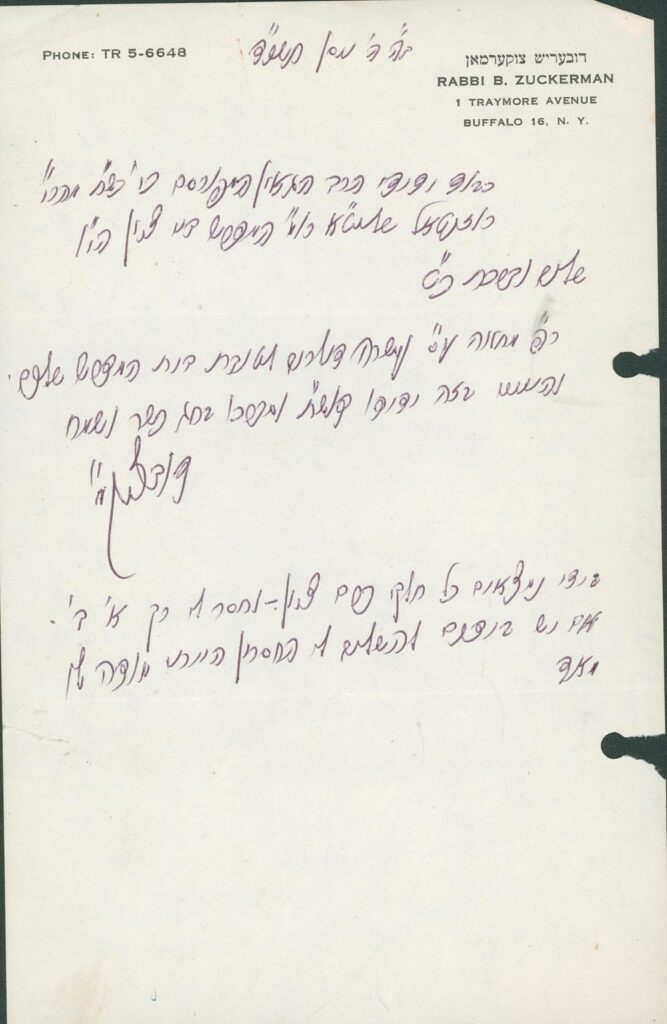
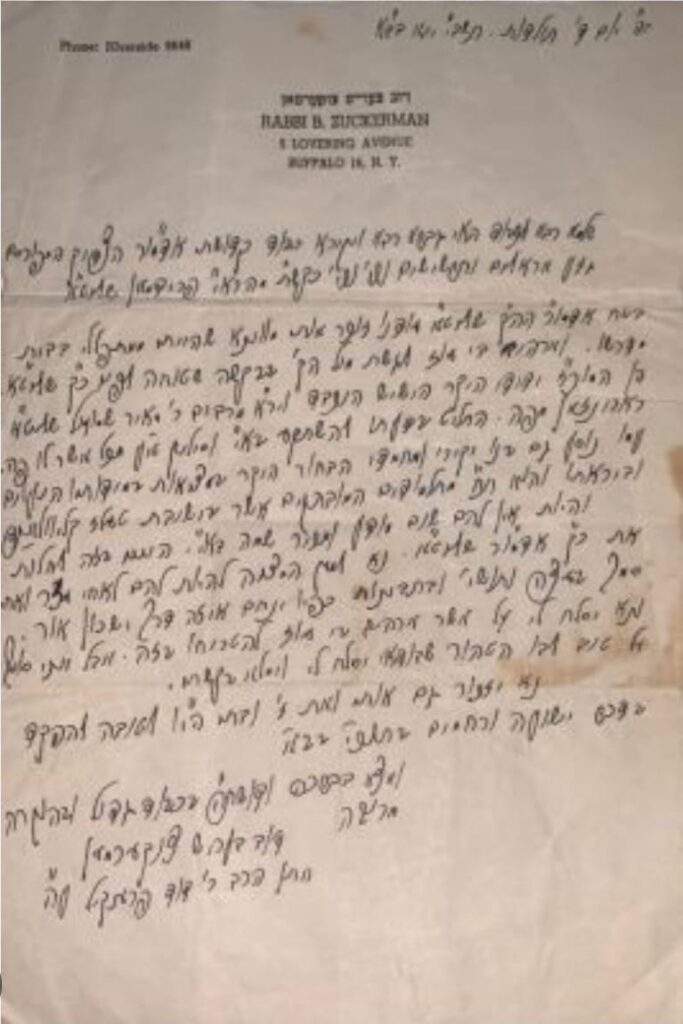
In 1953, Rabbi Zuckerman, together with Rabbi Justin Hofmann and Rabbi Samuel and Miriam Stern, assisted Buffalo shlucha Rebbetzin Devorah Groner in the effort to establish the Kenmore Mikvah, a project she spearheaded. The property at 1248 Kenmore Avenue was purchased in 1956, and the mikvah officially opened on August 4, 1957.28
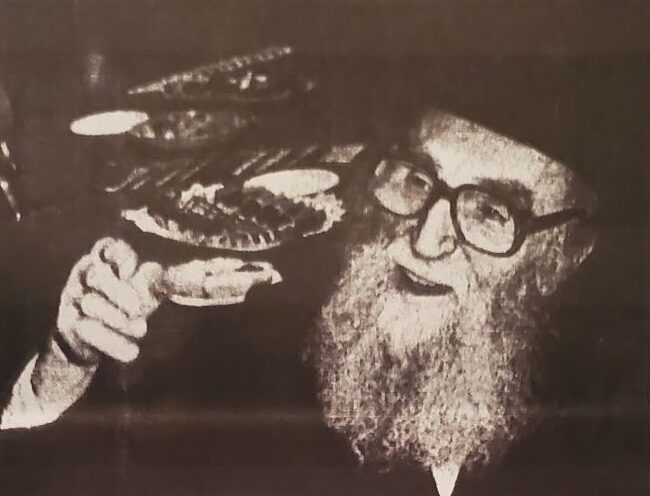
Rabbi Zuckerman remained in Buffalo until 1968, when he moved to Boro Park, Brooklyn. He passed away on 18 Adar I 5733 (February 20, 1973). With the Rebbe’s encouragement, his Torah writings were subsequently published as Beis Aharon. Rabbi Zuckerman is buried in Beth David Cemetery in Elmont, New York.29
The Merger of Anshe Lubavitz and Ahavas Achim
1949–1951
In 1949, Anshe Lubavitz sold its building at 115–117 Pratt Street for $30,000, after petitioning the New York State Supreme Court for permission to sell. Its Board of Directors at the time was Charles Etkin, Marcus Weinstein, Joseph Brook, Seymour Rodman, Max Friedman, Isadore Reinstein and Eugene Drozen.30
Two years later, in 1951, the newly merged congregation Ahavas Achim–Lubavitch built a new synagogue at 345 Tacoma Avenue, with seating for approximately 900 people.
The merger appears to have brought significant changes to the synagogue. By Elul 5711 (September 1951), there was already discussion within Ahavas Achim–Lubavitch of removing the mechitzah and allowing men and women to sit together during services. The matter was serious enough that the Rebbe sent multiple letters to members and leaders of the Buffalo Jewish community, urging them to oppose the proposed change and preserve the synagogue’s traditional standards. All three of the letters below are dated 4 Elul 5711 (September 5, 1951). None of them appears among the letters of Elul 5711 in the published Igros Kodesh.31
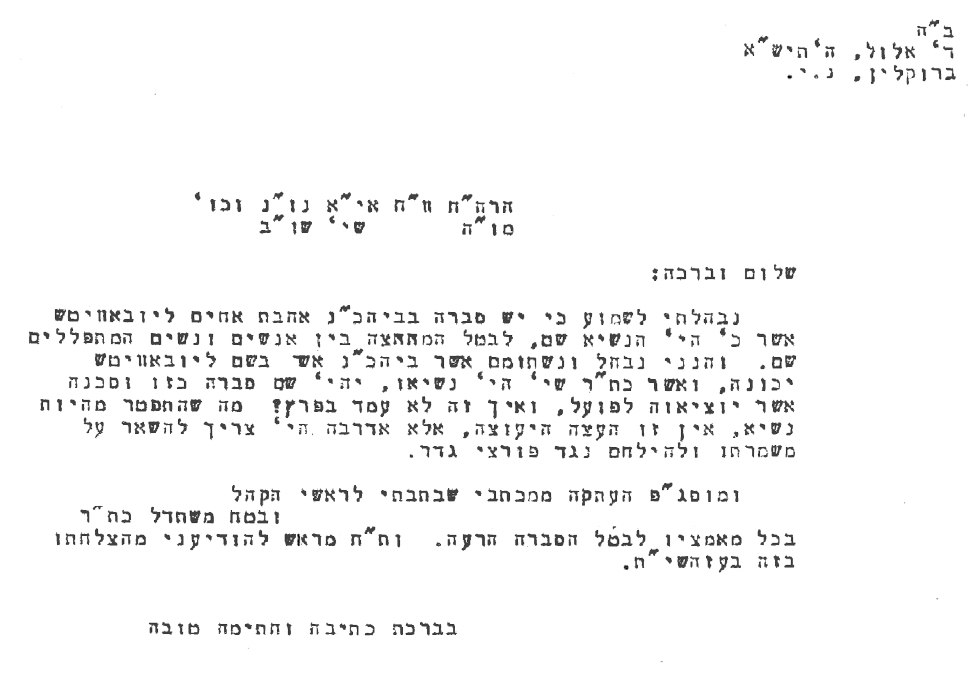
On that day the Rebbe wrote directly to Reb Leib Silverstein, a shochet who had served as president of the congregation. The Rebbe expressed his shock that such a proposal could even be considered in a synagogue bearing the name Lubavitch. More significantly, the Rebbe criticized Silverstein for having resigned from the presidency rather than remaining at his post and “standing in the breach.” The Rebbe wrote that leaving his position was not the proper course; rather, he should have remained at his post and fought against those seeking to break with the synagogue’s traditional standards. The Rebbe urged him to use every possible effort to have the proposal withdrawn and asked to be informed of his success.
„מה שהתפטר מהיות נשיא, אין זו העצה היעוצה, אלא אדרבה הי׳ צריך להשאר על משמרתו ולהילחם נגד פורצי גדר.”
“His resigning from the presidency is not the right course. On the contrary, he should have remained at his post and fought against those who breach the fence.”
The Rebbe to Reb Leib Silverstein, 4 Elul 5711
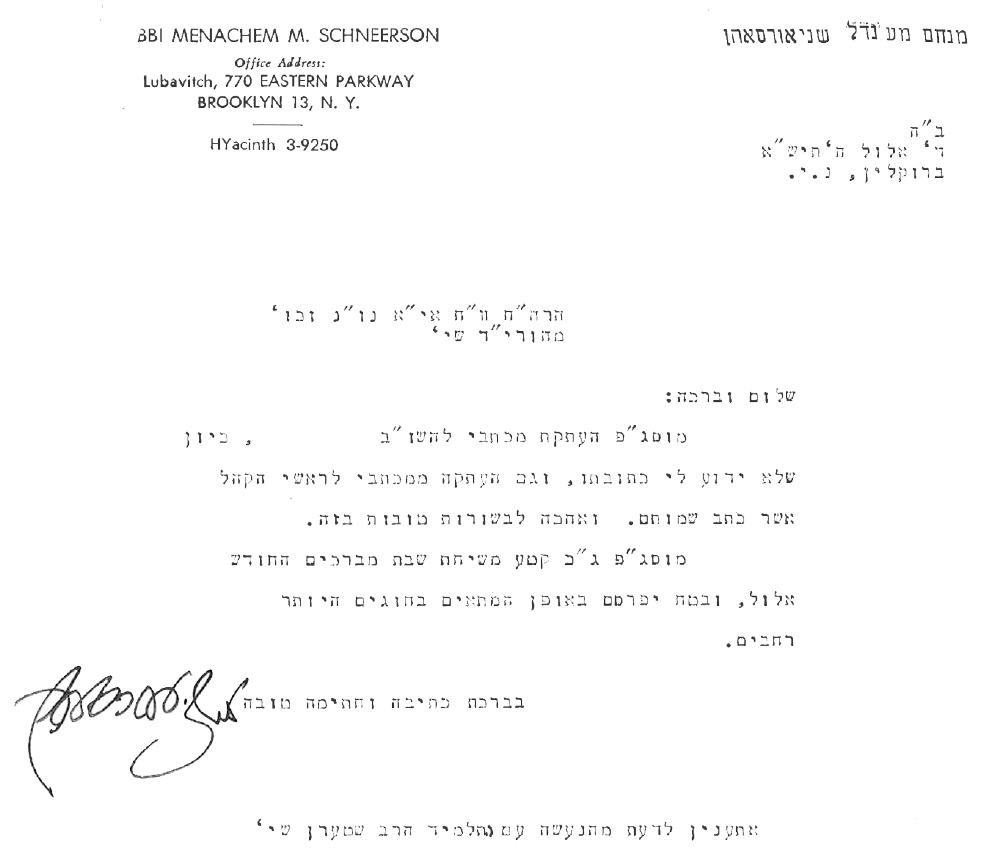
The Rebbe also wrote that day to Rabbi Yitzchok Dovid Groner, director of Yeshivas Achei Tmimim in Buffalo. Since he did not have Reb Leib’s address, the Rebbe sent Rabbi Groner a copy of that letter, together with a copy of his letter to the leaders of the congregation, and wrote that he awaited good news on the matter. He also enclosed an excerpt from the sicha of Shabbos Mevarchim Elul, asking Rabbi Groner to publicize it as widely as possible.
To Reb Leib Silverstein and to Rabbi Groner
Left: the Rebbe’s letter to Reb Leib Silverstein, urging him to stand firm against the proposal to remove the mechitzah. Right: the Rebbe’s letter to Rabbi Yitzchok Dovid Groner, enclosing copies of his letters to Reb Leib Silverstein and to the leaders of the congregation.
That same day, the Rebbe addressed a separate English letter to the President and Officers of Congregation Ahavas Achim Lubavitch. He wrote that he was “deeply disturbed” to hear that individuals in the congregation wished to introduce a new arrangement permitting men and women to worship together without a partition. The Rebbe emphasized that a synagogue carrying the name Lubavitch bore a particular responsibility to preserve traditional Jewish practice: “In a congregation bearing the noble name of ‘Lubavitch,’ a Shul without a Mechitza (partition) is completely unthinkable.”
The Rebbe appealed both to the longstanding tradition of separate seating in Jewish synagogues and to the legacy of the Lubavitcher Rebbeim, who had sacrificed greatly to preserve Jewish tradition. He called upon every member of the congregation, and particularly its officers and trustees, to use their influence to reject any attempt to remove the mechitzah. In a postscript, the Rebbe noted that he had sent similar letters to several leading members of the congregation, but stressed that each individual bore personal responsibility, “as though he were alone,” to ensure that the synagogue remained worthy of the name Lubavitch.
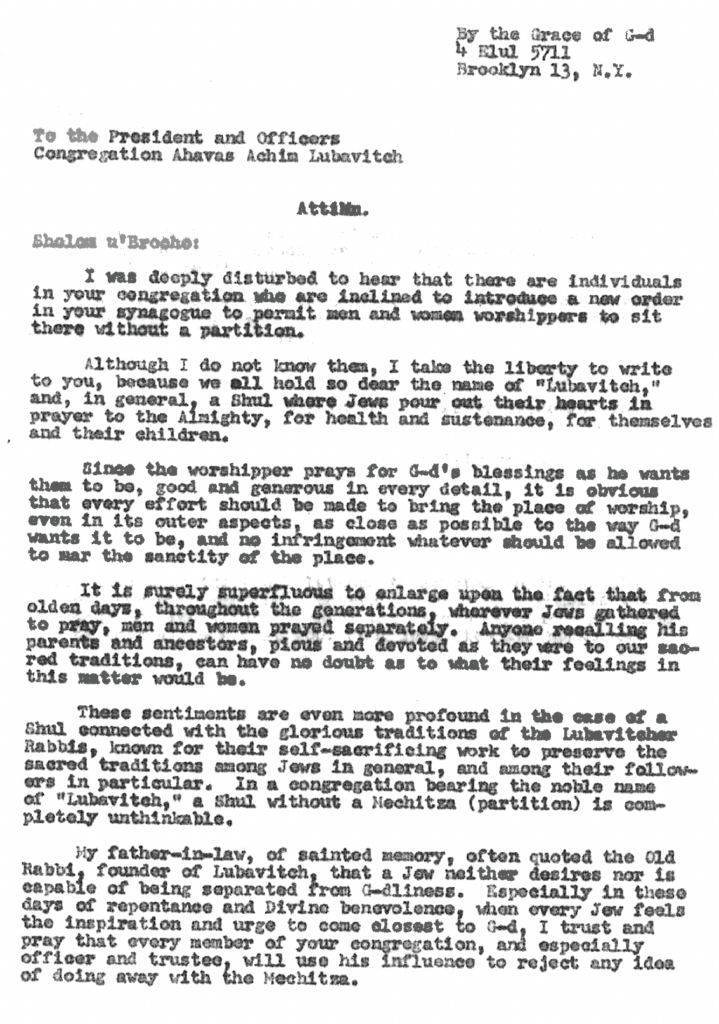
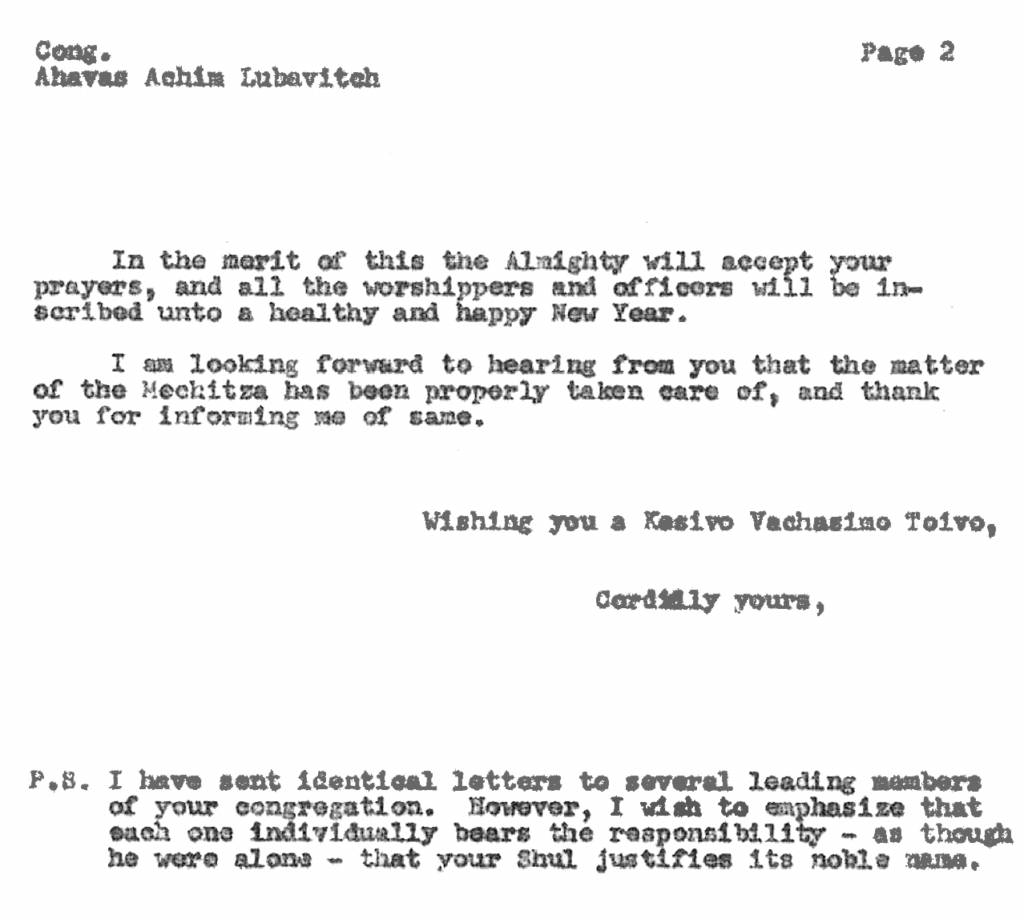
“A Shul without a Mechitza … is completely unthinkable”
The Rebbe’s English letter to the President and Officers of Congregation Ahavas Achim Lubavitch, 4 Elul 5711 (September 5, 1951). Tap a page to enlarge.
Part two
1943–1964
The Yeshiva Years: Yeshivas Achei Tmimim Lubavitch
The Previous Rebbe sends young Chassidim to open a yeshiva for Buffalo’s children and writes to them almost every month, and the Rebbe later refuses to let it stay closed.
1943: Yeshivas Achei Tmimim Lubavitch Is Established in Buffalo
Founded late summer and fall 1943 (5703–5704)
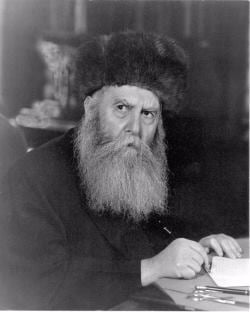
In 1943 (5703 / תש״ג), a new chapter in the history of Chabad in Buffalo began with the establishment of Yeshivas Achei Tmimim Lubavitch, part of the growing network of Jewish schools established under the direction of Rabbi Yosef Yitzchak Schneersohn, the Previous Rebbe and sixth Rebbe of Chabad-Lubavitch.
After arriving in the United States in 1940, the Previous Rebbe launched an ambitious effort to strengthen Torah education across America. Beginning with Mesibos Shabbos gatherings and supplementary Jewish education, the initiative soon developed into a network of schools known as Achei Tmimim.
Because the Previous Rebbe had been corresponding with Rabbi Dov Ber Zuckerman, “rav of the Lubavitcher shul,” he sent Rabbi Avraham Dov Hecht, then principal of Yeshivas Achei Tmimim in Newark, New Jersey, to Buffalo.32 Rabbi Hecht met with local rabbis and community leaders, organized support for the project, and laid the groundwork for a permanent Torah school. Rabbi Zuckerman’s father-in-law, Rabbi Dovid Frankel, who often visited Buffalo, helped as well; in March 1944 the Previous Rebbe wrote to him that he had earned a “broker’s reward” for the founding of the yeshiva in Buffalo.33
On 19 Menachem Av 5703 (August 20, 1943) the Previous Rebbe wrote to “the Chassidim and the Jewish community of Buffalo and the honored rabbis at their head.” He was pleased by Rabbi Hecht’s report of their decision to found a yeshiva, and introduced the man he had chosen “לראש ישיבה ולמנהל”, “as rosh yeshiva and menahel”: Rabbi Yehuda Tzvi Fogelman.34
Rabbi Yehuda Tzvi (Hershel) Fogelman: First Principal of Yeshivas Achei Tmimim in Buffalo
Rosh yeshiva and menahel, 1943–1946
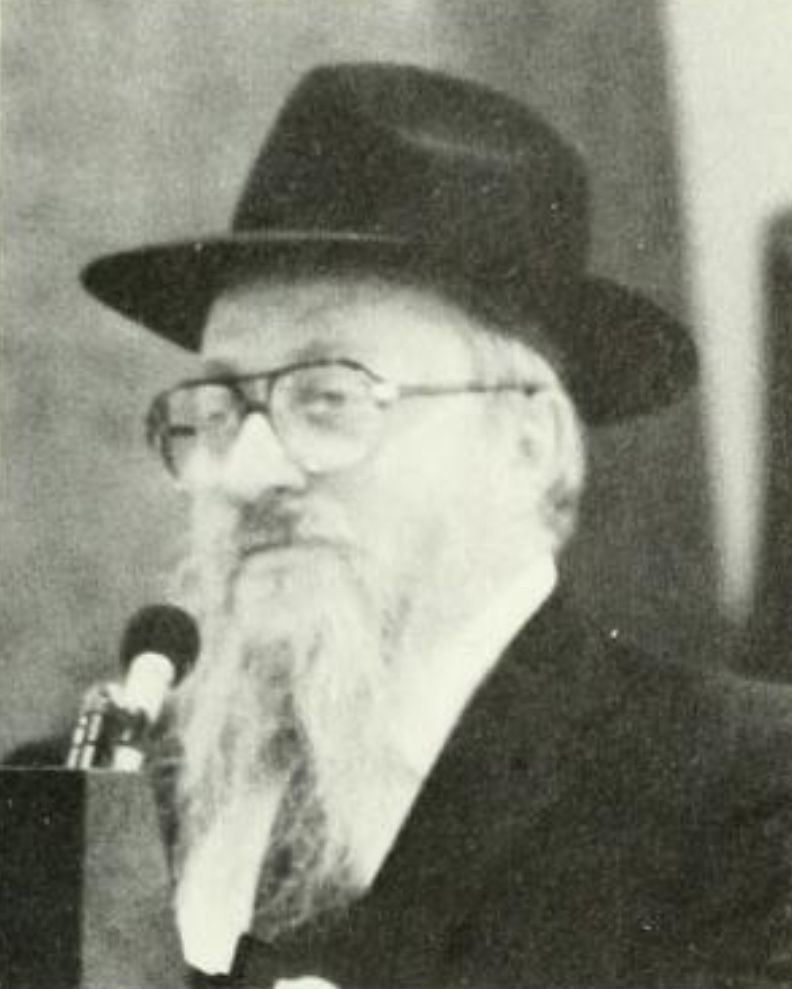
Rabbi Yehuda Tzvi (Hershel) Fogelman was chosen by the Previous Rebbe to be the first principal and rosh yeshiva of Yeshivas Achei Tmimim in Buffalo and assumed responsibility for developing the newly established school.
Before leaving for Buffalo at the end of Av 5703 (1943), Rabbi Fogelman had a private audience, or yechidus, with the Previous Rebbe, who blessed him with success in his work in Buffalo. The Rebbe instructed him that, in addition to his responsibilities at the yeshiva, he should also speak in Buffalo’s synagogues, while being careful not to interfere with the positions of the city’s existing rabbis. The Rebbe explained that he was being sent “בא להוסיף ולא לגרוע”, “to add and not to detract.”
Rabbi Fogelman then told the Previous Rebbe that whenever he traveled away from New York, “פיל איך זיך עלענט”, “I feel alone.” The Rebbe immediately replied in Yiddish:
„דו ביסט נישט עלענט, וואו דו טוסט פאר הרבצת תורה בין איך מיט דיר.”
“You are not alone. Wherever you work for the strengthening of Torah, I am with you.”
The Previous Rebbe to Rabbi Hershel Fogelman, Av 5703 (1943)
Rabbi Fogelman later wrote these words on a small piece of paper and kept them in his wallet for the rest of his life. Looking back on those years, he simply concluded: “ובאמת היה הצלחה גדולה”, “In reality, the work in Buffalo was a great success.”35
The yeshiva’s founding minutes, kept in Yiddish by one of the founders, record that on August 24, 1943 Rabbi Fogelman called a meeting in the Lubavitcher Shul on Pratt Street, chaired by Reverend Yitzchak Mentsch. Thirty people came. At a second meeting, on Chol HaMoed Sukkos, he reported 23 students in three classes and urged the city to wake from its “fifty-year slumber” in Jewish matters. Mrs. Greenberg offered to buy a building, and Rabbi Zuckerman closed with words of Torah.36
The beginning was challenging. Enrollment was small, and establishing a traditional Torah school in Buffalo required recruiting students, securing financial support, developing a faculty, and convincing Jewish parents of the importance of a full Jewish education. The Previous Rebbe wrote to encourage him: “וכל התחלות קשות המה”, “all beginnings are hard,” he wrote on 7 Elul 5703, “and do not be discouraged at all that you are starting with only a few… Often one must speak especially with the mothers, so that they send their sons to the yeshiva.”37
The yeshiva opened with just five students, but quickly grew to 23 students in three classes; by 1945 the boys’ school had 75 pupils.38 The school was supervised by the city’s Orthodox rabbis. Kovetz Lubavitch named the distinguished Buffalo rabbi Rabbi Michael Lifshitz, Ph.D. as its rosh yeshiva; a 1944 Tomchei Tmimim brochure calls him the assistant principal, and he signed the yeshiva’s letters as “Rabbi Michael Lipschutz, Ph.D., Co-educational Director.”3940
The officers of the yeshiva were: Meir Garin, founder and treasurer; R. Y. Manash, president; S. Segal and A. Labran, vice presidents; H. Greenberg, financial secretary; Y. Reiman, recording secretary; and a committee of prominent rabbis and Torah scholars.
The Previous Rebbe remained personally involved in the yeshiva’s development, corresponding with Rabbi Fogelman, guiding his work in Buffalo, and encouraging him to persevere despite the difficulties. His letters, nearly one a month, told Rabbi Fogelman that the yeshiva was his main work, “ובזה יניח כל עצמותו”, into which he must put his whole being,41 while also starting Mesibos Shabbos for boys and for girls, speaking to the young people in English, founding a Ladies Auxiliary, and in time opening a school for girls.42 He told the committee that it was only a helping committee and that the menahel alone decided the yeshiva’s affairs.43 From the Merkos office, the future Rebbe sent Rabbi Fogelman the new curriculum and Mesibos Shabbos badges, and advised that for now the children be taught in English while they learned Yiddish over time. It is the earliest known letter of the Rebbe connected to Buffalo.44
Rabbi Fogelman’s responsibilities extended beyond the yeshiva. He worked throughout Buffalo to recruit students, visited Jewish families, encouraged parents to give their children a Torah education, and sought to strengthen Jewish observance among the city’s youth. He also established a weekly program for children attending Buffalo’s public schools, bringing them to the yeshiva every Monday for an hour of Jewish learning, giving children who did not attend a Jewish school an opportunity to receive a Jewish education.45
The Previous Rebbe instructed that the students be educated not only in Torah knowledge, but also in good character, respect for parents, proper conduct and yiras Shamayim. At the same time, Rabbi Fogelman was encouraged to expand enrollment and develop additional educational activities throughout Buffalo. The work also included Mesibos Shabbos, bringing Jewish children together for Shabbos gatherings, Torah study and activities.
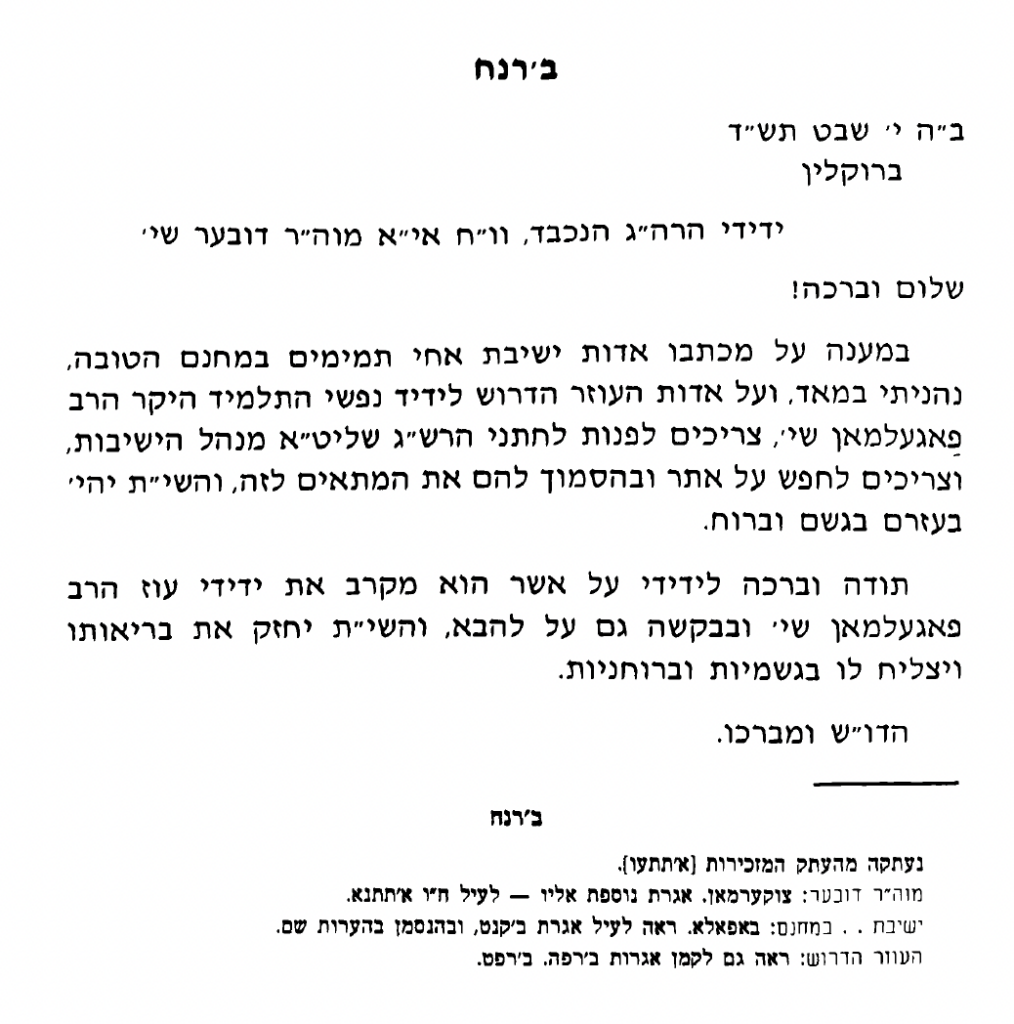
“Continue to help him”
The Previous Rebbe thanks Rabbi Zuckerman for his report on Yeshivas Achei Tmimim in Buffalo and for supporting Rabbi Hershel Fogelman, and asks him to continue that help.46
A Location for the Yeshiva: 42 Butler Avenue
The yeshiva’s building from fall 1943
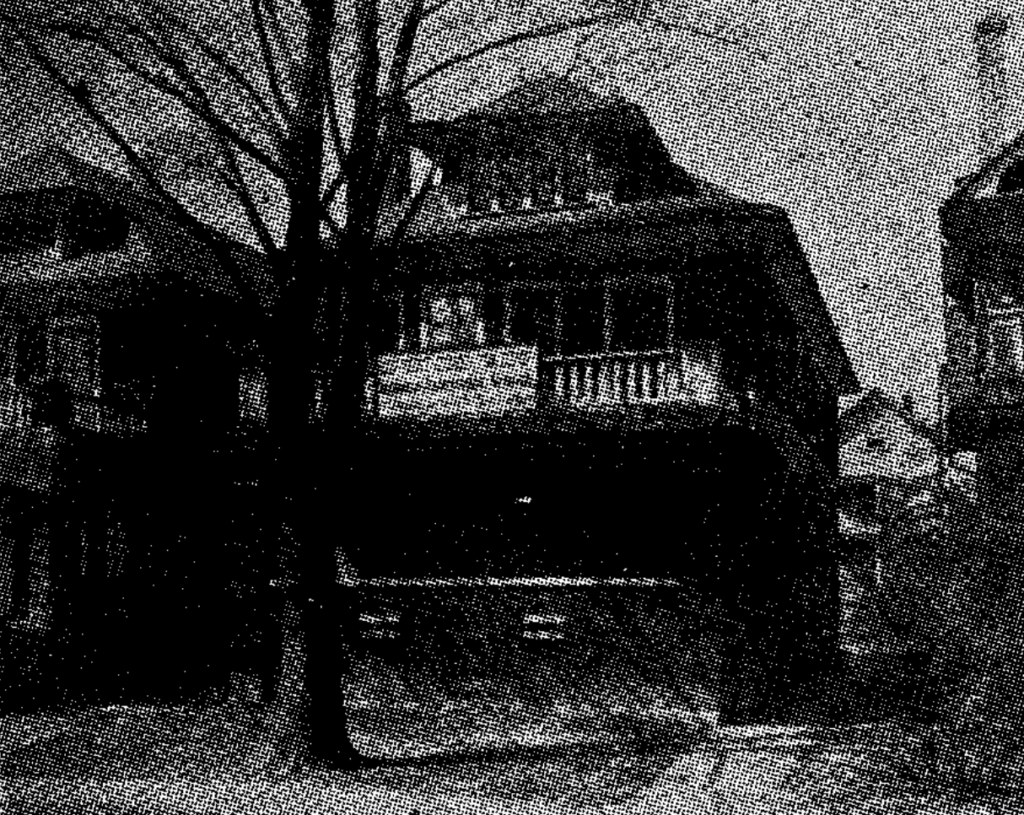
Despite starting the school in the summer of 1943, just a few months later, a major step in the development of the yeshiva was securing a permanent building at 42 Butler Avenue in Buffalo’s Humboldt section. The funds for the building were donated by Mrs. Rose Greenberg, providing the young institution with a permanent home from which it could continue to grow and expand. The Previous Rebbe had written that a large house should be bought, with room for a girls’ school and a yard, and that “Mrs. Greenberg agrees to give several thousand, and her brother will give up to $3,000.”47 When the purchase was reported, he answered that he would send his mazel tov once the house was registered in the name of the central Tomchei Tmimim.48
The yeshiva was publicized by means of a proclamation:
Proclamation, 1943 · translated from Yiddish
„ישיבה אחי תמימים ליובאוויטש”
42 Butler Ave. Premises for Yeshivah Donated by Mrs. Rose Greenberg.
Good news for Buffalo Jews!
The first time in our history, our city has been blessed with a Yeshiva, a branch of the widely branched Lubavitcher Yeshivos. The Yeshiva gives you the possibility to give every child a true Jewish education in Torah and Yiddishkeit, free of charge.
The program consists of Tanach, Rashi, Mishnayos, Gemara, history, reading and writing Yiddish and Hebrew. Much attention is given to developing the good character and good traits of the students.
Jews, save your children from lack of Jewish knowledge and bad behavior, and send them to the Yeshiva.
Registration: Daily from 3:30 until 8:00; Sunday from 10:00 until 2:00.
Signed: The Administration
With its own building, Yeshivas Achei Tmimim was able to develop from a small beginning into an established educational institution. Additional students enrolled, classes were expanded, and new teachers joined the faculty, among them Rabbi Shamban, whom the Previous Rebbe greeted by name in the winter of 1945.49 In its first years it was an afternoon yeshiva: classes ran two hours a day, six or seven days a week, all year round.50 The school at 42 Butler Avenue became a center for the effort to provide Buffalo’s Jewish children with a traditional Torah education and to strengthen Jewish life in the city.
A successful aspect of the yeshiva was its own special minyan, established for the students to daven together on Shabbos and Yomim Tovim in the yeshiva building. The students themselves led the davening at the amud. Over time, the yeshiva also began holding a special Shalosh Seudos for the students. Each Shabbos a student gave a short Torah talk, and the boys ran a “Shomre Shabbos” club and a “Torah Defense Club” that published its own newspaper. According to the yeshiva’s 1945 report, some of its pupils, “among them high school boys and even students of the U. B.,” had been “won back for Judaism.”51
1944: Beis Rivkah School for Girls
Opened 6 Cheshvan 5705 (fall 1944)
In 1944 (5705 / תש״ה), Chabad’s educational work in Buffalo expanded with the establishment of a Beis Rivkah school for girls, extending the Previous Rebbe’s vision for Torah education to the city’s Jewish girls. The first day of classes was the 6th of Cheshvan, and 25 girls registered. The Previous Rebbe wrote that he was “very pleased” at the news, and pleased too that the boys of Pirchei Machne Yisroel had taken on the running of Mesibos Shabbos.52 In March 1945 he wrote to the Pirchei themselves: “You, my dear ones, are students of Yeshivas Achei Tmimim Lubavitch… be worthy to carry its holy banner.”53
The establishment of Beis Rivkah marked another important step in the development of Chabad education in Buffalo. Together with Yeshivas Achei Tmimim for boys and the growing Mesibos Shabbos activities, it broadened the effort to provide Buffalo’s Jewish children with a strong Torah education and connection to Jewish life.
Rabbi Tzvi Fogelman Appointed Rabbi at Ahavas Achim
Mid-1944 · 833 Fillmore Avenue
In May 1944 the Previous Rebbe asked Rabbi Fogelman to write to him in detail about the synagogue Ahavas Achim.54 In mid-1944, Rabbi Tzvi (Hershel) Fogelman was appointed rabbi and leader, rav u’manhig, of the Synagogue Ahavas Achim of Buffalo, N.Y., at 833 Fillmore Avenue.55
Editorial note At this point, it appears that Buffalo had three separate Chabad-Lubavitch associated Shabbos minyanim operating simultaneously: Rabbi Berish Zuckerman at Anshe Lubavitz, Rabbi Hershel Fogelman at Ahavas Achim, and the Yeshivas Achei Tmimim student minyan at 42 Butler Avenue.
1945: A Second Location, 5 Lovering Avenue
Hertel section branch, 1945–1948
For the 1945–1946 school year, due to an influx of students in the yeshiva, an additional location was purchased at 5 Lovering Avenue, off Hertel Avenue, extending access to a Chabad-Lubavitch education to children living in other sections of the city. The Hertel section branch opened with 20 boys.56
The property was purchased under the corporation Yeshivos Tomchai Tmimim Lubavitz, Inc., a corporation set up in Brooklyn by Chabad-Lubavitch headquarters to promote, aid and assist in the creation and organization of Chabad-Lubavitch schools in the United States. The directors of the corporation included the Previous Rebbe, as well as his son-in-law Rabbi Shmaryahu Gurary (known by his initials as the Rashag), director of the Tomchei Tmimim yeshiva network, which was founded in Lubavitch in 1897 and continued in the United States.
The yeshiva also established a Beis Midrash division for older students, with Reb Leib Silverstein appointed as its instructor, further expanding the institution beyond its younger grades.
The property was ultimately sold in 1948 for $8,000, as the yeshiva’s main location at 42 Butler Avenue was sufficient and the second property had become surplus and a continuing expense.57 The same address later appears on Rabbi Dov Berish Zuckerman’s personal letterhead.
Rabbi Dovid Edelman Arrives in Buffalo
In Buffalo 1945–1948
In 1945, the Previous Rebbe sent Rabbi Dovid HaLevi Edelman to Buffalo to join the developing Yeshivas Achei Tmimim. Before coming to Buffalo, Rabbi Edelman had helped establish a Chabad educational institution in Bridgeport, Connecticut, and later taught in Pittsburgh. He went to Buffalo, in his words, “to run the yeshiva there which was in its infancy.”
Rabbi Edelman joined the yeshiva during the latter part of Rabbi Hershel Fogelman’s leadership and remained in Buffalo for approximately three years. Following Rabbi Fogelman’s departure the following summer, Rabbi Edelman succeeded him in directing the yeshiva and remained at its head until 1948.58
1946: Rabbi Dovid Edelman Succeeds Rabbi Fogelman
Rabbi Hershel Fogelman continued leading and developing Chabad’s educational work in Buffalo until the summer of 1946 (5706 / תש״ו), when he left Buffalo to assume leadership of Yeshivas Achei Tmimim in Worcester, Massachusetts.
Following his departure, Rabbi Dovid Edelman succeeded him as director of Yeshivas Achei Tmimim in Buffalo. Rabbi Aharon Popack worked alongside him in the leadership and educational work of the school, while additional young Chabad educators joined the growing faculty.
Rabbi Aharon and Chana Popack
1946–1948
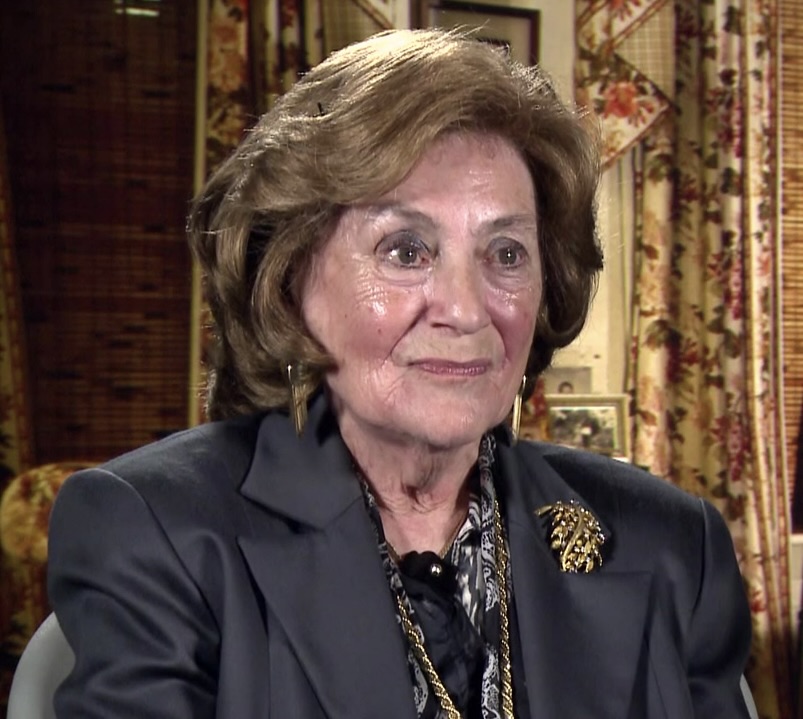
That same year, in 1946 (5706 / תש״ו), the Previous Rebbe sent Chana Teleshevsky, later Mrs. Chana Popack, to Buffalo, where she joined the work of Beis Rivkah, the Chabad school for girls that had been established two years earlier.
In Buffalo she met Rabbi Aharon Popack, who was working in Yeshivas Achei Tmimim. Rabbi Aharon and Chana subsequently married, with the Previous Rebbe serving as mesader kiddushin at their wedding.
Following their marriage, Rabbi Aharon and Mrs. Chana Popack continued their work in Buffalo providing Jewish education, Rabbi Aharon with Achei Tmimim and Mrs. Popack with Beis Rivkah.59
Rabbi Shimon Goldman
Teacher at Butler Avenue, until 1949
During this same period, Rabbi Shimon Goldman was sent to Buffalo to join the faculty of Yeshivas Achei Tmimim at 42 Butler Avenue. Upon his arrival, Rabbi Aharon Popack assigned him a class of children to teach.
Rabbi Goldman devoted himself intensely to his students and the yeshiva, and to the mission of establishing lasting Torah education in Buffalo. He approached his work according to the teaching of the Sages, “Words that come from the heart enter the heart,” seeking to instill within his students an enduring love of Torah and mitzvos.
He also became closely connected with Buffalo’s Orthodox Jewish community and studied shechita during his years in the city, spending considerable time with the local shochtim and Rabbi Dov Berish Zuckerman.
Rabbi Goldman recalled in his book, From Shedlitz to Safety, that the task was not an easy one. Although Buffalo had a large and established Jewish community, there was considerable skepticism that traditional Torah education could take root and flourish in the city. He writes that many local Jewish residents watched the developing yeshiva with disbelief, convinced that it would eventually close. Time and again, they told the young Chassidim: “There’s no future for the Torah way in Buffalo. It simply won’t work.” They were proven wrong.
In 1949, following his marriage to Esther Gordon, Rabbi Goldman settled in Philadelphia and later moved to Brooklyn, bringing his years of educational work in Buffalo to a close.60
Rabbi Shmuel Lazar
From 5708 (1947–48)
Beginning in 5708 (1947–1948), Rabbi Shmuel Lazar joined the broader effort to strengthen Chabad education in Buffalo. He was among the young Chassidim sent by the Previous Rebbe to establish and support Chabad schools in communities across the United States. His assignments during this period included Buffalo, Rochester, New Haven and Worcester, placing his work in Buffalo during the latter part of Rabbi Edelman’s leadership of Yeshivas Achei Tmimim.61
Yeshivas Achei Tmimim continued to grow steadily. Its classes expanded, additional students enrolled, and the school began bringing significant religious change to Jewish life in Buffalo.
The yeshiva’s success was strengthened by dedicated members of the local Jewish community who believed in its mission. Reb Leib (Leibish) Silverstein, the honorary president of the school, worked tirelessly to raise funds for its activities. He was assisted by two local shochtim, Mr. Landau and Mr. Siggel, together with another individual who served as the school’s secretary.62
Together, the yeshiva’s leadership, teachers and local supporters helped transform what many had considered an impossible undertaking into an established center of Torah education in Buffalo.
1948: Rabbi Yitzchok Dovid and Devorah Groner
In Buffalo 1948–1956 (5708–5716)
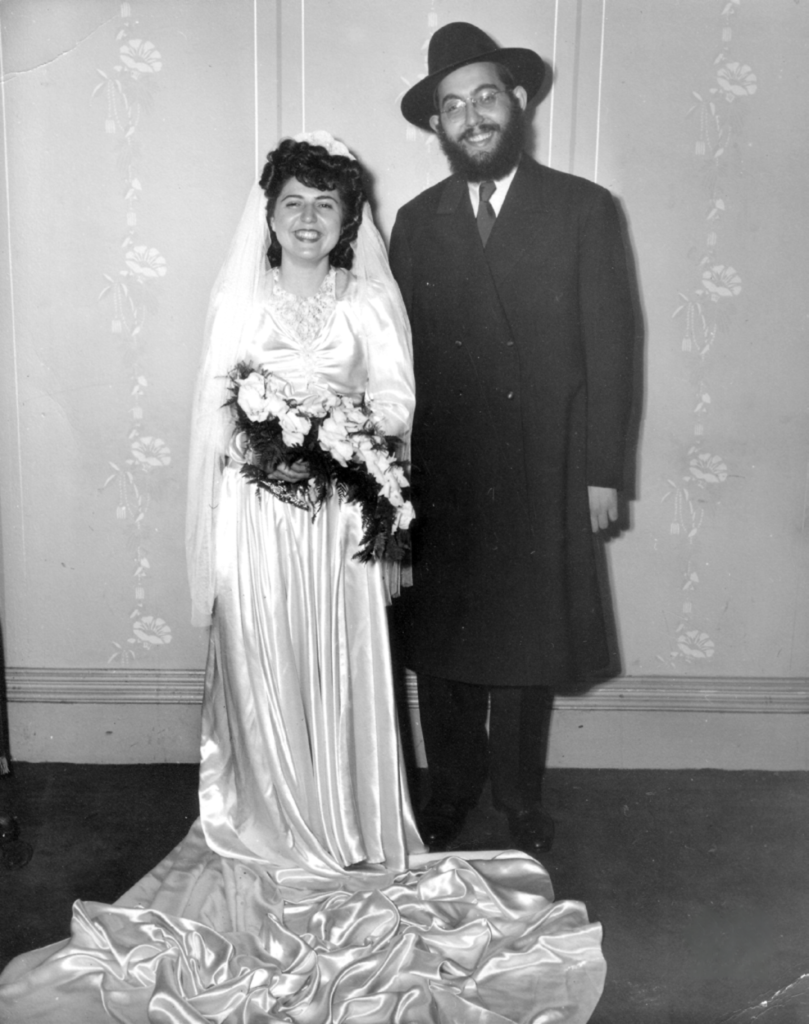
In 1948 (5708 / תש״ח), Rabbi Edelman’s three years in Buffalo came to an end when he married and was sent by the Previous Rebbe to Boston.
That same year, the Previous Rebbe sent Rabbi Yitzchok Dovid Groner and his wife, Devorah Groner, to Buffalo. Rabbi Groner succeeded Rabbi Edelman as director of Yeshivas Achei Tmimim, while Rabbi and Mrs. Groner also became deeply involved in the wider Jewish community.
Their arrival opened the next major period in the history of Chabad education in Buffalo. The Groners would remain in the city for approximately eight years, continuing the work of the yeshiva and expanding Chabad’s educational and communal activities throughout Buffalo and Western New York.63
Under their leadership, the yeshiva and its community programs flourished. In addition to providing structured Torah education for children, they expanded learning opportunities for adults through regular classes, lectures and community gatherings that inspired greater Jewish observance and participation.
One of Devorah Groner’s proudest achievements in Buffalo was the establishment of the women’s mikvah on Kenmore Avenue, a project she spearheaded and helped organize, fundraise for and manage. Her efforts strengthened the city’s religious infrastructure and provided an essential resource for Jewish family life.64
In the early 1950s, the Rebbe asked Rabbi Groner to perform a certain task. Sensing Rabbi Groner’s feeling of difficulty in accomplishing it, the Rebbe related: each morning, either before or after Birchos HaShachar, anyone who had merited to see the Previous Rebbe should go to a corner and envision his holy countenance. After doing so, the Rebbe said, his work would be accomplished on an entirely new level.65
In 1954 Rabbi Groner spent about six months raising funds in Australia. When the shluchim there asked that he stay, the Rebbe answered that he was tied to “מחלקת הישיבה דכאן שבעיר בופאלא”, “the yeshiva’s branch in the city of Buffalo,” and had promised to continue his work there, so he would first have to make sure the Buffalo yeshiva could run without him. Rabbi Groner returned to Buffalo at the start of 5715.66
Together, Rabbi and Mrs. Groner became deeply involved in the spiritual development of Buffalo’s Jewish community, helping inspire a new generation of committed Jewish families and mentoring young men who would later assume rabbinic and communal leadership positions throughout North America. Their years of shlichus in Buffalo continued until 1956 (5716 / תשט״ז), when they departed the city after about eight years, bringing this chapter of their pioneering work in Western New York to a close. On their return to New York, Rebbetzin Groner described their struggles to the Rebbe in a yechidus of more than forty-five minutes; the Rebbe, distressed by what he heard, began to cough and could not catch his breath. From then on she decided to tell the Rebbe of her difficulties only in writing.67 In 1958 the Groners went on shlichus to Melbourne, Australia.
Rabbi Yehuda Leib (Leibel) Posner
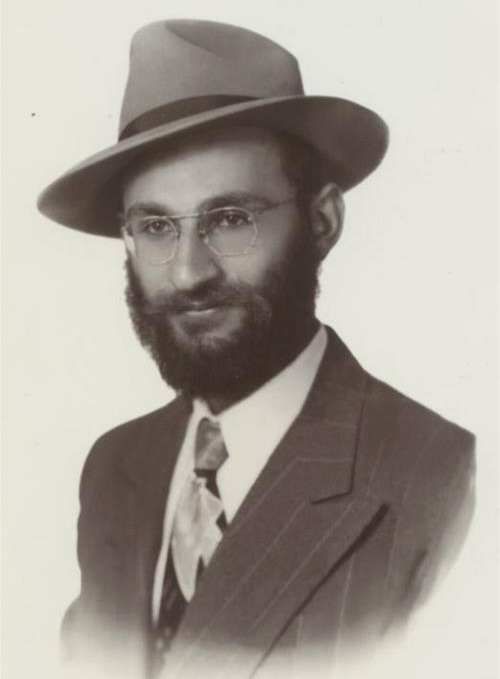
Rabbi Yehuda Leib (Leibel) Posner assisted in the leadership and administration of the yeshiva during this period. A dedicated educator and one of the prominent young Chabad leaders of that era, Rabbi Posner helped guide the institution during a time when maintaining a strong Torah presence required tremendous dedication and effort.
1955: 85 Saranac Avenue
Incorporated January 31, 1955
In 1955, the property at 85 Saranac Avenue was purchased. The property was acquired under a newly formed religious corporation, Yeshiva Achei Tmimim of Buffalo, incorporated on January 31, 1955. Its directors were Rabbi Leib (Louis) Silverstein, Rabbi Ben Kape and Rabbi Shimon (Sam) Goldman.68 The building still houses Congregation Achei Tmimim, the Saranac Synagogue, which has met there without interruption since.69
Rabbi Hershel Slansky: Principal of Yeshivas Achei Tmimim
In Buffalo 1954–1959 · menahel 5717–5719
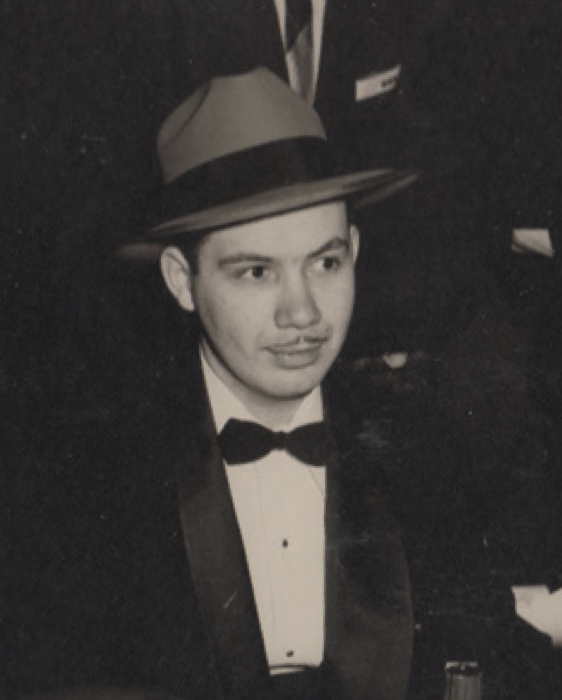
Rabbi Hershel Slansky, one of the early American students of Tomchei Tmimim, was sent by the Rebbe with his wife Debby to Buffalo following their marriage in 1954. He initially worked in Yeshivas Achei Tmimim alongside its existing leadership. After Rabbi Yitzchok Dovid and Devorah Groner left Buffalo in 1956, Rabbi Slansky assumed the position of menahel for the 1957 school year, continuing in that role until 1959.
Rabbi Slansky later recalled: “After my marriage in 1954, the Rebbe sent me to make a yeshivah in Buffalo, where we lived until 1959.”70
During his years in Buffalo, Rabbi Slansky worked tirelessly to strengthen the institution and secure its financial stability. The yeshiva faced significant financial challenges, and Rabbi Slansky regularly shared his concerns about its situation with the Rebbe.
The Rebbe emphasized that support for the yeshiva needed to be directed specifically toward the educational institution itself. After reviewing the yeshiva’s needs, Merkos L’Inyonei Chinuch sent financial assistance, including a donation of $1,000, a substantial amount at the time.
On Yom Kippur, Rabbi Slansky shared the story with the community. Holding up the check, he declared that there was “a rabbi in Brooklyn who worries about your children.” His words inspired renewed communal support for the yeshiva and demonstrated the Rebbe’s personal concern for the future of Jewish education in Buffalo.
Rabbi Slansky and his family remained in Buffalo until 1959 (5719 / תשי״ט). It appears that around the time of his departure, the yeshiva did not reopen for the following school year. Despite this, it did not mark the end of the Rebbe’s concern for Jewish education in Buffalo. As the following chapter would demonstrate, the Rebbe soon sought to revitalize Chabad’s work in the city and rebuild the yeshiva.
1960: A New Chapter, Rabbi Mordechai (Mottel) Zajac
Dean and executive director, 1960–1964
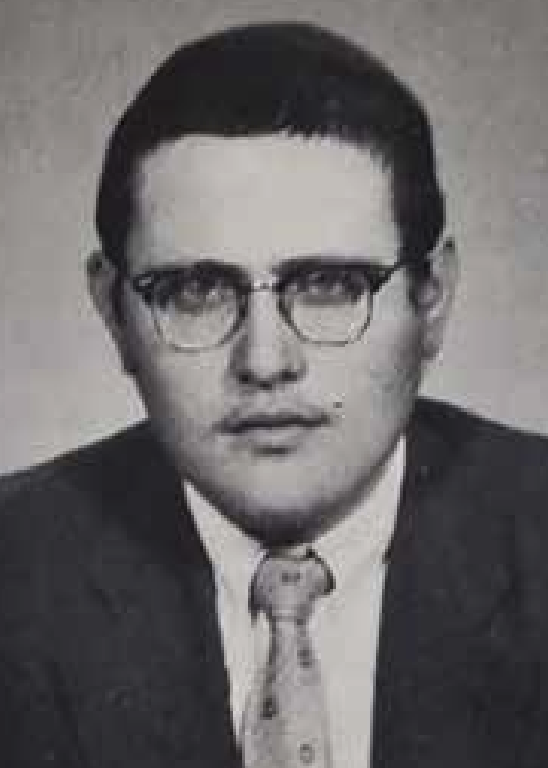
In 1960 (5720 / תש״כ), Rabbi Mordechai (Mottel) Zajac, then living in Brazil, traveled to New York before Shavuos to receive the Rebbe’s blessing before embarking on a new business venture, a coat factory. Instead, his visit took an unexpected turn: the Rebbe asked him to move to Buffalo, entrusting him with strengthening Chabad’s work in the city.
A central part of Rabbi Zajac’s mission was rebuilding Yeshivas Achei Tmimim, which had closed the previous year. Expressing the urgency of restoring the institution established by the Previous Rebbe, the Rebbe said: “I want to know how a young man such as yourself can sleep peacefully and eat peacefully, knowing that a yeshiva which my father-in-law opened has closed down… I want you to go to Buffalo.”71
Rabbi Zajac accepted the mission and moved to Buffalo, where he served for more than three years as Dean and Executive Director of Yeshivas Achei Tmimim, working to restore its educational programs and strengthen the institution. Writing in the yeshiva’s journal as it entered “our eighteenth year,” he described a school that now gave its pupils Hebrew, religious and secular studies “during the course of a regular school day,” supported by a Founders’ Group, a Ladies Auxiliary, a Young Men’s Club and a PTA.72
His work also reached beyond the yeshiva, including outreach to the growing number of Jewish students at Buffalo’s universities. Rabbi Dovid Schochet, a Chabad rov and shliach in neighboring Toronto, later recalled that Rabbi Zajac invited him to Buffalo to address local Jewish university students, an early example of the student outreach that would become an important part of Chabad’s work in Buffalo in the years that followed.73
The Rebbe remained closely interested in the progress of the yeshiva. On 1 Menachem Av 5721 (July 14, 1961) he wrote to the yeshiva’s administration that he was pleased by their report of its improvement, and hoped it was improving spiritually as well as materially.74 In the winter of 1963 the pupils of the third, fourth and sixth grades wrote to the Rebbe that they had collected money for the Keren Shneur campaign; he answered that it “אין הדבר תלוי אלא בכם ורצונכם”, “depends only on you and your will.”75
In 1964 (5724 / תשכ״ד), after approximately three and a half years of dedicated work, Rabbi Zajac left Buffalo and returned to Brazil.
Part three
1971–1994
The Gurary Years
The modern Chabad on campus: one of the first campus Chabad Houses in the world, a day school, a community shul, and the shluchim Rabbi and Rebbetzin Gurary brought to Buffalo.
1971: Rabbi Noson and Miriam Gurary
Shluchim to Buffalo from 1971 (5731)
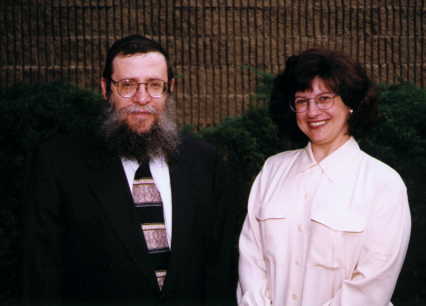
In 1971 (5731 / תשל״א), Rabbi Noson Gurary and his wife, Miriam Gurary, were sent to Buffalo by the Rebbe to establish what would become one of the very first Chabad Houses on a college campus.
Their arrival followed an appeal from members of Buffalo’s Jewish community, who had contacted the Rebbe’s secretariat out of concern for the spiritual well-being of the many Jewish students at the University at Buffalo, a campus then shaken by anti-war protests, bombings and the drug culture. At the same time, Rabbi Gurary had expressed his desire to go on shlichus wherever the Rebbe would send him; Finland and Greece had both been proposed and had fallen through. Buffalo was chosen as their destination. Before they left, Rabbi Gurary asked in yechidus how to answer students who asked about the Vietnam War; the Rebbe told him to say the issues were too complex for him to give an opinion.76
The Gurarys began in their apartment on Amherst Manor Drive and then established the Chabad House of Buffalo at 3292 Main Street, a pagoda-style former Chinese restaurant near the university’s original campus. On September 7, 1971, more than 500 people walked in a candlelight procession with a Sefer Torah under a chuppah to dedicate it. The Spectrum, the student paper, listed the plans: a minyan every morning at 8, tefillin available at all times, a kosher sandwich machine, and weeknight classes in Jewish mysticism and Torah. The same article mentions the Chabad Houses that already existed at UCLA and in Minnesota, placing Buffalo’s among the very first campus Chabad Houses anywhere.77
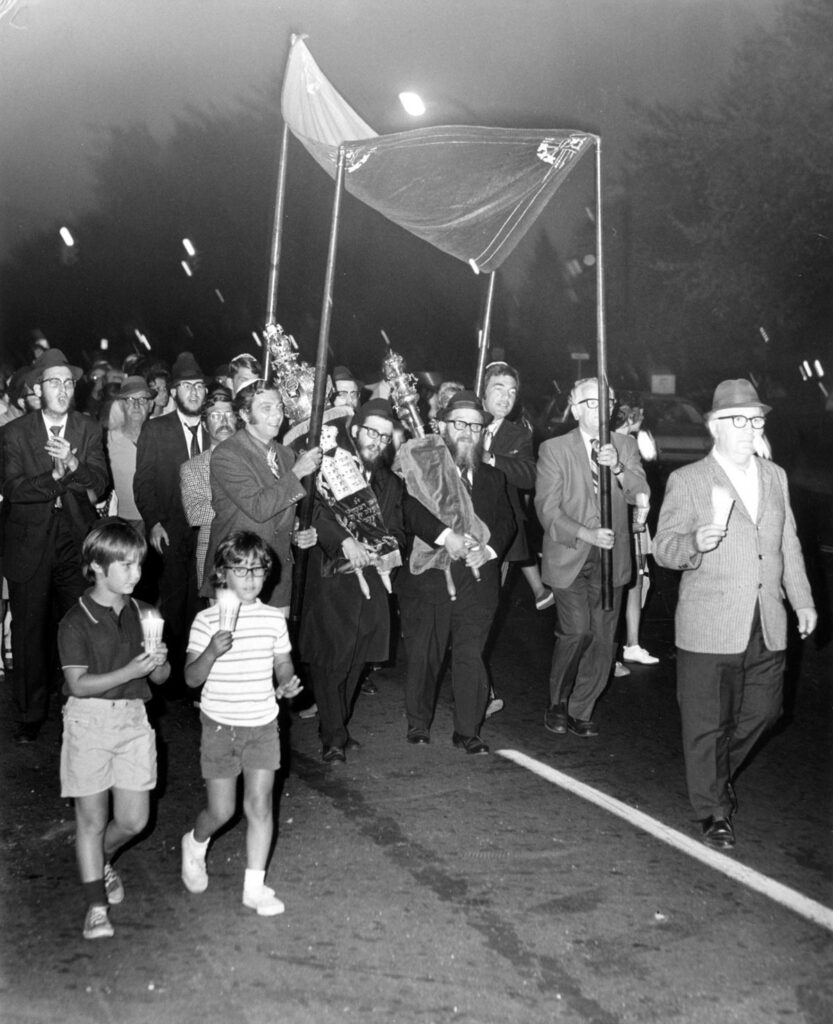
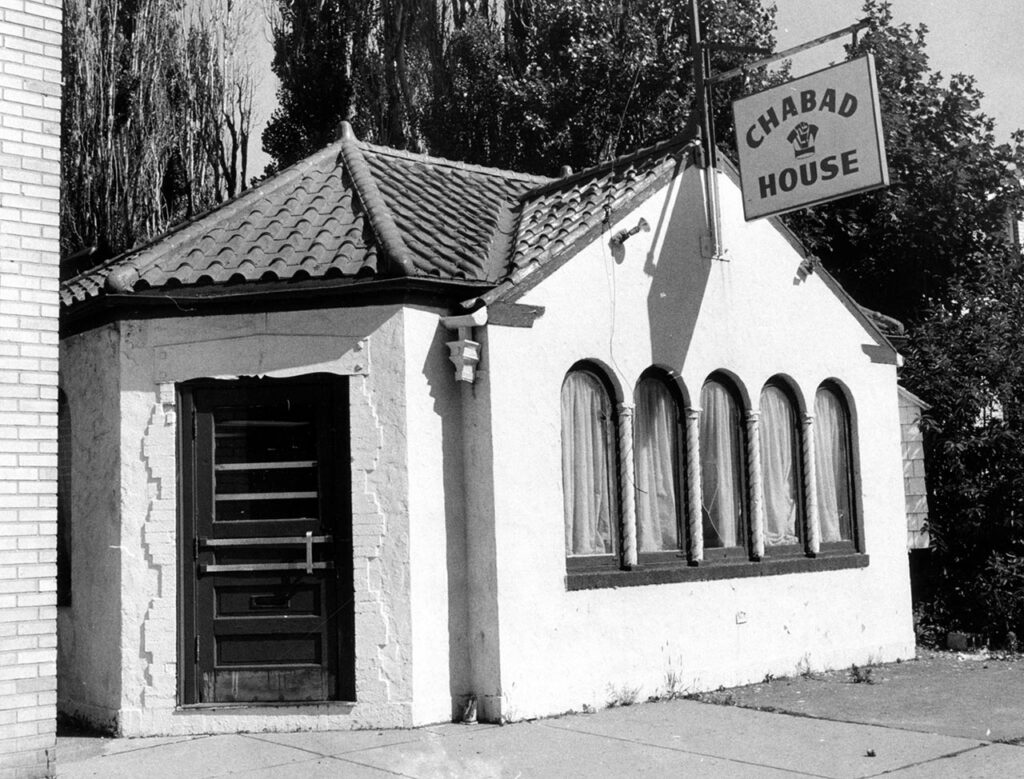
Rabbi Gurary actively reached out to students across campus, while the Chabad House provided Torah classes, Shabbos meals, Yom Tov celebrations and personal guidance, creating a welcoming Jewish home for students from every background. He set up a table in the Student Union with a record player playing Nichoach melodies. His signs became known across campus: “POT for sale,” with “Put On Tefillin” in small letters underneath, and “LSD: Let’s Start Davening.” Instead of asking students whether they were Jewish, he asked, “What’s your Jewish name?” and called each student by it from then on.
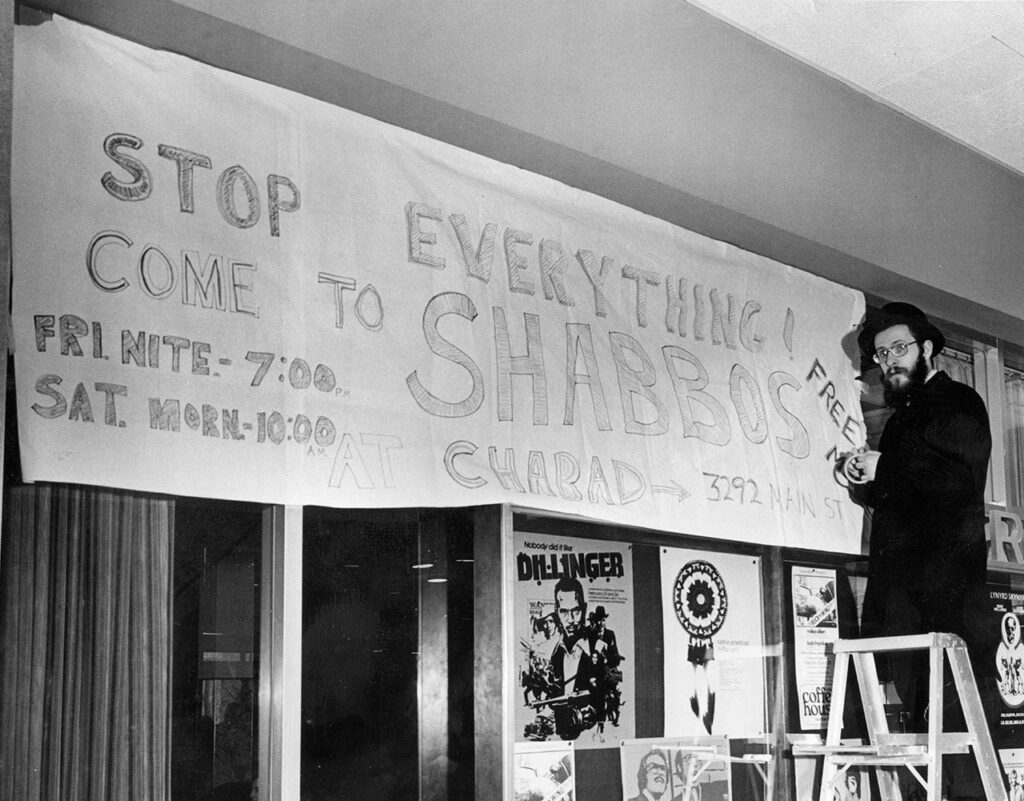
One of the students he reached was Tamar Adelstein, a Buffalo ninth-grader who first came to the Chabad House for hakafos on Simchas Torah. She later remembered “parading around Main Street at midnight with the crowd led by Rabbi Nosson Gurary and Rabbi Heschel Greenberg.” When she wrote to the Rebbe asking what her Jewish name should be, the answer was to choose one from the Chumash. She went to the library, read through an English Chumash, and chose Tamar.78
As Chabad’s activities in Buffalo expanded, between 1972 and 1986 Rabbi Gurary brought approximately ten shluchim to broaden Chabad’s work throughout the city and its universities. Over the years, most of these shluchim eventually moved on from Buffalo. Rabbi Heschel and Lea Greenberg and Rabbi Shmaryahu Charitonow are the only ones from this group who remain in Buffalo today.
Rabbi Heschel and Lea Greenberg
In Buffalo since 1972
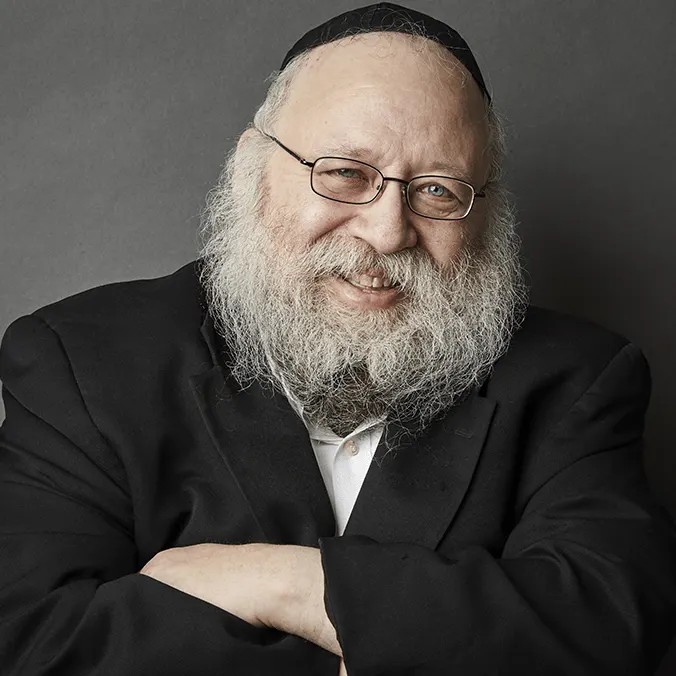
In 1972, Rabbi Heschel and Lea Greenberg joined the Chabad work in Buffalo, with Rabbi Greenberg working alongside Rabbi Gurary in reaching Jewish students at the University at Buffalo and helping expand Chabad’s educational and outreach activities on campus. They arrived on Columbus Day, 1972; before they left New York, the Rebbe told them in yechidus “to go with joy.”79
In 1993, after more than two decades of working as part of the Chabad House of Buffalo, the Greenbergs’ work separated from Rabbi Gurary’s organization. They continued their activities independently through the Jewish Discovery Center. Over the following decades, Rabbi Heschel Greenberg became widely known for his Torah teaching, writing, lectures and the long-running television program Let My People Know.
Today, Rabbi Heschel and Lea Greenberg continue their work through the Jewish Discovery Center in Williamsville. They are joined there by two of their sons and their wives: Rabbi Yehoshua and Brocha Leah Greenberg and Rabbi Levi and Rivky Greenberg.
Rabbi Dovid Sholom and Shulamit Pape
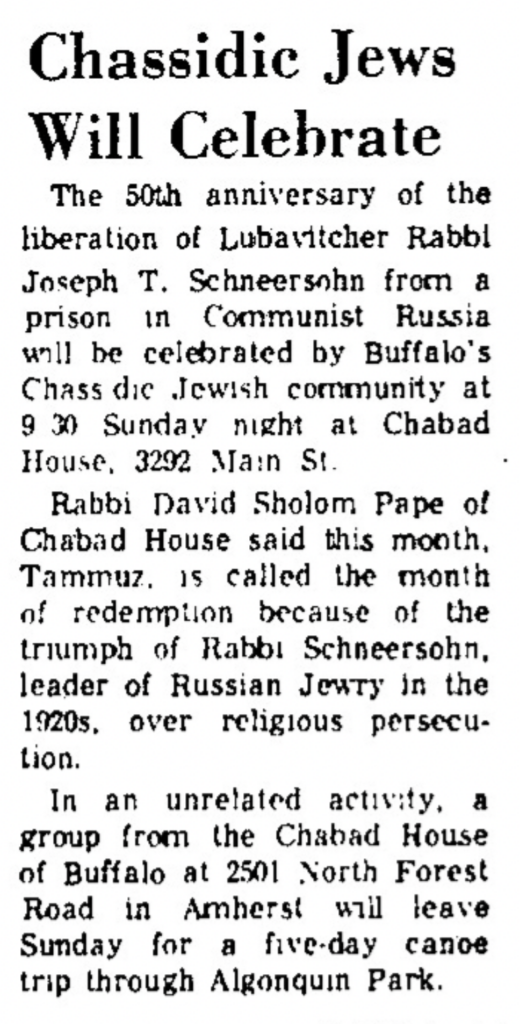
By 1978, Rabbi Dovid Sholom and Shulamit Pape were also serving on shlichus with Chabad in Buffalo, joining the growing team of shluchim working under the Gurarys. That July the Courier-Express quoted Rabbi Pape of the Chabad House on the 50th anniversary of the Previous Rebbe’s liberation from Soviet prison.80 Rabbi Pape was publicly identified at the time with the Chabad House of Buffalo and later became widely known as the longtime editor of The Moshiach Times.
Rabbi Gershon and Sarah Leah Oberlander
In the early 1980s, following their marriage in 1982 and a period of study in kollel, Rabbi Gershon and Sarah Leah Oberlander joined the Buffalo shlichus under Rabbi Noson Gurary, serving and strengthening Chabad’s work in the community. Rabbi Gershon Oberlander served as the campus rabbi at the State University of New York at Buffalo, where he also served as adjunct professor of Jewish studies. They remained in Buffalo until shortly before Pesach 1988, when Rabbi Oberlander left to establish Chabad’s work at Oxford University in England. He later continued his shlichus in London and today serves as a Chabad shliach in Hendon.81
A New Campus in Amherst
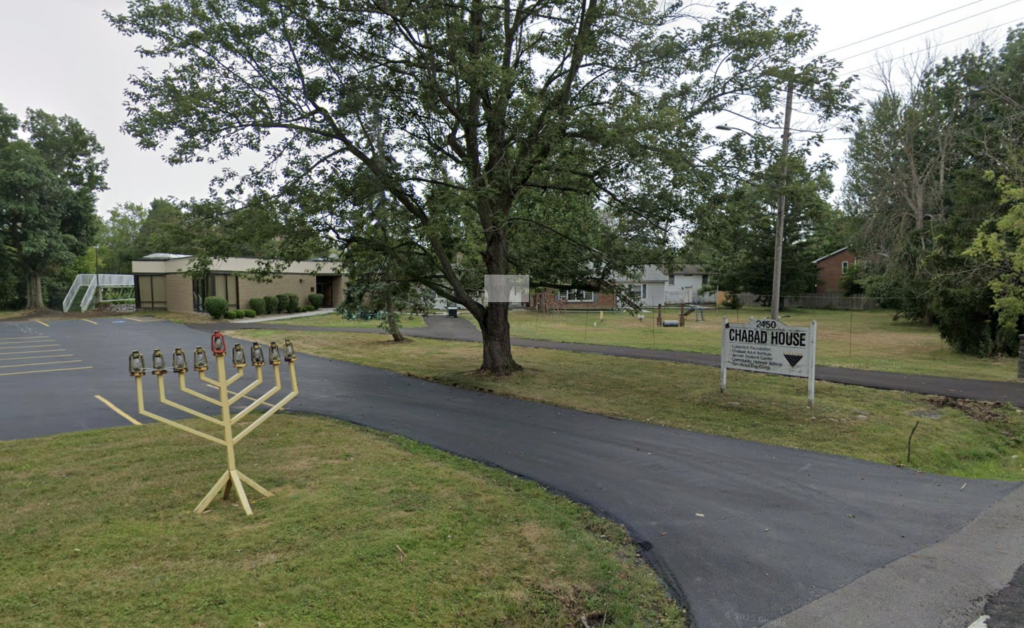
185 Maple Road · 2450 North Forest Road, Getzville
As the University at Buffalo expanded its new campus in Amherst, Chabad established a new center at 185 Maple Road in Amherst. A few short weeks later, on Shabbos, the building had a catastrophic fire. “The entire Chabad House was burnt to the ground,” Rabbi Gurary recalled. “Boruch Hashem everyone was saved.” The Rebbe told him the saying of the Rebbeim that after a fire one becomes rich, and added that the sayings of the Rebbeim can be relied on even when one is not “cramped in a corner.” “Subsequently,” Rabbi Gurary said, “we miraculously found a new location, a much bigger place and much closer to the campus.”82
In November 1975 Chabad purchased the location at 2450 North Forest Road in Getzville, and the center reopened in 1976. The Chabad House was situated immediately adjacent to the university’s North Campus and provided Chabad with a permanent base for serving the growing student population there. Ellicott Creek ran between the campus and the Chabad House; a floating bridge put up by Chabad drew complaints and headlines (“Chabad Went One Bridge Too Far”), and in the end New York State paid for a permanent footbridge, and the university put up a sign directing students to the Chabad House.83 The North Forest Road center became the longtime home of Chabad at the University at Buffalo, hosting student programs, Shabbos and Yom Tov gatherings, Torah classes and other activities.
On the Rebbe’s instruction, Rabbi Noson Gurary taught on campus only for credit. The university accepted his semicha, and he taught accredited university courses in Jewish mysticism, Chassidic philosophy, Jewish law and Chassidic music, bringing Torah and Chassidus directly into the academic life of the university. By his count, more than ten thousand students took his courses over the years.84
From its beginnings in 1971, the Chabad House became the core of Jewish life at the University at Buffalo, influencing generations of Jewish students and establishing Buffalo as an early chapter in the development of the Chabad on Campus movement.
Torah Temimah and Camp Gan Israel
Founded 5736 (1975–76)
Rabbi Noson and Miriam Gurary expanded their work beyond the university with the establishment of Torah Temimah Day School in the mid-1970s, providing Buffalo’s Jewish children with both Jewish and general education. Miriam Gurary served as principal and played a central role in the school’s development. In 2008 Torah Temimah merged with Jewish Heritage Day School to form Ohr Temimim.85
In 1976, Shaina Ebert, later Shaina Charitonow, came to Buffalo to teach at Torah Temimah.86 Rebbetzin Gurary also brought Gittel Lazerson to teach the preschool; Rabbi Gurary introduced her to her husband, the Buffalo native Dr. David Lazerson.87
Chabad’s educational activities continued through the summer with Camp Gan Israel, providing generations of Buffalo children with a Jewish summer camp experience. Today, the camp continues under Rabbi Shmaryahu Charitonow, together with his son and daughter-in-law, Rabbi Sholom Ber and Rochel Charitonow.
Rabbi Shmuel Yosef and Ester Zirkind
Rabbi Shmuel Yosef and Ester Zirkind also came to Buffalo on shlichus and served as teachers in the Chabad school, helping educate and inspire Jewish children and families throughout the community.88
1984: Bais HaKnesset HaGadol–Lubavitch
500 Starin Avenue · purchased July 12, 1984
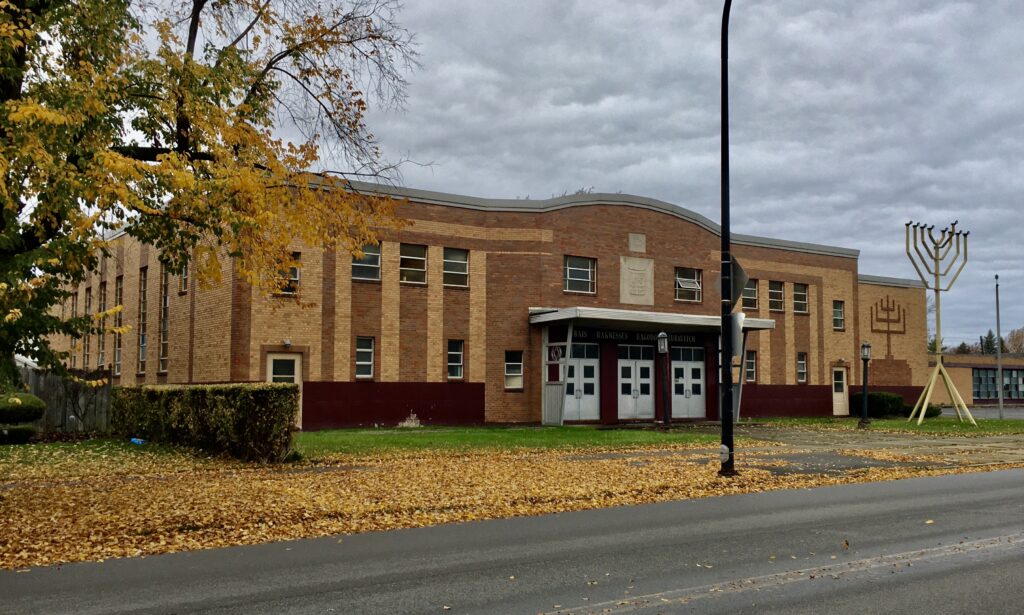
Alongside Chabad’s work at the University at Buffalo and the growth of Torah Temimah, a broader Chabad community in Buffalo developed under the leadership of Rabbi Noson and Miriam Gurary.
On July 12, 1984, Chabad purchased the synagogue building at 500 Starin Avenue from Temple Beth David–Ner Israel. The building became Bais HaKnesset HaGadol–Lubavitch, commonly known as the Chabad Knesset Center, and developed into a center of Chabad communal life in Buffalo, hosting daily minyanim, Shabbos and Yom Tov services, Torah study, farbrengens and communal gatherings.
Rabbi Berel Bell served as a rov at Bais HaKnesset HaGadol–Lubavitch during this time. Today he serves as a member of the Rabbinical Court of Montreal.
1985: The First Siyum HaRambam in the World
2 Nissan 5745 · March 24, 1985 · 500 Starin Avenue
In 1984 the Rebbe called on Jews everywhere to learn the Rambam’s Mishneh Torah daily. The first public celebration of its completion anywhere in the world was held in Buffalo, at the Chabad Knesset Center, on 2 Nissan 5745 (March 24, 1985), the yahrzeit of the Rebbe Rashab. Rabbi Gurary organized it. Rabbi Simcha Elberg of the Agudas HaRabbonim said the final halacha and told the crowd: “This is the first time in history! And who merited this? Buffalo!” Rabbi Moshe Feinstein sent a written blessing through his son-in-law, Rabbi Dr. Moshe Tendler.
The day before, at the farbrengen of Shabbos Vayikra, the Rebbe spoke of the Buffalo siyum, “Fortunate is their lot, and may they be blessed for their alacrity in this matter,” and handed Rabbi Gurary a bottle of mashke for the celebration. The Rebbe edited a sicha for the Chabad House’s commemorative journal, Meginei Melech. When the Rebbe made his own siyum at the farbrengen of 11 Nissan, he read from an enlarged copy of the siyum text that Chabad of Buffalo had printed.89
Rabbi Shmaryahu and Shaina Charitonow
Shluchim from 1986 (5746)
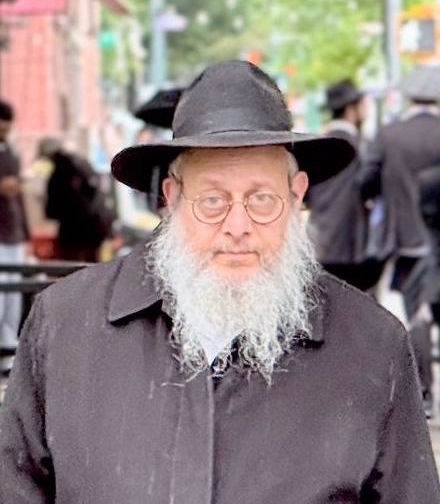
Following their marriage in 1985, Rabbi Shmaryahu and Shaina Charitonow spent a year in Brooklyn before settling in Buffalo in 1986 to continue the Chabad shlichus. A diary kept in 770 records that on Friday, 24 Menachem Av 5746 (August 29, 1986), the Rebbe’s answer came for “ר׳ שמרי׳ חריטאנאוו שנוסע לבאפאלא, אף הוא להיות מחנך בחיידר”, “Shmaryahu Charitonow, who is going to Buffalo, also to be an educator in the cheder.” The Rebbe answered: “אזכיר עה״צ”, “I will mention it at the Ohel.”90
Shaina went on to work closely with Miriam Gurary on community programs, co-direct Camp Gan Israel, oversee the women’s mikvah, and teach for decades. Rebbetzin Shaina Charitonow passed away on 14 Shevat 5773 (January 25, 2013). Rabbi Shmaryahu Charitonow currently serves as the rabbi of the Chabad Knesset Center.
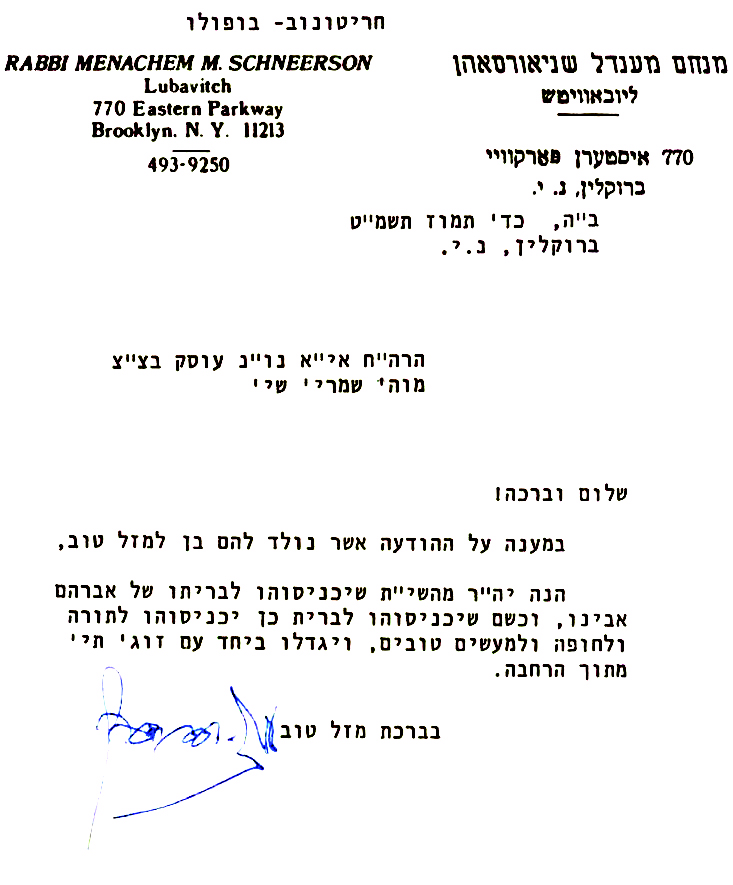
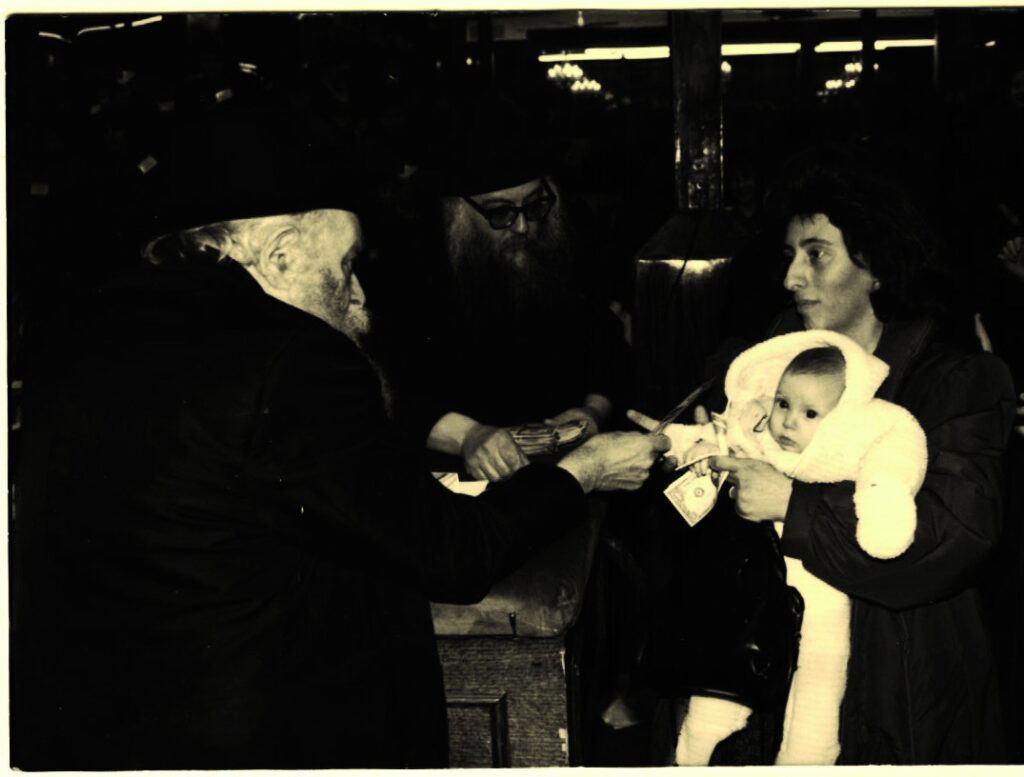
“Charitonow – Buffalo”
Left: the Rebbe’s blessing on the birth of a son, 24 Tammuz 5749 (1989), filed in the Rebbe’s office under “חריטונוב – בופולו”. Right: Rebbetzin Charitonow and her son receive a dollar from the Rebbe, 22 Teves 5752 (1992). From the Charitonow–Sheiman wedding teshura, 5773.
Soviet Jews, a Downtown Menorah and the Noahide Laws
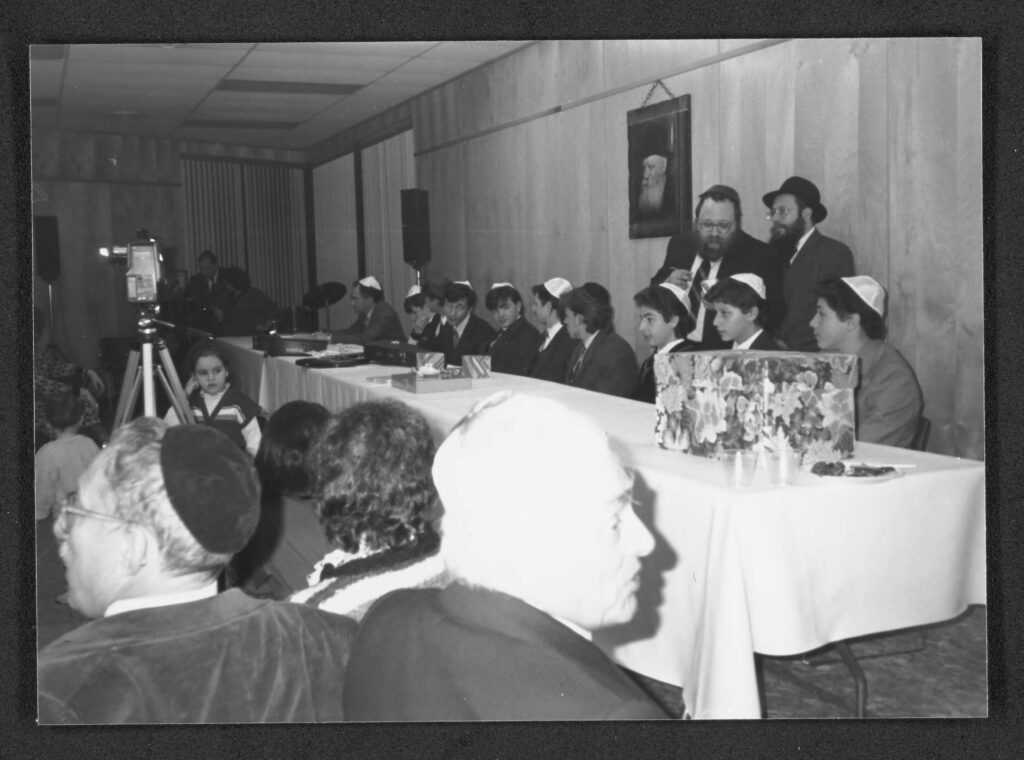
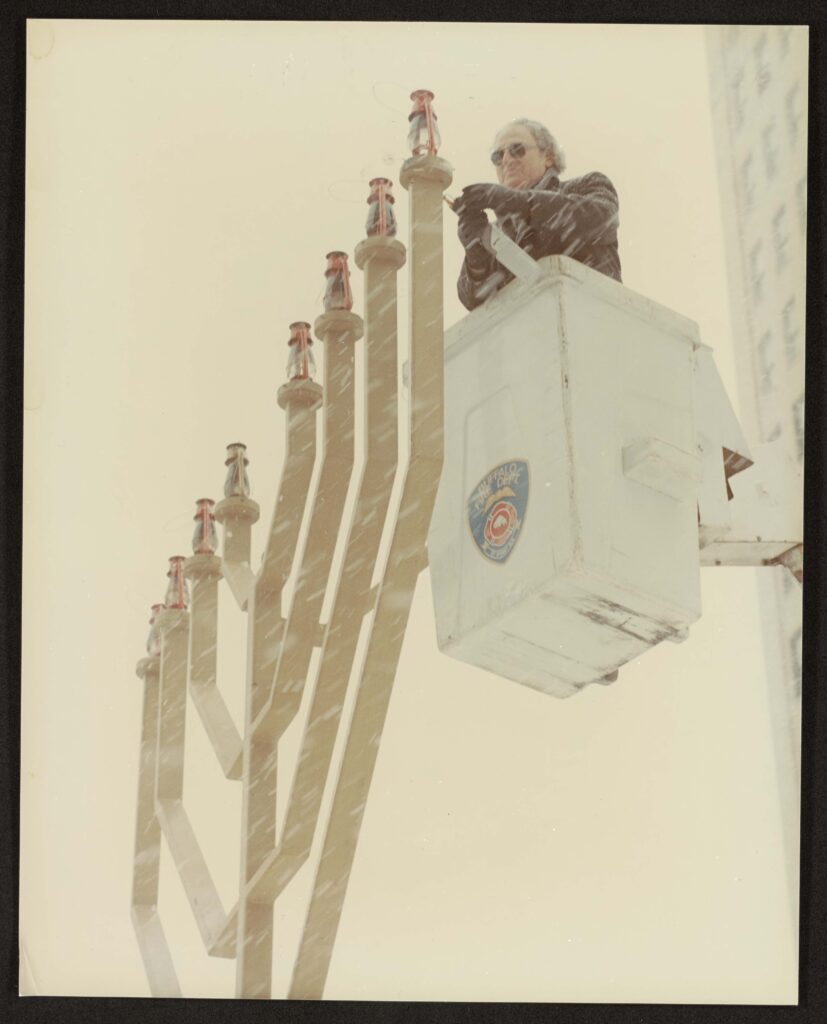
In 1990, Chabad helped the community of former Soviet Jews who had settled in Buffalo hold a community bar mitzvah, with Rabbi Gurary and Rabbi Greenberg taking part.91 Around the same time, Chabad’s public menorah stood in Lafayette Square downtown; one year it was lit by Professor Herbert Hauptman, winner of the 1985 Nobel Prize in Chemistry.92 On September 17, 1987, Buffalo’s congressman Jack Kemp entered remarks in the Congressional Record that began: “Rabbi Noson Gurary of the Chabad Lubavitch House of Western New York reminds me that there is a system of ancient laws, the Noahide laws…”93
The Next Generation at the University at Buffalo
After many years of dedicated service to the Jewish community of Buffalo and Western New York, Rabbi Noson and Miriam Gurary transitioned the leadership of Chabad’s work at the University at Buffalo to the next generation.
Their sons and daughters-in-law, Rabbi Avrohom and Chani Gurary, who joined in 1994, and Rabbi Moshe and Rivka Leah Gurary, who joined in 1999, continued and expanded the work their parents had begun, providing Jewish education, programming, Shabbos and holiday experiences, and community support for students at the university.
Rebbetzin Miriam Gurary passed away on 12 Iyar 5766 (May 10, 2006). Rabbi Noson Gurary later remarried and settled in Monsey, and today lives in Brooklyn.94
1943 and 1981
“Not Alone”
“You Are Not Alone”: The Rebbeim’s Assurance to Buffalo’s Shluchim
Throughout the years, the Rebbe remained personally involved in the Buffalo shlichus.
In 1981, about ten years into his shlichus, Rabbi Gurary faced a particularly difficult period. As the University at Buffalo shifted to its sprawling new Amherst campus, it became increasingly difficult to gather students, and even assembling a minyan on Shabbos and Yom Tov could be a struggle. Having grown up spending Yom Tov among thousands of Chassidim in Crown Heights, Rabbi Gurary later recalled how lonely those days in Buffalo could sometimes feel.
During a yechidus, Rabbi Gurary wrote to the Rebbe about this feeling of loneliness. The Rebbe responded in Yiddish:
„וויבאלד אז דו טוסט די ארבעט פון דעם רבי׳ן דעם שווער, איז ער מיט דיר.”
“Since you are doing the work of the Rebbe, my father-in-law, he is with you.”
„און מיר זיינען אויכעט צוזאמען.”
“And we are also together.”
The Rebbe to Rabbi Noson Gurary, 1981
Rabbi Gurary later recalled that hearing directly from the Rebbe that he was with him, and understood what he was going through, gave him tremendous strength to continue the work. These words became a source of strength and encouragement to Rabbi and Mrs. Gurary as they continued their shlichus in Buffalo.95
Editor’s note: The wording of the Rebbe’s response is especially striking. Rabbi Gurary had never personally received a shlichus from the Previous Rebbe. Yet the Rebbe told him, “Since you are doing the work of the Rebbe, my father-in-law, he is with you.” The Rebbe was thus identifying Rabbi Gurary’s work in Buffalo as a continuation of the shlichus that the Previous Rebbe had established there decades earlier.
This gives added meaning to the Rebbe’s words. In 1943, shortly before Rabbi Hershel Fogelman left for Buffalo, he told the Previous Rebbe that whenever he traveled away he felt alone: “פיל איך זיך עלענט”, “I feel alone.” The Previous Rebbe immediately reassured him: “דו ביסט נישט עלענט, וואו דו טוסט פאר הרבצת תורה בין איך מיט דיר”, “You are not alone. Wherever you work for the strengthening of Torah, I am with you.”96
Nearly forty years later, Rabbi Gurary was carrying forward that same shlichus in Buffalo and expressed the same feeling of loneliness. The Rebbe’s answer appears to make clear that the Previous Rebbe’s assurance to Rabbi Fogelman did not end with Rabbi Fogelman personally. Since Rabbi Gurary was now “doing the work of the Rebbe, my father-in-law,” the Previous Rebbe’s promise, “You are not alone … I am with you,” continued with the shliach carrying on that work in Buffalo.
The Rebbe then added a further dimension: “And we are also together.”
Seen in this light, these words were not only personal assurances to the individual shluchim who first heard them. They were brachos connected to the shlichus itself, a shlichus that continues in Buffalo to this day. Those same brachos, “You are not alone … I am with you” and “And we are also together,” continue to accompany and strengthen the shluchim carrying on the Rebbeim’s work in Buffalo today!
Part four
1995–2026
Chabad in Buffalo Today
Community-focused Chabad, a high-school yeshiva, Chabad Downtown Buffalo, Chabad Young Professionals, and the first Chabad and first Jewish organization in Clarence.
1995: Rabbi Laizer and Chani Labkovski
Shluchim from Adar 5755 (1995)
In Adar of 1995 (5755 / תשנ״ה), Rabbi Laizer and Chani Labkovski moved on shlichus to Buffalo as emissaries of the Lubavitcher Rebbe, Rabbi Menachem Mendel Schneerson, to expand Chabad’s presence and develop a new center focused on serving Jewish individuals and families throughout the broader community.
They established Buffalo’s first community-focused Chabad House, creating a welcoming Jewish center where people of all backgrounds and levels of observance could participate in Jewish life without requiring synagogue membership or affiliation.
Rabbi Laizer and Chani Labkovski initially directed the Jewish Discovery Center alongside Rabbi Heschel and Lea Greenberg. The programming developed by the Labkovskis subsequently continued and expanded under what is today the Center for Jewish Life – Chabad, so named in 2021, while the Greenbergs continued their work through the Jewish Discovery Center.97
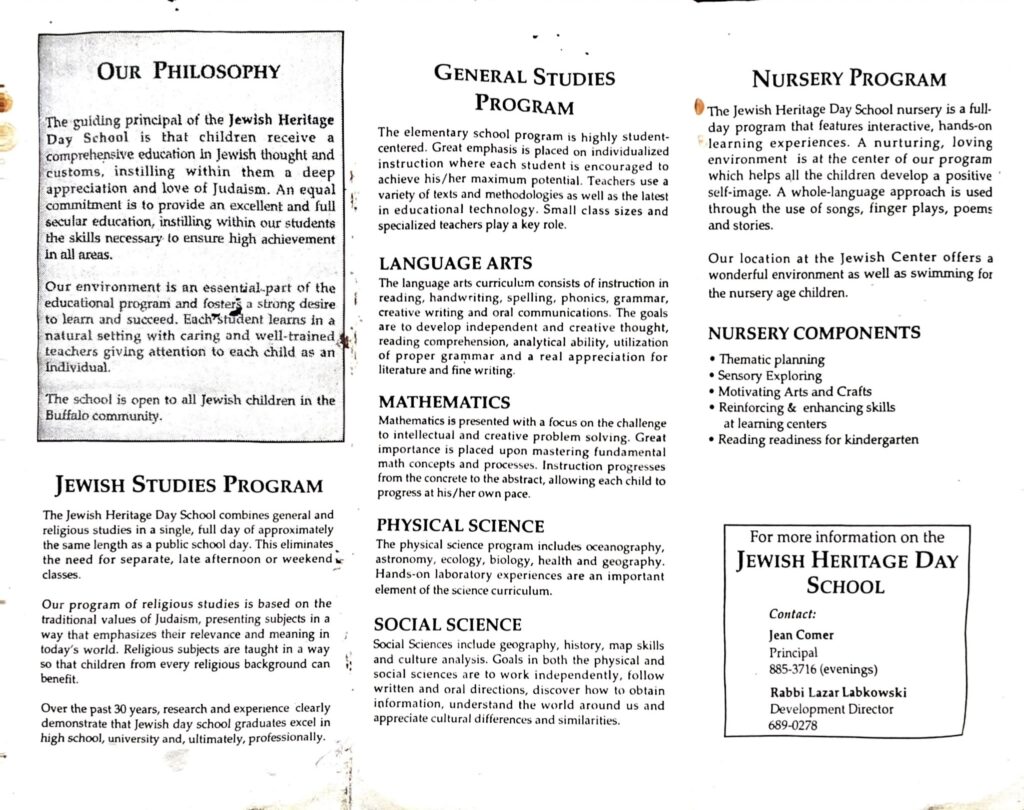
Jewish Heritage Day School
An early promotional flyer for Jewish Heritage Day School, today Ohr Temimim, outlining the school’s educational philosophy and programs. Rabbi Laizer Labkovski is listed as development director.
Rabbi Laizer Labkovski was also instrumental in the inception of Buffalo’s local Chabad school, Jewish Heritage Day School, today known as Ohr Temimim, playing a key role in its establishment and development and serving as development director during its early years. The school moved to John James Audubon Parkway in 2001, merged with Torah Temimah in 2008, and today teaches more than one hundred children.98
Their work grew to include a welcoming synagogue, adult Jewish education through JLI (Jewish Learning Institute) courses, youth and teen programming including CTeen, winter camp, holiday celebrations, family programs and a year-round daycare center.
In 2000 (5760 / תש״ס), Rabbi Laizer and Chani Labkovski purchased 757 Hopkins Road in Williamsville, providing a permanent home for their growing Chabad center and its expanding educational, religious and community activities.
A Hebrew School Open to Every Jewish Child
Among their important educational initiatives was the establishment of Buffalo’s first Hebrew school that did not require synagogue membership. The Hebrew school opened Jewish education to families who might otherwise not have been affiliated with a synagogue, providing children from a wide range of backgrounds with an engaging education in Hebrew, Torah, Jewish holidays, mitzvos, traditions and Jewish values. This approach reflected a central principle of Chabad’s work: that Jewish education and meaningful Jewish experiences should be accessible to every Jewish child, regardless of a family’s background or level of observance.
Kosher Meals on Wheels
Recognizing that strengthening Jewish life also meant caring for the physical needs of members of the community, Rabbi Laizer and Chani established Kosher Meals on Wheels. The program provides kosher meals and personal connection to seniors and homebound individuals, combining practical assistance with companionship and care for members of the Jewish community who might otherwise be isolated.
Through their educational, religious, youth, family and humanitarian initiatives, Rabbi Laizer and Chani helped expand Chabad’s reach to a new generation of Jewish families throughout Buffalo and Western New York.
The Next Generation
Today, Rabbi Laizer and Chani are joined in their shlichus by their sons and daughters-in-law, Rabbi Dovid and Chaya’le Labkowski and Rabbi Nochum and Sora’le Labkowski, continuing and expanding the work begun by their parents in 1995. Together, the family continues to develop Jewish education, community programming, Torah learning, youth activities, holiday celebrations and outreach, carrying the work forward into a new generation.99
1998: Mesivta Menachem of Buffalo
1080 Maple Road, Amherst · purchased October 2, 1998
In 1998, Rabbi Yosef Yitzchok and Devorah Munitz moved with their family from Pittsburgh to Buffalo to establish and run Mesivta Menachem, a Chabad yeshiva for high-school-age bochurim. Rabbi Munitz had previously spent nineteen years in Pittsburgh working in Jewish education before coming to Buffalo to open the new yeshiva.100
The Mesivta purchased 1080 Maple Road in Amherst on October 2, 1998. The yeshiva developed as a small residential Chabad mesivta with an emphasis on Torah learning, Chassidishkeit, personal attention and a warm family atmosphere. Contemporary descriptions emphasized its small size and the individualized relationship between the hanhalah and each student. The bochurim also joined members of the hanhalah and the local Chabad community for Shabbos meals and farbrengens.
Rabbi Yosef Yitzchok Munitz served as the rosh yeshiva. His son Rabbi Mendel Munitz taught in the yeshiva, developed its Yahadus Sheli curriculum, and later became involved in the Mesivta’s management. His son Rabbi Yisroel Meir Munitz served as director and maggid shiur. Rabbi Yehuda Lorber, a son-in-law of Rabbi Yosef Yitzchok Munitz, later joined the Mesivta.
As the Mesivta grew, it acquired a separate dormitory at 642 Hopkins Road in Amherst, where many of the out-of-town bochurim lived. The dormitory became part of the Mesivta’s residential program and was used through the following years.
Alongside its regular yeshiva studies, Mesivta Menachem introduced several practical educational programs. In 2011, the bochurim took part in a practical-finance course covering banking, budgeting, credit cards, savings and investments, identity theft and maaser. The school also held workshops on positive thinking and social skills. Its Yahadus Sheli program included study of the Rebbe’s directives concerning mashke together with education about alcohol and its effects. The Mesivta also brought talmidim shluchim to Buffalo, who took part in the learning and activities of the yeshiva and in the broader Buffalo Chabad community.101
Mesivta Menachem remained an active part of Buffalo’s Chabad educational landscape for many years before eventually closing. Members of the Munitz family continued their educational and communal work in Buffalo, with much of it later centered on Ohr Temimim School and other local Chabad institutions. Rabbi Mendel Munitz became head of the boys’ division at Ohr Temimim together with Rabbi Yisroel Meir Munitz, Rabbi Yehuda Lorber joined its faculty and runs Chayolei Tzivos Hashem, and Rabbi Yosef Yitzchok Munitz continued as a mashpia and educator in the Buffalo community.102
Menorahs and Chabad Across Western New York
Chabad’s Chanukah menorahs became part of the city’s calendar. The Chabad House of Buffalo’s giant menorah, more than 25 feet tall, has been lit in Buffalo for over forty years.103 Since 2016 the Chabad House has led a parade of cars with menorahs on their roofs from North Buffalo to the menorah lighting at Canalside.104
Chabad also spread across Western New York. In the summer of 2001 Rabbi Zalman and Esther Wilenkin, she a daughter of Buffalo shluchim, founded Chabad at Chautauqua.105 In 2024 Rabbi Yehuda and Yehudis Lorber, who had worked in Jewish education in Buffalo, formally opened Chabad of Niagara Falls USA; their sukkah at Terrapin Point drew more than 3,000 visitors.106
2021: Chabad Downtown Buffalo, A New Chapter in Buffalo’s Jewish Renaissance
Chabad Center for Jewish Life of Buffalo · 409 Franklin Street · founded 5781 (2021)
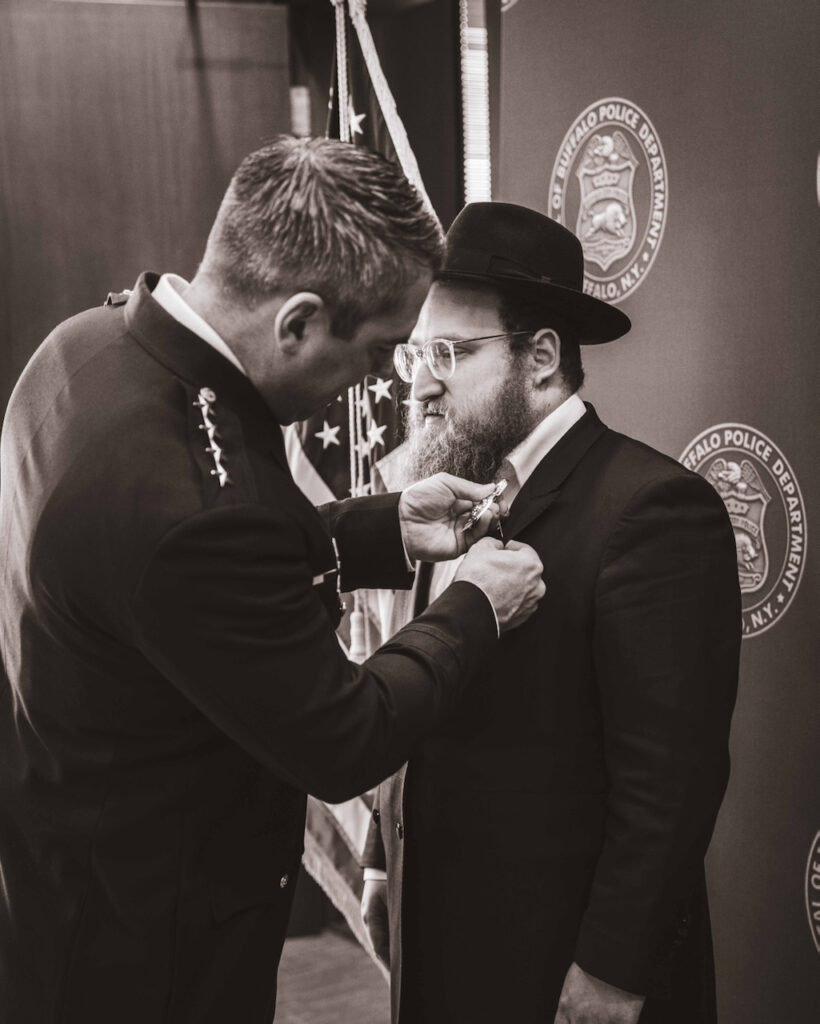
The Chabad Center for Jewish Life of Buffalo, also known as Chabad Downtown Buffalo, was established in 2021 (5781 / תשפ״א), when Rabbi Mendy and Chaya Mushka Labkowski moved on shlichus to Buffalo as emissaries of the Lubavitcher Rebbe, Rabbi Menachem Mendel Schneerson, representing the next stage in Chabad’s 130-year legacy in Western New York.107
The Center serves as a hub for Jewish engagement, education and outreach, reaching individuals and families across Elmwood Village, Bryant, Allentown, Downtown and North Buffalo. In November 2021 it lit a nine-foot menorah in Niagara Square as part of a community-wide Chanukah celebration, and since 2022 it has held an annual public menorah lighting on Elmwood Avenue.108 In October 2023, after the attacks of October 7, Rabbi Labkowski organized the “Western New York Stands with Israel” rally in Niagara Square.109
Chabad Young Professionals (CYP) of Buffalo
Rabbi Mendy and Chaya Mushka Labkowski also founded Chabad Young Professionals (CYP) of Buffalo, creating a community for Jewish adults in their 20s and 30s to connect with one another, study Torah, celebrate Jewish life and build meaningful relationships within the Jewish community.
According to our research and local community studies, Buffalo’s Jewish population is estimated at approximately 25,000 in 2026.110 As the City of Buffalo, and especially its downtown area, experiences a cultural and economic renaissance, Chabad Downtown Buffalo is proud to serve this growing and revitalized community.
Guided by the Rebbe’s vision of Ahavas Yisrael, unconditional love for every Jew, the Center provides Torah study, Shabbos and holiday experiences, youth programs, community service and spiritual guidance, while also supporting the material and emotional needs of members of the community.
Through these initiatives, Chabad Downtown Buffalo and the Chabad Center for Jewish Life of Buffalo continue the long history of Chabad-Lubavitch in the city, honoring the generations of shluchim, educators and community leaders who came before while embracing the opportunities of the 21st century and ensuring that the light of Judaism continues to illuminate Buffalo for generations to come.
2026: The First Chabad and First Jewish Organization in Clarence
Rabbi Yossi and Chayale Labkowski · 5786 (2026)
As Jewish families moved further out from the city, through Amherst and Williamsville and now into Clarence, Chabad followed. In 2026, Rabbi Yossi and Chayale Labkowski opened the first Chabad in Clarence, New York, at 8825 Sheridan Drive. It is not only the first Chabad in the town but the first Jewish organization of any kind in Clarence, giving the town’s Jewish families a place for Shabbos, holidays, Torah study and Jewish community close to home.111
More than 130 years after five trustees signed the incorporation papers of the Lubavitz Synagogue, Chabad in Buffalo includes a campus Chabad House, a community shul, a day school, a summer camp, and Chabad centers in Williamsville, Amherst, Downtown Buffalo and Clarence.
Reference
Addresses
Chabad Addresses in Buffalo, 1890–2026
The buildings that housed Chabad shuls, schools and Chabad Houses, in order.
| 1911–1949 | 115–117 Pratt Street, Buffalo Anshe Lubavitz, the Lubavitz Synagogue (“Pratt Street Shul”) |
| 1943–1950s | 42 Butler Avenue, Buffalo Yeshivas Achei Tmimim Lubavitch, donated by Mrs. Rose Greenberg |
| 1944 | 833 Fillmore Avenue, Buffalo Ahavas Achim, Rabbi Hershel Fogelman, rav |
| 1945–1948 | 5 Lovering Avenue, Buffalo Second yeshiva building, Yeshivos Tomchei Tmimim Lubavitz, Inc. |
| 1951 | 345 Tacoma Avenue, Buffalo Ahavas Achim–Lubavitch, after the merger |
| 1955–today | 85 Saranac Avenue, Buffalo Yeshiva Achei Tmimim of Buffalo; today Congregation Achei Tmimim, the Saranac Synagogue |
| 1957 | 1248 Kenmore Avenue, Kenmore Kenmore Mikvah, led by Rebbetzin Devorah Groner |
| 1971–1990s | 3292 Main Street, Buffalo Chabad House of Buffalo, dedicated September 7, 1971 |
| 1975 | 185 Maple Road, Amherst First Amherst Chabad House, destroyed by fire weeks after opening |
| 1975–today | 2450 North Forest Road, Getzville Chabad House at UB’s North Campus, opened 1976 |
| 1984–today | 500 Starin Avenue, Buffalo Bais HaKnesset HaGadol–Lubavitch, the Chabad Knesset Center |
| 1998 | 1080 Maple Road, Amherst Mesivta Menachem; dormitory at 642 Hopkins Road |
| 2000 | 757 Hopkins Road, Williamsville Center for Jewish Life, Rabbi Laizer and Chani Labkovski |
| 2021–today | 409 Franklin Street, Downtown Buffalo Chabad Center for Jewish Life of Buffalo · Chabad Downtown Buffalo · Chabad Young Professionals (CYP) of Buffalo |
| 2026 | 8825 Sheridan Drive, Clarence The first Chabad in Clarence, Rabbi Yossi and Chayale Labkowski |
Reference
Chronology
A Chronology of Chabad in Buffalo
| 1880s | Lubavitch families meet for prayer in homes on Buffalo’s East Side. |
| Jul 11, 1890 | The Lubavitz Synagogue is incorporated. |
| 1903 | Reb Menachem Mendel Leib Gilden leaves Russia for America and settles in Buffalo. |
| 1911 | The synagogue at 115–117 Pratt Street is built. |
| Oct 21, 1928 | The Previous Rebbe writes from Riga to Rabbi Chaim Davidovich about Jewish education in Buffalo. |
| May 2, 1933 | Rabbi Yehoshua Halevi Zambrowsky arrives as Chief Rabbi and rav of Anshe Lubavitz. |
| Aug 20, 1942 | The Previous Rebbe congratulates Rabbi Dov Berish Zuckerman on accepting the rabbinate of Anshe Lubavitz. |
| Summer 1943 | Yeshivas Achei Tmimim opens under Rabbi Hershel Fogelman; 42 Butler Avenue follows. |
| Oct 1944 | Beis Rivkah school for girls opens. |
| 1946 | Rabbi Dovid Edelman succeeds Rabbi Fogelman. |
| 1948 | Rabbi Yitzchok Dovid and Devorah Groner arrive. |
| 1949 | The Pratt Street building is sold; the congregation merges with Ahavas Achim. |
| Sep 5, 1951 | The Rebbe’s letters on keeping the mechitzah at Ahavas Achim–Lubavitch. |
| Aug 4, 1957 | The Kenmore Mikvah opens. |
| 1954–1959 | Rabbi Hershel Slansky; the yeshiva closes after he leaves. |
| 1960 | At the Rebbe’s request, Rabbi Mottel Zajac reopens the yeshiva. |
| Sep 7, 1971 | The Chabad House of Buffalo is dedicated at 3292 Main Street. |
| 1972 | Rabbi Heschel and Lea Greenberg arrive. |
| 1975–76 | Torah Temimah Day School opens; 2450 North Forest Road is bought. |
| Jul 12, 1984 | 500 Starin Avenue becomes Bais HaKnesset HaGadol–Lubavitch. |
| Mar 24, 1985 | The world’s first public Siyum HaRambam is held at 500 Starin Avenue. |
| Aug 29, 1986 | The Rebbe’s answer to Rabbi Shmaryahu Charitonow, going to Buffalo. |
| 1995 | Rabbi Laizer and Chani Labkovski arrive. |
| 1998 | Mesivta Menachem opens in Amherst. |
| 2001 | Chabad at Chautauqua is founded. |
| 2008 | Torah Temimah and Jewish Heritage Day School merge as Ohr Temimim. |
| 2016 | The Chabad House’s menorah car parade to Canalside begins. |
| 2021 | Chabad Downtown Buffalo is founded by Rabbi Mendy and Chaya Mushka Labkowski, who also found Chabad Young Professionals (CYP) of Buffalo. |
| 2024 | Chabad of Niagara Falls USA opens. |
| 2026 | Rabbi Yossi and Chayale Labkowski open the first Chabad in Clarence. |
Help Preserve This History
This page grows as people share what they have. If you have photographs, letters, documents, memories or corrections, please be in touch.
Questions
FAQ: Chabad History in Buffalo and the Local Community
What is Chabad Buffalo?
Chabad-Lubavitch in Buffalo is a center for Jewish outreach, education and community programs. Chabad-Lubavitch has had a presence in Buffalo for more than 130 years, beginning with The Lubavitz Synagogue in the 1880s. Today, multiple Chabad institutions serve the Buffalo Jewish community, including the Chabad Center for Jewish Life of Buffalo, also known as Chabad Downtown Buffalo, under Rabbi Mendy and Chaya Mushka Labkowski.
What is the history of Chabad in Buffalo?
Lubavitch families were praying together in Buffalo by the 1880s and incorporated the Lubavitz Synagogue (Anshe Lubavitz) in 1890; its shul at 115–117 Pratt Street was built in 1911. The Previous Rebbe sent shluchim to open Yeshivas Achei Tmimim in 1943, and the Rebbe sent Rabbi Noson and Miriam Gurary to open the Chabad House of Buffalo in 1971, one of the first campus Chabad Houses in the world.
What was Anshe Lubavitz?
Anshe Lubavitz, legally The Lubavitz Synagogue, was Buffalo’s first Chabad congregation. Its synagogue at 115–117 Pratt Street on the East Side was known as the Pratt Street Shul or the Lubavitcher Shul. It was sold in 1949 and the congregation merged with Ahavas Achim.
Where was the first Chabad House in Buffalo?
The Chabad House of Buffalo opened at 3292 Main Street, near the University at Buffalo’s original campus, and was dedicated on September 7, 1971. Chabad at UB later moved to 2450 North Forest Road in Getzville, beside the North Campus.
Where is the Chabad Center for Jewish Life in Buffalo located?
The Chabad Center for Jewish Life is located at 409 Franklin Street in Downtown Buffalo, NY. It serves individuals and families across Elmwood Village, Bryant, Allentown, Downtown and North Buffalo, offering a range of Jewish programs and community services.
Is there a Chabad for young professionals in Buffalo?
Yes. Chabad Young Professionals (CYP) of Buffalo, founded by Rabbi Mendy and Chaya Mushka Labkowski of the Chabad Center for Jewish Life, is a community for Jewish adults in their 20s and 30s, with Torah study, Shabbos and holiday events and social programs. See CYPBuffalo.com.
What programs does Chabad Buffalo offer for teens?
Chabad Buffalo runs CTeen, a youth program for Jewish teens, as well as Hebrew school classes. These programs focus on Torah education, leadership development, and a welcoming environment for Jewish teens to engage with their heritage.
Does Chabad Buffalo offer adult education?
Yes. Chabad offers adult Jewish education, including JLI courses, Torah study sessions, and classes on Jewish holidays and traditions, open to all adults looking to deepen their knowledge of and connection to Judaism.
Does Chabad Buffalo provide community services?
Yes. Chabad Buffalo is committed to outreach and community support, including Kosher Meals on Wheels, holiday programs, family services and spiritual guidance for individuals and families in the Buffalo Jewish community.
How many Jews live in the greater Buffalo community?
According to our research and local Jewish community studies, the Buffalo Jewish population is approximately 25,000 people.
Is there a Chabad in Clarence, NY?
Yes. In 2026 Rabbi Yossi and Chayale Labkowski opened the first Chabad, and the first Jewish organization, in Clarence, at 8825 Sheridan Drive.
How is Buffalo experiencing a renaissance?
Buffalo, especially its downtown area, is undergoing a cultural, economic and community renaissance. The Chabad Center for Jewish Life is proud to be part of this renewed energy, fostering Jewish life and connection in the region.
How can I contribute to this history?
Email history@chabadbuffalo.com or call, text or WhatsApp 716-545-6806 with photographs, documents, memories or corrections.
Buffalo Jewish History
More from Buffalo Jewish History
Chabad in Buffalo
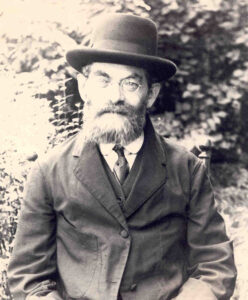 Shochet, mohel and chazzan · in Buffalo 1903–1933Reb Menachem Mendel Leib Gilden
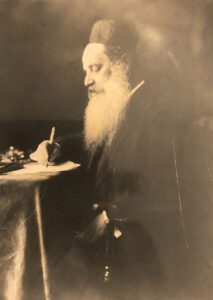 Rav of Anshe Lubavitz and Chief Rabbi · 1933–1939Rabbi Yehoshua Halevi Zambrowsky
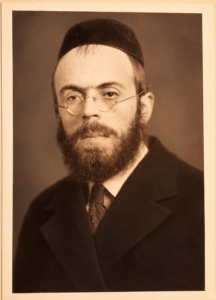 Rav of Anshe Lubavitz and Chief Rabbi · from 1942Rabbi Dov Ber (Berish) Zuckerman
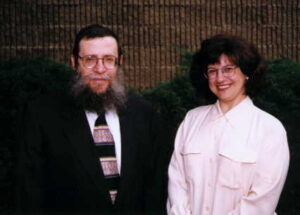 Founder of the Chabad House of Buffalo · from 1971Rabbi Noson Gurary
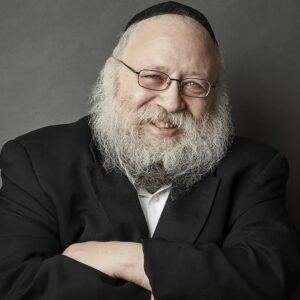 Shliach to Buffalo · since 1972Rabbi Heschel Greenberg
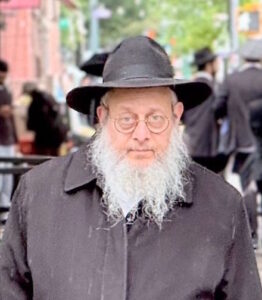 Rav of the Chabad Knesset Center · since 1986Rabbi Shmaryahu Charitonow
Tzaddikim, Rabbanim and Chazzanim of Buffalo
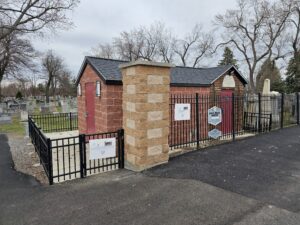 The Buffalo Rebbe · tzion and visitors informationHarav Eliyahu Yosef Rabinowitz
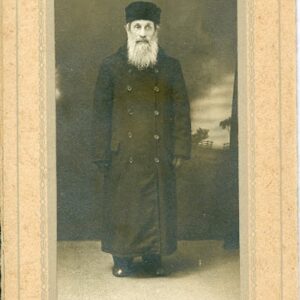 Chazzan of Bris Shalom · 1848–1925Rabbi Yehoshua Heschel Singer
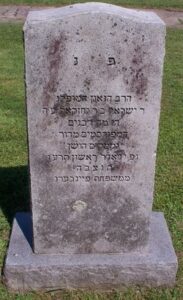 Rav of Beth JacobRabbi Yisroel Feinberg
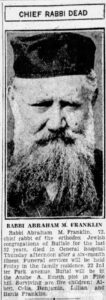 Chief Rabbi of Buffalo · 1862/63–1932Rabbi Avraham Meir Franklin
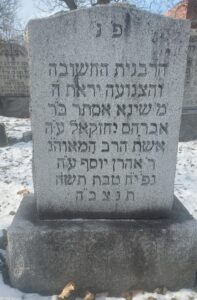 Torah scholar and educatorRabbi Aaron Yosef Bloch
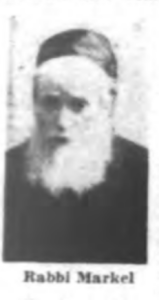 Rav of Bris Shalom · 1877–1947Rabbi Nissan Markel
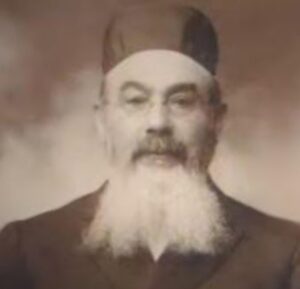 Rav of Bris ShalomRabbi Simcha Paltrovich
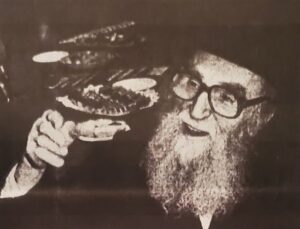 Rav in Buffalo · 1927–1945Rabbi Chaim Davidovich
Notes
Sources and Notes
Primary sources are cited wherever they exist. Tap ↩ to return to the place in the text.
- Nusach Ari. The prayer rite based on the teachings of Rabbi Yitzchak Luria (the Arizal), as arranged for Chabad by Rabbi Schneur Zalman of Liadi, the Alter Rebbe. A “Nusach Ari synagogue” is one whose services follow this Chassidic rite rather than the standard Ashkenazic liturgy. See Chabad.org, “The Siddur”. ↩︎
- Erie County Clerk’s Office, Incorporation Records, Liber 44, p. 66: Certificate of Incorporation of The Lubavitz Synagogue, recorded July 11, 1890. The handwritten certificate gives Buffalo as the congregation’s place of business and names its first five trustees as Louis Bernstein, Israel Slater, Peter Rakin, Gusin Dickman and Israel Barkan. Its stated purposes were religious worship, charitable and benevolent work, and the maintenance of a Sabbath school. Original research, Chabad Buffalo. ↩︎
- Erie County Clerk’s Office, Corporation Records, Corporation Box 10550: the 1949 New York State Supreme Court petition and order authorizing the Lubavitz Synagogue to sell its property, which describes it as “115–17 Pratt Street, Buffalo, N.Y.” Adler and Connolly (below) also give 115 Pratt Street. Some later secondary sources give 113 Pratt Street; the court record is followed here. Original research, Chabad Buffalo. ↩︎
- Selig Adler and Thomas E. Connolly, From Ararat to Suburbia: The History of the Jewish Community of Buffalo (Philadelphia: Jewish Publication Society of America, 1960), p. 195. The authors record that the congregation built its Pratt Street synagogue in 1911 at a reported cost of $30,000, seating about 650; that in 1917 it operated on a budget of $700; and that six years later it had about 140 members and spent about $5,000 a year. ↩︎
- JewishGen Online Worldwide Burial Registry, Lubavitz Congregation Cemetery, Pine Ridge Road, Cheektowaga (USA-02824): 792 burials recorded. ↩︎
- Adler and Connolly, From Ararat to Suburbia, p. 195; gravestone of Jacob and Devorah (Dora) Rosokoff, Lubavitz Congregation Cemetery (Dora 1860–1924; Jacob 1858–1940). Rosokoff was also a jeweler and an early figure in Buffalo’s motion-picture business: in 1904 he and his sons opened a penny arcade at 1021 Broadway, later a nickelodeon, and he afterwards opened one of the first movie houses in Lackawanna. During the Panic of 1907 he ran his own bread line there, handing out up to 200 loaves a day. ↩︎
- Mendel Gilden, “The Diary of my trip to the United States,” beginning 10 Av 5663 (August 3, 1903); Yiddish original and English translation (March 2001), family copy: Yiddish · English. The diary records his route through Danzig, Libau, Copenhagen, Hull and Liverpool. Some secondary sources give 1902 for his arrival in Buffalo; his own diary shows he left Russia in August 1903. ↩︎
- Dr. David L. Frey, “Daharoa Beshincovichi: The Road to Beshincovichi,” Belarus SIG Online Newsletter 3 (May 1999), JewishGen. Frey, a descendant, identifies Rabbi Avram Yisroel Gildensohn as a Chassidic rabbi of Beshenkovichi and Rev. Menachem Mendel Gildin of Buffalo as his son, and records that the family kept Yiddish letters the father wrote to his son in Buffalo. ↩︎
- Rabbi Yosef Yitzchak Schneersohn, diary entry of 14 Sivan 5662 (June 19, 1902), “The Schoolteachers of Beshenkovitz”: the two teachers, Reb Peretz and Reb Menachem Mendel, were making their thirty-third annual Shavuos journey to Lubavitch. (This Reb Menachem Mendel was not Reb Mendel Gilden.) On the town’s five synagogues in 1896, two of them Lubavitch, see Mishpoha, “Legends and Facts of Beshenkovichi”. ↩︎
- Mendel Gilden, “The Diary of my trip to the United States,” beginning 10 Av 5663 (August 3, 1903); Yiddish original and English translation (March 2001), family copy: Yiddish · English. The diary records his route through Danzig, Libau, Copenhagen, Hull and Liverpool. Some secondary sources give 1902 for his arrival in Buffalo; his own diary shows he left Russia in August 1903. ↩︎
- Adler and Connolly, From Ararat to Suburbia, p. 195, write that Gilden “served the Lubavitz Shul on and off for many years until he moved uptown.” The National Register of Historic Places nomination for Ahavas Achim Cemetery (NYS Historic Preservation Office, 2025) identifies Cantor Mendel Gilden with the Pratt Street synagogue. ↩︎
- Deed of the Lubavitz Synagogue, April 1917, conveying part of the congregation’s cemetery plot, signed by Jacob Rosokoff as president and Mendel Gilden as secretary. Copy in the collection of Chabad Buffalo. Original research. ↩︎
- Chernoff family, Gilden Family History (Jacob H. Gilden, born October 16, 1891, married Anna Sernoffsky June 29, 1919; 1920 census, 569 Auburn Avenue, student of dentistry); Frey, “The Road to Beshincovichi” (his Jewish name, Zvi Hersch). ↩︎
- Buffalo & Erie County Public Library, “Births, Deaths, and Marriages Found in Select Buffalo and Erie County Publications”: “Gilden, Mendel L.,” date of death November 10, 1933; gravestones of Reb Menachem Mendel Leib and Baila (Bertha) Gilden, Lubavitz Congregation Cemetery. ↩︎
- Jewish Telegraphic Agency, April 20, 1933 and April 30, 1933; “Orthodox Jews Welcome Rabbi: New Leader Arrives Here to Preside Over Local District,” Buffalo newspaper, May 3, 1933. The May 3 report says he arrived the previous day at the invitation of the Buffalo Council of Jewish Congregations, “nine synagogues and three temples.” ↩︎
- Adler and Connolly, From Ararat to Suburbia, p. 195: Cantor Perez Freedman began officiating at Anshe Lubavitz in 1923 and continued until the congregation left Pratt Street. ↩︎
- Rabbi Yosef Yitzchak Schneersohn, Igros Kodesh, vol. 16, letter 5970 (Riga, 7 Marcheshvan 5689 / October 21, 1928), answering Rabbi Davidovich’s letter of 11 Elul 5688: כי ענין החנוך הדתי בכל מדינה שתהי׳ נוגע הוא בנפשי; עצתי נאמנה אשר יתפשר עם המשמאילים באופן כזה, אשר בעניני החנוך הדתי תהי׳ הדעה שלו מחוייבת; and letter 6052 (18 Teves 5689 / December 31, 1928). The editors identify the recipient as “Chaim Davidovich, Buffalo.” See also Rabbi Chaim Davidovich. ↩︎
- Louis Silverstein, “Buffalo’s Last Shochet Describes Jewish Community Since 1920’s,” Buffalo Jewish Review Supplement, July 9, 1976, p. 2: “The Lubavitch Shule on Pratt Street had Rabbi Joshua Zambrowsky.” Silverstein lived in Buffalo from 1923. ↩︎
- Jewish Telegraphic Agency, April 20, 1933 and April 30, 1933; “Orthodox Jews Welcome Rabbi: New Leader Arrives Here to Preside Over Local District,” Buffalo newspaper, May 3, 1933. The May 3 report says he arrived the previous day at the invitation of the Buffalo Council of Jewish Congregations, “nine synagogues and three temples.” ↩︎
- Jewish Telegraphic Agency, “Funeral Services for Chief Rabbi of Buffalo,” November 9, 1932; gravestone of Rabbi Avraham Meir Franklin, אב״ד דבאפאלי. See Rabbi Avraham Meir Franklin. ↩︎
- “Orthodox Jews Welcome Rabbi,” May 3, 1933 (kosher slaughtering at the Jacob Dold Packing Company); Jewish Telegraphic Agency, “Kashruth Position for Rabbi Zambrowsky,” July 20, 1933 (inspector, New York State Department of Agriculture and Markets; executive board, Union of Orthodox Rabbis). ↩︎
- Gravestone of Rabbi Yehoshua Halevi Zambrowsky, Lubavitz Congregation Cemetery, Cheektowaga: הרב אב״ד דבאפפאלא ומלפנים מ״ץ דווארשא · יהושע ב״ר ישראל יצחק הלוי זאמבראסקי · מחבר ספר חמדת יהושע · נפטר י״א אלול תרצ״ט. See Rabbi Yehoshua Halevi Zambrowsky. ↩︎
- Rabbi Shalom DovBer Levin, Toldos Chabad B’Artzos HaBris, 5660–5710 (Kehot, 1988), pp. 124–125 (page scan): a partial, undated list of 48 Chabad synagogues, no. 15 בופאלא אנשי ליובאוויטש, in the context of Agudas Chassidei Chabad’s registration of Nusach Ari shuls in its Chabad Bulletin (from Marcheshvan 5696, autumn 1935). ↩︎
- Rabbi Hershel Fogelman, “Stories and Memories,” in Memento from the Wedding of Rabbi Mendel & Mushkie Fogelman, 2 Marcheshvan 5775 (October 26, 2014), Story 15, calling Rabbi Zuckerman “the chief Rabbi of Buffalo.” See also BoroPark24, “Memory Lane: Rav Dov Berish Zuckerman”. ↩︎
- Rabbi Yosef Yitzchak Schneersohn, Igros Kodesh, vol. 6, p. 409, letter 1851, 7 Elul 5702 (August 20, 1942), to Rabbi Dov Berish Zuckerman, on accepting the rabbinate “בביהכנ״ס אנשי ליובאויץ בעי״ת באפפאלא.” Rabbi Sholom Rivkin’s introduction to Beis Aharon likewise dates Rabbi Zuckerman’s move to Buffalo to 5702. ↩︎
- Rabbi Shimon Goldman, From Shedlitz to Safety (Kehot), pp. 184–185: Jews came from Rochester to consult Rabbi Zuckerman on gittin; he supervised shechita and examined the slaughterers’ knives himself. ↩︎
- Rabbi Menachem M. Schneerson, Igros Kodesh, vol. 7, letter 2030, 1 Adar 5713 (1953), to “Dovberish Zuckerman, Buffalo,” with comments on his notes on the Meiri. Regards through Rabbi Groner and the suggestion of a regular study session: Yemei Melech, from Rabbi Yitzchok Dovid Groner. ↩︎
- Kenmore Mikvah, 1248 Kenmore Avenue, opened August 4, 1957. Posner, “Mrs. Devorah Groner, 92” (above); see also Rabbi Dov Berish Zuckerman. ↩︎
- See Rabbi Dov Berish Zuckerman for his years at Brith Sholem, his correspondence with Rabbi Yosef Eliyahu Henkin and Rabbi Moshe Feinstein, and the publication of Beis Aharon. Letterheads: original letters on his personal stationery, Chabad Buffalo collection. ↩︎
- Erie County Clerk’s Office, Corporation Records, Corporation Box 10550: petition and order of the New York State Supreme Court, 1949, authorizing the sale of 115–17 Pratt Street for $30,000, with the names of the board of directors. Original research, Chabad Buffalo. ↩︎
- Original letters of the Rebbe, Rabbi Menachem M. Schneerson, dated 4 Elul 5711 (September 5, 1951): to Reb Leib Silverstein (Hebrew); to Rabbi Yitzchok Dovid Groner (Hebrew); and to the President and Officers of Congregation Ahavas Achim Lubavitch (English, two pages). Copies in the collection of Chabad Buffalo. These three letters do not appear among the letters of Elul 5711 in the published Igros Kodesh of the Rebbe, vol. 4. ↩︎
- Levin, Toldos Chabad B’Artzos HaBris, ch. 47, pp. 244–245 (page scan), quoting the Yiddish minutes: אוגוסט 24 1943 … ספעשיל מיטינג … אין ליבאוויטשער שול פראט סטריט; נאך דעם וואס ער האט זיך דורך געשריבין מיט הרב דוב בער צוקערמאן פון באפפאלא, רב פון ליבאוויטשער שול. ↩︎
- Rabbi Yosef Yitzchak Schneersohn, Igros Kodesh, vol. 8, letter 2320, 13 Adar 5704 (March 8, 1944), to Rabbi Dovid Frankel: שכר סרסרות – עבור התיסדות ישיבת אחי תמימים בעי״ת באפפאלא. On his visits to Buffalo: Fogelman teshura, 5775, Story 15. ↩︎
- Rabbi Yosef Yitzchak Schneersohn, Igros Kodesh, vol. 7, letter 2124, p. 354, 19 Menachem Av 5703 (August 20, 1943), to the Chassidim, the Jewish community and the rabbis of Buffalo: מוה״ר יהודא צבי שי׳ פאגעלמאן, אשר בעזה״י בו בחרתי לראש ישיבה ולמנהל ישיבת אחי תמימים במחנם. ↩︎
- Rabbi Yehuda Tzvi (Hershel) Fogelman, Ten LaChacham, “Reshimas Zichronos V’Sipurim,” sec. 18: the yechidus at the end of Menachem Av 5703 (1943) and the Previous Rebbe’s words בא להוסיף ולא לגרוע and דו ביסט נישט עלענט, וואו דו טוסט פאר הרבצת תורה בין איך מיט דיר; he concludes ובאמת היה הצלחה גדולה. That he kept the words in his wallet: Fogelman teshura, 5775, Story 18, pp. 16–17. ↩︎
- Levin, Toldos Chabad B’Artzos HaBris, ch. 47, pp. 244–245 (page scan), quoting the Yiddish minutes: אוגוסט 24 1943 … ספעשיל מיטינג … אין ליבאוויטשער שול פראט סטריט; נאך דעם וואס ער האט זיך דורך געשריבין מיט הרב דוב בער צוקערמאן פון באפפאלא, רב פון ליבאוויטשער שול. ↩︎
- Rabbi Yosef Yitzchak Schneersohn, Igros Kodesh, vol. 7, letter 2130, p. 381, 7 Elul 5703 (September 7, 1943), to Rabbi Yehuda Tzvi Fogelman: וכל התחלות קשות המה… הרבה פעמים צריכים לדבר ביחוד עם האמהות שיתנו את בניהם להישיבה. ↩︎
- Yeshivah Achei Tmimim of Buffalo, petition to the Jewish Federation of Buffalo, September 1945, signed “Rabbi Michael Lipschutz, Ph.D., Co-educational Director”: afternoon schools in the Humboldt section (boys, from 6 to 75; girls, 25 registered) and the Hertel section (boys, 20), “2 hours a day per class,” the “Shomre Shabbos” and “Torah Defense Club,” and pupils “won back for Judaism.” ↩︎
- Kovetz Lubavitch, no. 2, p. 25 (HebrewBooks 25448): Rabbi Michael Lifshitz as rosh yeshiva, the officers of the yeshiva, and its first enrollment. ↩︎
- Tomchei Tmimim brochure, 18 Elul 5704 (1944), p. 19, quoted in the editors’ note to Rabbi Yosef Yitzchak Schneersohn, Igros Kodesh, vol. 8, letter 2159: the yeshiva was founded “in the autumn of 1943,” at 42 Butler Ave., donated by Mrs. Rose Greenberg; principal, Rabbi Tzvi H. Fogelman; assistant principal, Rabbi Dr. M. Lifshitz. ↩︎
- Rabbi Yosef Yitzchak Schneersohn, Igros Kodesh, vol. 8, letter 2215, 16 Kislev 5704 (December 13, 1943): the students in shul on Shabbos, Mesibos Shabbos, אבל עיקר עבודתו היא הישיבה ובזה יניח כל עצמותו. ↩︎
- Rabbi Yosef Yitzchak Schneersohn, Igros Kodesh, vol. 8, letter 2172, p. 25, 10 Marcheshvan 5704 (November 8, 1943), to Rabbi Fogelman: Mesibos Shabbos, a girls’ school, a Ladies Auxiliary, speaking to the youth in English, the purchase of a large house, and Mrs. Greenberg’s and her brother’s gifts. ↩︎
- Rabbi Yosef Yitzchak Schneersohn, Igros Kodesh, vol. 8, letter 2347, 3 Nissan 5704 (March 27, 1944): the committee is ועד העוזר, and the menahel alone has the deciding voice. ↩︎
- Rabbi Menachem M. Schneerson, Igros Kodesh, vol. 21, letter 7787, 5 Kislev 5704 (December 2, 1943), to Rabbi Y. Tz. Fogelman, Buffalo: שילמדו הילדים באופן זמני הכל באנגלית. ↩︎
- Rabbi Yosef Yitzchak Schneersohn, Igros Kodesh, vol. 8, letter 2396, 17 Iyar 5704 (May 10, 1944), to Rabbi Fogelman: Rabbi Lifshitz and the yeshiva’s income, the students’ minyan, the “Monday hour,” and יכתוב לי בפרטיות אודות בהכנ״ס אהבת אחים. ↩︎
- Rabbi Yosef Yitzchak Schneersohn, letter to Rabbi Dov Berish Zuckerman, 10 Shevat 5704 (February 4, 1944), concerning Yeshivas Achei Tmimim in Buffalo and Rabbi Hershel Fogelman. ↩︎
- Rabbi Yosef Yitzchak Schneersohn, Igros Kodesh, vol. 8, letter 2172, p. 25, 10 Marcheshvan 5704 (November 8, 1943), to Rabbi Fogelman: Mesibos Shabbos, a girls’ school, a Ladies Auxiliary, speaking to the youth in English, the purchase of a large house, and Mrs. Greenberg’s and her brother’s gifts. ↩︎
- Rabbi Yosef Yitzchak Schneersohn, Igros Kodesh, vol. 8, letter 2191, 24 Marcheshvan 5704 (November 22, 1943): כשיכתבו את הבית ע״ש מרכז הישיבות תו״ת ליובאוויטש אז אכתוב להם ברכת מז״ט. ↩︎
- Rabbi Yosef Yitzchak Schneersohn, Igros Kodesh, vol. 8, letter 2616, Rosh Chodesh Shevat 5705 (January 15, 1945): regards to Rabbi Lifshitz and Rabbi Shamban. ↩︎
- Yeshivah Achei Tmimim of Buffalo, petition to the Jewish Federation of Buffalo, September 1945, signed “Rabbi Michael Lipschutz, Ph.D., Co-educational Director”: afternoon schools in the Humboldt section (boys, from 6 to 75; girls, 25 registered) and the Hertel section (boys, 20), “2 hours a day per class,” the “Shomre Shabbos” and “Torah Defense Club,” and pupils “won back for Judaism.” ↩︎
- Yeshivah Achei Tmimim of Buffalo, petition to the Jewish Federation of Buffalo, September 1945, signed “Rabbi Michael Lipschutz, Ph.D., Co-educational Director”: afternoon schools in the Humboldt section (boys, from 6 to 75; girls, 25 registered) and the Hertel section (boys, 20), “2 hours a day per class,” the “Shomre Shabbos” and “Torah Defense Club,” and pupils “won back for Judaism.” ↩︎
- Rabbi Yosef Yitzchak Schneersohn, Igros Kodesh, vol. 8, letter 2537, pp. 439–440, 24 Marcheshvan 5705 (November 10, 1944): the founding of a girls’ school, and Pirchei Machne Yisroel running Mesibos Shabbos. ↩︎
- Rabbi Yosef Yitzchak Schneersohn, Igros Kodesh, vol. 8, letter 2661, p. 571, 23 Adar 5705 (March 8, 1945), to Pirchei Machne Yisroel in Buffalo. ↩︎
- Rabbi Yosef Yitzchak Schneersohn, Igros Kodesh, vol. 8, letter 2396, 17 Iyar 5704 (May 10, 1944), to Rabbi Fogelman: Rabbi Lifshitz and the yeshiva’s income, the students’ minyan, the “Monday hour,” and יכתוב לי בפרטיות אודות בהכנ״ס אהבת אחים. ↩︎
- Kovetz Lubavitch, no. 2, p. 30 (HebrewBooks 25448): Rabbi Tzvi Fogelman appointed “rav u’manhig” of Ahavas Achim, 833 Fillmore Avenue. ↩︎
- Yeshivah Achei Tmimim of Buffalo, petition to the Jewish Federation of Buffalo, September 1945, signed “Rabbi Michael Lipschutz, Ph.D., Co-educational Director”: afternoon schools in the Humboldt section (boys, from 6 to 75; girls, 25 registered) and the Hertel section (boys, 20), “2 hours a day per class,” the “Shomre Shabbos” and “Torah Defense Club,” and pupils “won back for Judaism.” ↩︎
- Erie County Clerk’s Office, Corporation Records, Corporation Box 26399: purchase and 1948 sale ($8,000) of 5 Lovering Avenue by Yeshivos Tomchei Tmimim Lubavitz, Inc. Original research, Chabad Buffalo. ↩︎
- S. Z. Levin, “A Lifetime of Shlichus”, Beis Moshiach 967 (March 25, 2015); Chabad.org, “Teacher of Generations”. After Bridgeport and Pittsburgh he went to Buffalo “to run the yeshiva there which was in its infancy,” stayed three years, and after his marriage in 1948 was sent to Boston. ↩︎
- Anash.org, “Mrs. Chana Popack, 98”; COLlive, “Mrs. Chana Popack, 98” (the Previous Rebbe as mesader kiddushin). ↩︎
- Rabbi Shimon Goldman, From Shedlitz to Safety (Kehot), pp. 182–185; Chabad.org obituary. Goldman recalls Rabbi Popack and Rabbi Edelman leading the yeshiva on Butler Avenue, Reb Leibish Silberstein as its honorary president, and the shochtim Mr. Landau and Mr. Siggel. ↩︎
- COLlive, “Rabbi Shmuel Lazar, OBM”: from 5708 (1947–48) sent by the Previous Rebbe to Buffalo, Rochester, New Haven and Worcester. ↩︎
- Rabbi Shimon Goldman, From Shedlitz to Safety (Kehot), pp. 182–185; Chabad.org obituary. Goldman recalls Rabbi Popack and Rabbi Edelman leading the yeshiva on Butler Avenue, Reb Leibish Silberstein as its honorary president, and the shochtim Mr. Landau and Mr. Siggel. ↩︎
- Anash.org, “She Understood Humanity: Rebbetzin Devorah Leah Groner”; Menachem Posner, “Mrs. Devorah Groner, 92,” Chabad.org, May 28, 2018. ↩︎
- Kenmore Mikvah, 1248 Kenmore Avenue, opened August 4, 1957. Posner, “Mrs. Devorah Groner, 92” (above); see also Rabbi Dov Berish Zuckerman. ↩︎
- A Chassidisher Derher 71 (Av 5778), p. 50: Rabbi Groner’s yechidus about the difficulties of his work in Buffalo. ↩︎
- Rabbi Menachem M. Schneerson, Igros Kodesh, vol. 9, letter 2920, 8 Elul 5714 (September 6, 1954), to Rabbi Zalman Serebryanski, Melbourne; see also A Chassidisher Derher 71, p. 50. ↩︎
- Anash.org, “She Understood Humanity: Rebbetzin Devorah Leah Groner”; Menachem Posner, “Mrs. Devorah Groner, 92,” Chabad.org, May 28, 2018. ↩︎
- Erie County Clerk’s Office, Deed Records, Liber 145, p. 361: incorporation of Yeshiva Achei Tmimim of Buffalo, January 31, 1955, and purchase of 85 Saranac Avenue. Original research, Chabad Buffalo. ↩︎
- Buffalo Architecture and History, “85 Saranac Avenue”. ↩︎
- Jewish Educational Media, Rabbi Hershel Slansky, document 1742: “After my marriage in 1954, the Rebbe sent me to make a yeshivah in Buffalo, where we lived until 1959.” ↩︎
- Rabbi Mottel Zajac, JEM, Living Torah, Disc 94, Program 373; quoted in A Chassidisher Derher, Shevat 5785, “Pinpoints: Buffalo”. ↩︎
- “Rabbi’s Message,” signed Rabbi Motel Zaiontz, Executive Director and Dean, Yeshiva Achei Tmimim of Buffalo, c. 1960–61. ↩︎
- Shneur Zalman Levin, “Harav Dovid Schochet: A Firm & Compassionate Rav”, Beis Moshiach. ↩︎
- Rabbi Menachem M. Schneerson, Igros Kodesh, vol. 20, letter 7718, p. 300, 1 Menachem Av 5721 (July 14, 1961), to the administration of Yeshivas Achei Tmimim Lubavitch in Buffalo. ↩︎
- Rabbi Menachem M. Schneerson, Igros Kodesh, vol. 22, letter 8599, 25 Shevat 5723 (February 19, 1963), to the third, fourth and sixth grades of Yeshivas Achei Tmimim Lubavitch in Buffalo. ↩︎
- “Pioneer on Campus: Interview with Rabbi Nosson Gurary,” A Chassidisher Derher, Cheshvan 5778, pp. 36–45; JEM, Here’s My Story: “Riots, Bombings, and Chasidic Music”. See Rabbi Noson Gurary. ↩︎
- The Spectrum (University at Buffalo), September 13, 1971, p. 7, “Chabad House dedicated in candlelight ceremony”; University at Buffalo Archives, Golden Reunion 1971–72: “On September 7, 1971 over 500 people attended the dedication of Chabad House at 3292 Main Street.” ↩︎
- Tamar Adelstein, interview, Beis Moshiach 1345 (Shevat 5783), p. 42. ↩︎
- Ellen Goldstein, “Women of Valor,” Jewish Journal of Western New York, July 2018, p. 18: Lea Greenberg recalls arriving on Columbus Day 1972 and the Rebbe telling them “to go with joy.” See Rabbi Heschel Greenberg. ↩︎
- Buffalo Courier-Express, July 15, 1978, p. 41. ↩︎
- Chabad of Hendon, “Rabbi Gershon Oberlander”. ↩︎
- Rabbi Noson Gurary, interview, A Chassidisher Derher, Cheshvan 5778, p. 44. ↩︎
- A Chassidisher Derher, Cheshvan 5778, p. 44; Lubavitch.com, “A Bridge Built in Buffalo”. ↩︎
- “Pioneer on Campus: Interview with Rabbi Nosson Gurary,” A Chassidisher Derher, Cheshvan 5778, pp. 36–45; JEM, Here’s My Story: “Riots, Bombings, and Chasidic Music”. See Rabbi Noson Gurary. ↩︎
- Anash.org, “The Miraculous School: 50 Years of Torah Tmimah of Buffalo” (2026). ↩︎
- Teshura, wedding of Yossi Charitonow and Mushka Sheiman, 25 Sivan 5773 (2013), pp. 5, 14–15. See Rabbi Shmaryahu Charitonow. ↩︎
- Lubavitch.com, “A Bridge Built in Buffalo,” Lubavitch International, Winter 2022, quoting Gittel Lazerson. ↩︎
- Ester Zirkind, “Armament of the Soul,” Mishpacha. ↩︎
- Meginei Melech (Chabad House of Buffalo, Nissan 5745), foreword: “the first completion cycle of the Rambam’s study, which took place in the Great Shul of Lubavitch, Buffalo, New York, on the 2nd of Nissan, 5745”; translated with the account of the Rebbe’s words and the mashke in Anash.org, “The Story of the Very First Siyum HaRambam in History,” February 5, 2026. The Rebbe’s words at the farbrengen of Shabbos Vayikra 5745 are printed in Toras Menachem – Hisvaaduyos 5745, vol. 3, p. 5; the edited sicha in Likkutei Sichos, vol. 26, p. 114. See also COLlive, March 16, 2025. ↩︎
- Diary of Rabbi Mordechai Mishulovin, 770, 5746, reprinted in the Super–Mishulovin teshura, 23 Av 5774: “ר׳ שמרי׳ חריטאנאוו שנוסע לבאפאלא, אף הוא להיות מחנך בחיידר.” ↩︎
- University at Buffalo Libraries, Digital Collections, JBIC556, “Local Former Soviet Jews celebrate a community Bar mitzvah with help of Chabad,” 1990. Jewish Federation of Greater Buffalo Records, University Archives. ↩︎
- University at Buffalo Libraries, Digital Collections, “Professor Herbert Hauptmann lights the Chanukah Menorah in Lafayette Square, 1990?” Photograph by Frederic Marschall, Chabad House of Buffalo collection, University Archives. ↩︎
- Congressional Record, vol. 133, September 17, 1987: Hon. Jack F. Kemp, “The Noahide Laws and the Constitution Preamble.” ↩︎
- Lubavitch.com, “A Bridge Built in Buffalo”; information from Chabad Buffalo. ↩︎
- Rabbi Noson Gurary, JEM My Encounter, “We Are Together,” Living Torah, Disc 137, Program 545; quoted in A Chassidisher Derher, Nissan 5776, p. 31. ↩︎
- Rabbi Yehuda Tzvi (Hershel) Fogelman, Ten LaChacham, “Reshimas Zichronos V’Sipurim,” sec. 18: the yechidus at the end of Menachem Av 5703 (1943) and the Previous Rebbe’s words בא להוסיף ולא לגרוע and דו ביסט נישט עלענט, וואו דו טוסט פאר הרבצת תורה בין איך מיט דיר; he concludes ובאמת היה הצלחה גדולה. That he kept the words in his wallet: Fogelman teshura, 5775, Story 18, pp. 16–17. ↩︎
- Center for Jewish Life, “About Us”: “In 2021, they established the Center for Jewish Life – Chabad.” IRS records list Jewish Discovery Center Inc and later Center for Jewish Life Inc at 757 Hopkins Road (ProPublica). ↩︎
- Ohr Temimim School, “Excellence in Education” and Faculty. ↩︎
- Information from the Labkowski family, Chabad Buffalo. ↩︎
- Rabbi Yosef Yitzchok Munitz, “The Teacher the Rebbe Wanted Students to See Every Day,” JEM Here’s My Story; COLlive, “Buffalo Welcomes Mesivta Students”. ↩︎
- COLlive, “Mesivta to Hold Open House”; “Buffalo Mesivta Fights Drinking”; “New Zal to Offer Smicha Prep”; “Bochurim Learn Practical Finance”; CrownHeights.info, “Buffalo Welcomes the New Zman at Mesivta Menachem,” September 6, 2010. ↩︎
- Ohr Temimim School, Faculty. ↩︎
- WKBW, December 8, 2023: “It stands more than 25 feet tall and has been used in Buffalo for more than 40 years.” ↩︎
- Mike Desmond, WBFO, “Chanukah Spreads Light and Warmth at Canalside,” December 15, 2017: “For the second year, the event began with a parade of cars with menorahs on the roof, from North Buffalo to the waterfront.” ↩︎
- Lubavitch.com, “A Utopian Experience Gets Better,” August 23, 2002. ↩︎
- Lubavitch.com, “Chabad Opens in Niagara Falls USA,” May 9, 2025. ↩︎
- IRS exempt-organization records: Chabad Jewish Center of Buffalo Inc, ruling August 2021 (ProPublica). Information from the Labkowski family. ↩︎
- Buffalo Rising, November 30, 2021; WKBW, December 15, 2025 (“4th annual public menorah lighting in Elmwood Village”). ↩︎
- WBEN, “Weekend Rally for Israel Was Beyond All Expectations,” October 16, 2023. ↩︎
- Chabad Buffalo estimate, based on local Jewish community studies, including a community study of the 1990s. ↩︎
- Center for Jewish Life, locations: “Clarence location / 8825 Sheridan Dr.” Information from the Labkowski family. ↩︎
How to cite this page: Mendy Labkowski, “Chabad History in Buffalo,” Chabad Center for Jewish Life of Buffalo, updated November 2026, chabadbuffalo.com/chabad-history-in-buffalo/.
© 2026 Chabad Center for Jewish Life of Buffalo. Text, research and original documents may not be reproduced without permission. Photographs from other collections are credited in their captions.